Showing posts with label Champagne. Show all posts

Thursday, July 24, 2025

Taste Champagne 2025

 The production of Champagne is relatively complex, but I find its evaluation quite simple. The things that matter are

1) The grape composition. A 100% Chardonnay Champagne tends to show citrus taste, and is often quite acidic. I prefer Champagne where the majority is Pinot Noir and Pinot Meunier based, as these have greater complexity, including toasty flavours.

2) The percentage of 1er cru fruit. This is self explanatory.

3) The mousse and fineness of the bubbles. Fine bubbles is good, but there can be too much mousse.

4) Age. More complexity with age.

The sugar content. This tends to be low in all good and mainstream Champagne. 

Mr. Champagne, Tyson Stelzer, obviously happy with the crowd

Based on what I said before, it is no surprise that Bollinger is a favourite of mine, as all Champagnes are Pinot Noir dominant, and the fruit is 100% 1er cru. La Grande Année 2015, is based on 60% Pinot Noir, 40% Chardonnay. This Champagne has great depth and length, is very fine, with a brioche influenced taste (97 points). The 100% Pinot Noir PN VZ19 is equally impressive, but of younger fruit (96 points). And the Special Cuvée NV is still the benchmark for entry level Champagne (94 points).

I am also a fan of Pol Roger. The Brut Vintage 2018 is the same blend as the Grande Année. It has a lot of mousse and is quite fresh (93 points).  

Two very special Champagnes were the Louis Roederer Vintage Brut 2016, a 100% Pinot Noir Champagne with good complexity and a long finish (96 points). It also represents reasonable value for this quality. Much higher priced is the Rare Champagne 2013, the special Piper-Heidsieck project. This is 70% based on Chardonnay and has an interesting yellow peach flavour, showing the age (95 points).

The Charles Heidsieck Champagnes, the Brut Reserve and the Brut Millésime 2013, both Pinot Noir dominant, were good, quite acidic, with fine bubbles (93 points).  

I found Veuve Fourny & Fils and the Deutz Champagnes less appealing.


Wednesday, July 24, 2024

Taste Champagne

 The Tyson Stelzer Champagne tasting extravaganza rolled into Sydney again this year. Not quite as big as in some previous years, but certainly plenty of Champagne to taste. And it proved to be popular again.


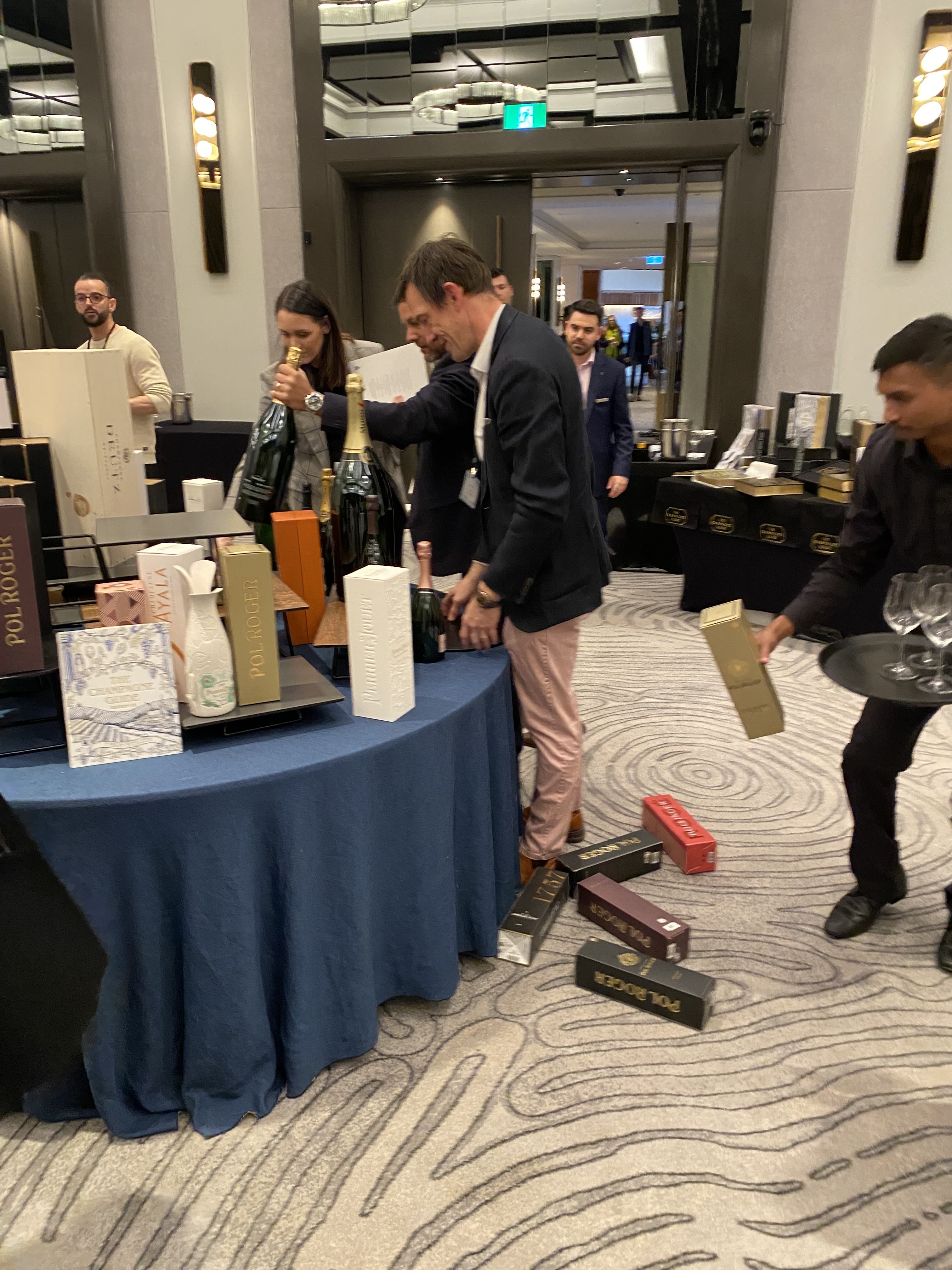
Soon after I arrived, almost disaster struck, as the Champagne pyramid in part came tumbling down, but it turned out the cartons were empty, haha.


On to the tasting; last year I called it 'The main houses are back'. So this year I did a comparison of some Major Houses with some reputable Grower Champagnes. The Major Houses I tasted were Bollinger, Billecart-Salmon and Pol Roger. On the Grower side, I had Ayala, Duval Leroy, Jacquesson, Veuve Fourny and Mailly.

The overall winner, as in the year before, was Bollinger. Bollinger has access to perhaps the best vineyards in Champagne (all premier cru), and it has a Pinot Noir grape bias, adding to the complexity of the Champagnes. I rated the Special Cuvée NV 94 points, with its fine mousse, great balance between freshness and toasty flavours and its long finish. La Grande Année 2015 had a darker colour, more concentration and outstanding length (96 points). I found the special PN AYC 18 NV lighter, quite savoury, and not as refreshing (93 points).

The Billecart-Salmon Champagnes rated 92-94 points, with the Rendez-Vous Number 3, being the best. I have always been quite fond of Pol Roger. I found the Vintage 2016 flavoursome, but a bit short (93 points). I preferred the 2015 Blanc de Blancs with its fine mousse, good depth, and longer finish (94 points).

The two outstanding Grower Champagne houses were Jacquesson and Veuve Fourny. The 746 Jacquesson is based on the 2018 vintage. It includes a significant amount of Pinot Meunier (24%). The flavours make quite a strong statement, based on the Pinot depths (94 points). Equally good, if not better were the Fourny Champagnes I tasted. The Grands Terroir Brut Vertus Premier Cru NV included only 20% Pinot Noir, but showed a lot of depth and good length (94 points). The R Extra Brut Vertus Premier Cru is 100% Chardonnay based on the 2015 and 2016 vintages. It is quite toasty, having spent three years on lees. It is a very layered Champagne (95 points).

I found the Mailly Champagnes agreeable, on the lighter side (92-93 points). The Ayala Champagnes are very refreshing, for a hot summer day (91 points). Duval-Leroy, which also sources fruit from the village of Vertus would not be my choice, compared with Fourny (92 points).

In summary, Bollinger is an outstanding Champagne producer. Overall, it is difficult to generalize, as it is with all wine, but with Grower Champagnes in particular, choose the producer wisely. 


Friday, August 11, 2023

Taste Champagne


The Tyson Stelzer extravaganza, with a tasting of over 200 Champagnes, was back this year. Unfortunately, some leading Grower Champagnes were not included, so I decided to focus on the larger Champagne houses this time - maybe with some regret in hindsight.

Before you read my assessment, I should emphasize that I have a particular preference as far as Champagne is concerned. I like complexity on the palate, including some biscuit flavours. Interestingly, there has clearly been a trend to very fresh Champagne, more in the blanc de blancs style.

Bollinger has been a favourite of mine, with its high quality vineyards. La Grande Année 2014 impresses with its fine bubbles. It is soft and smooth, but more in the fresh style. The PN TX 17 2017 is 100% Pinot Noir with more depth, but not as precise. Pol Roger's Brut Reserve is always a go to Champagne. It has a beautiful balance and some toast - a bit broad. The Blanc de Blancs Vintage 2015 is longer and persistent on the palate with some biscuit notes.

Pierre Gimmonet has an excellent Champagne with its Special Club Grand Terroirs de Chardonnay 2015. The bubbles are small, delivering a satisfying and complex mouthfeel. In contrast, I found the 1er cru Blanc de Blancs 2017 less convincing. Billecart-Salmon was impressive with its Brut Reserve. It is quite a delicate Champagne, but with some depth and a long finish. The Extra Brut 2009 is even better, with very fine bubbles, a light but intense palate and a very dry finish. Charles Heidsieck just sneaked into the top group with the Blanc de Blancs NV and the Millésime Brut 2012/13. There are similarities to the Bollinger wines, with a bit less refinement.

Below these wines, and in the second group, I have Deutz, Louis Roederer (Crystal was not on offer), and Taittinger.

Monday, February 21, 2022

Taste Champagne

 Today, I participated for the first time since the start of the pandemic in a larger public tasting. It felt good to be back. It was Tyson Stelzer's juggernaut Taste Champagne. A few interesting grower Champagnes were missing, but Tyson managed to get about 40 houses to exhibit.


I found a comparison between Bollinger, Pol Roger, and Taittinger interesting. Bollinger has the brilliant fruit, Pol Roger showed more fruit weight and lees character. Taittinger was the most elegant of the three, with very fine mousse. I also enjoyed the mouthfeel of the Louis Roederer Vintage Brut 2013. But the best wine was the Millésime Vintage Brut 2012 from Charles Heidsieck; very fine, with great depth and some toast, yet refreshing.


Tuesday, March 9, 2021

Day Three: Adelaide Hills, part 1

 There is now a plethora of wineries in the Adelaide Hills. It is cooler than McLaren Vale or the Barossa and it attracts also some innovative approaches, mainly in the northern part. I have never visited there before. So I decided to split the day between more conventional wineries and some more adventurous ones. The first winery is The Lane Vineyard. It wants to be especially known for its Champagne.

The bottles are sweating. I had not noticed.

The first is the Lois. This is quite a find; a very refreshing, forward champagne, yet with very fine beads. I liked this a lot. It compares favorably with Croser or Chandon, in my view, for less cost (91 points). The second is the Estate Blanc de Blanc which has been on lees for five years. It is darker in colour and more textural, but I did not find it entirely convincing for this kind of approach (90 points). The third champagne is very rare; the Heritage, a champagne 2010 late disgorged. This wine is darker again, with brioche notes, and very long in the mouth (95 points).

I then participated in the Gathering tasting. This is a tasting of four wines, matched with canapés. This was very well done, and is supported by detailed information.


Skipping the Sauvignon/Semillon (you have to have some principles), let us start with the 2019 Beginning Chardonnay. There is flinty citrus and pineapple on the palate. The oak influence (30% new) is noticeable, but the wine is balanced - a good food wine (92 points). The 2016 Reunion Shiraz is quite a delight. This is a lighter style, very pretty. Red berries feature on the palate, lightly peppered. This is an elegant wine, finishing with soft tannins (93 points). I found the 2017 19th Meeting Cabernet Sauvignon a bit herbaceous. It is a clean wine, but the fruit weight is too light (89 points).

My second stop is at Murdoch Hill, increasingly known for its Chardonnay. The first wine I taste is the 2019 Sulky Riesling. The wine is fruity, a little sweet, with not much definition (88 points). Then come three Chardonnays. The 2020 standard Chardonnay delivers intense apple and pineapple flavours. 35% new oak adds vanilla on the palate. Overall, the wine is a little broad (90 points). the 2019 Tilbury Chardonnay is the premium wine. It consists of 100% Piccadilly fruit (think Petaluma). The flavours are quite intense and powerful. There is good length in this wine (93 points). The 2020 Tilbury Chardonnay has less new oak (15%), but more drive and intensity, as the apple and pineapple flavours are well supported by acidity (94 points).

The red wines are also worth a try. The 2018 Phaeton Pinot Noir comes from higher altitude at Piccadilly. The wine has a slightly earthy colour.  It is strawberry based with earthy undertones. There is 40% wholebunch in this wine, and the tannins are soft and silky - not your standard Pinot, but I quite liked it (93 points). The 2018 Landau Syrah is also a bit unusual. It is medium-bodied. Game and savoury notes dominate the palate. The wine is elegant, but slightly herbaceous (92 points).


Monday, September 7, 2020

Dom Perignon

 When a friend of mine presented a bottle of 1990 Dom Perignon with the words 'I don't think this has always been stored properly', we were both more than sceptical.


The cork came out well and looked good. This Champagne was amber in colour, and some small bubbles rose to the surface. So far so good.

And the taste was excellent. Apple crumble and toasty flavours delivered a complex experience for this still very alive Champagne.

It is astonishing how this bottle delivered so well. There is a debate if ageing of Champagne is a good idea, but the flavours experienced here could never be replicated by a young Champagne. 

Score: 95/+++


Saturday, June 27, 2020

Three Taste Expanding Wines

During a blind tasting, I encountered three wines, two wines, one Champagne, actually, which delivered an unusual and very exciting flavour profile. The Champagne was a dry blanc de blanc from the grower Ulysse Collin 'Les Enfers'. In my simplistic way of thinking, I would normally characterize Champagne along a freshness/acidic/yeast spectrum. This one was quite floral with delicate pear and apple notes - very unusual. The wine was delicate, but with piercing intensity. There was a lot of complexity on the palate. Small and slow rising bubbles confirmed the quality of this drink.

Score: 95/+++

The wine of the night was a 2014 Keller Abts Erde GG from Rheinhessen. This area is flat to undulating as opposed to the river facing vineyards of the Rheingau and Moselle. It comes from a small block of the Westhofer Brunnenhaeuschen vineyard. The history of this esteemed limestone and ironstone vineyard goes back to the 14th century. When the highly regarded Kellers purchased this vineyard in 2001, the stars aligned. The texture of this wine is aristocratic Riesling, and the nose and palate is quite unique. Quince and yellow fruits on the nose are enticing. On the palate, there is peach, apple, grapefruit, passionfruit, and tight minerality. This complex flavour is hardly that of a typical Riesling. There is a good drive on the palate, without the wine being linear. Superb! The quality of this wine is only matched by its price.

Score: 97/+++


The third wine's story is altogether different. The 2013 Bressan Schioppettino frum Friuli tastes like nothing I have ever tasted before. This is a special wine, to start with, due to its history. The Schioppettino grape, also known as Ribolla Nera, was nearly extinct. Bressan collected the last vines, and established a new vineyard of this indigenous variety. Strong peppery notes and a cherry and wild berry bouquet jump out of the glass. On the palate, pepper and exotic spices are the main game. Underneath, raspberry, plum, candied fruit, and mossy flavours deliver an unusual sensation. I will not forget this for some time.

Score: 93/+++    


Friday, August 9, 2019

Taste Champagne: The Major Houses Are Back

Taste Champagne is a very large tasting of Champagnes with over 40 Champagne houses pouring their bubblies.

It is a bit overwhelming. Champagne is the most manipulated wine in the world. You get a house style, mainly along the axis of Pinot vs. Chardonnay composition, ageing sur lies or not, and residual sugar. While there are premier cru and grand cru fruit going into Champagnes, terroir cannot easily be detected.

Over the last few years, so called Grower Champagnes made big inroads into the traditional leaders. Partly on the back of the fabulous 2008 vintage, the major houses have fought back.

Crowds gathering at Bollinger and Billecart-Salmon

My Champagne of the night was the Bollinger La Grande Année 2008. Great purity of fruit, caressing the mouth, very fine and fresh, with yeast underneath the fruit, delivering moderate bread and toast flavours - beautifully balanced (97 points). The Bollinger R.D. 2004 was finer and very delicate, and long on the finish (95 points).

Other Champagnes in the 94/95 point bracket were the Billecart-Salmon Vintage Extra Brut 2007, the Louis Roederer Blanc de Blancs 2011, Pol Roger Vintage Brut 2012, Agrapart & Fils Grand Cru Terroirs Blanc de Blancs NV, Brimoncourt Extra Brut Grand Cru NV, Henriot Brut Millésimé 2008, Palmer & Co Amazone de Palmer NV, Taittinger Brut Millésimé 2009, Charles Heidsieck Millésimé Vintage Brut 2005. 

Krug and Dom Perignon were not present. 

Tuesday, August 7, 2018

Taste Champagne - The Biggest Champagne Showcase In The World

79 Champagne Estates have come together to showcase their products in Australia. This is because Australia is the seventh largest Champagne market in the world and growing strongly in unit imports as well as value. A tasting of this kind is a bit different from your average wine tasting. The atmosphere is a bit more hushed and serious.
 The trade tasting. Bollinger was the most popular stand

What was I looking for when the choice was between over 200 different Champagnes to taste? I have a lot less experience in tasting bubbles compared with still wine, but I know what I like: freshness, complexity of flavour, and some toastiness, all in balance. These were my findings:

Overall, the quality was very good, but there was not much wow!, I must say.

Vintage vs. Non-Vintage: The proportion of vintage Champagne sold in Australia is very small, smaller than in most other countries. This, no doubt, is due to the high pricing for these wines, particularly in Australia. And this tasting did not convince me. Freshness was lacking in many vintage wines, in particular the Bollinger La Grande Année 2007. But then, the Charles Heidsieck Brut Vintage 2005 was my Champagne of the day. Still fresh, with great depth, balance and elegance. 

The second debate is between the quality and distinctiveness of the large Champagne houses versus the increasingly popular grower Champagnes. I would call this a draw. I was impressed by Ruinart, Billecart-Salmon, Charles Heidsieck, Larmandier-Bernier, De Sousa, André Clouet and Jacquesson.

Then there is the question of Rosé. A number of Champagnes in this category were a little sweet, but I can recommend as dry Rosés the Billecart-Salmon Brut Rosé NV and the Bollinger Rosé Brut NV.     

Friday, May 26, 2017

Brimoncourt Champagne

18 months ago I reviewed the brut Champagnes of Brimoncourt, a relatively new entrant to the Australian market, which has established itself well, in particular at leading restaurants. This time I am reviewing the remaining two Champagnes.

The Brimoncourt Brut Rosé is composed of the three Champagne grapes. It has quite a deep salmon pink colour. On the palate, strawberry and raspberry notes are prominant, but this is not a sweet wine. On the back palate mushroom flavours add to the savoury component. This is an elegant Champagne of substance, not a pink party drink.

Score : 94/+++

The Brimoncourt Blanc de Blancs opens to a finely structured effervescence. The emphasis of this Champagne is on the fruit, with refreshing grapefruit and citrus flavours. At the same time, there is depth in this wine, with nutty characters and mineral notes, leading in a fine line to a complex and dry finish. This wine is nicely balanced between fruit and creamy features of excellent quality.

Score: 94/+++

Brimoncourt is a valuable addition to the booming Australian Champagne market. For a little extra money, you can experience much more interest and personality than with many of the large Champagne houses.


Saturday, January 2, 2016

Laherte Freres Extra Brut Ultradition

Laherte Freres is a leading artisan Champagne producer. I chose this Champagne for New Year's eve, without really knowing anything about it. It turned out to be the perfect choice.

The Laherte brothers are in their sixth generation and have vineyard parcels in many villages. They farm biodynamically, although in the winery it can be a bit different. This wine consists of 60% Pinot Meunier, 30% Chardonnay, and 10% Pinot Noir.

The cork came out with considerable oomph, but the real explosion took place in the mouth. The effervescence of this Champagne was astounding. Bright citrus flavours and minerality dominate on the palate. This Champagne is not about yeast or length of flavour. It is about initial impact - perfect for NewYears eve.

Score: 92/+++

Monday, November 30, 2015

Brimoncourt Champagne

For quite a while now, there has been a trend of smaller growers to develop and promote their own labels in Champagne. And as champagne drinkers have been through the champagnes of the main houses, they have embraced the more unique flavours of grower Champagnes.

Brimoncourt is a relatively new name, but one you should remember, I suggest. It has access to all three Champagne grape varieties from top vineyard locations.

The Brimoncourt Brut Regence is very fresh on the front palate, with citrus flavours and mineral components dominating. On the mid-palate, it develops some creaminess. Overall, this Champagne is nicely balanced and refreshing.

Score: 92/++

The Brimoncourt Extra Brut is dominated by Pinot Noir, whereas the Brut includes 80% Chardonnay grapes. It has more weight. Citrus flavours and minerality are still there, but the creamy feel is now ‘replaced’ by stronger toasty and yeasty textures. This is a more intense Champagne with an attractive dry finish.

Score: 94/++

I would happily drink the Brut at the beginning of an event or evening, and the Extra Brut at the end. They are fairly well priced.

Friday, May 22, 2015

Taittinger Visit and Champagne Conclusions

The greatest thing about touring Champagne houses are the caves. Taittinger has two cellars in Reims. One in the city centre, which holds 6 million bottles, and one where the old Abbey stood, which houses 2 million of large format bottles and the reserve Comtes de Champagne. This is where you visit. It is an impressive experience.

Over 70,000 bottles stored in this cave

The tasting started with the traditional blend, a widely available Brut, composed of 40% Chardonnay, 35% Pinot Noir and 25% Pinot Meunier. This Champagne is fresh and well balanced. It has good effervescence, length on the palate and some toasty characters. The 2008 Vintage Champagne takes it up a notch. It consists of 50% Chardonnay and 50% Pinot Noir. This Champagne has more weight, but is very elegant and rounded. It consists only of premier cru and grand cru grapes.

Taittinger is fortunate in that it owns 290ha of vines, more than most others and 50% of its needs, and 30% comes from grand cru villages. I did a quick calculation: 1ha is worth 1 million euros in Champage, so there is 300million tied up in capital. There is another 500million or so in inventory, which they can afford to keep and mature in the caves. How many are in this position? Entry barriers are high, and because of the regulations, not much is changing. The two wines I tasted here were good, but I would like to see a much more dynamic environment (and yes I know, many growers are starting to do it for themselves).

Thursday, May 21, 2015

Champagne Houses in Epernay

On my second day in Champagne, I went to three relatively unknown producers in the centre of Champagne, Epernay. The first was Castellane, a fairly large producer who sells 80% of its production domestically. This is unusual, but becomes clearer during the visit. Castellane would be the equivalent of an industrial wine producer. Its Brut Champagne has strong citrus flavours. It is fresh, but quite acidic with no yeast flavours to speak of. This is the result of bought-in grapes ( quality control?) and a relatively short maturation period.

Caves in Epernay

A visit to the small grower Julien Chopin was a little more rewarding. I tasted a Brut from 100% Chardonnay,  a Rose made from 90% Chardonnay and 10% Pinot Noir, and a Brut Nature (zero dosage) from 100% Pinot Meunier. The Chardonnay Champagne is light and quite delicate, the Rose is equally light, while the Meunier is much fruitier and a little plump. These Champagnes are true to their grapes, but lack finesse and excitement.

The third producer was Bouche Pere et Fils. The standard wines were similar to above, but the Cuvee Saphir was more interesting. This was a Champagne blend with 75% Chardonnay, matured for 8 years. Citrus was still the dominant flavour, but the finish was much softer and more toasty.

There are many rules and regulations in Champagne. The  mighty Committee tells you when to harvest, how many grapes per hectare can go into your Champagne, and so on. There are not many variables you can play with. And if you do not have old vines or the capital for long maturation periods, you will not make great Champagne.

Saturday, May 16, 2015

Veuve Clicquot

My tour de France started in Reims today with a visit at Veuve Clicquot. This famous Champagne house can lay claim to a number of things. Madame Clicquot was one of the first female industrialists, when she took the reign more than 200 years ago. Her most audacious move was towards the end of the Napoleon war, when she managed to ship a large amount of Champagne across closed borders to St. Petersburg for the Russians to celebrate their victory. At the end of her time, she handed the business over to a German businessman. A French patriot she was not.

The caves are over 1000 years old, initially a quarry to build the city
 Old bottles stored in the caves

. The highlight at present is a bottle from the oldest Champagne find, from the early 1840s, which was discovered on the bottom of the Baltic Sea five years ago. Of the 168 in tact bottles on the ship wreck, 48 were from Veuve Clicquot (still keeping dominant share of the Russia trade). Three were giftet back to Veuve Cliquot. Apparently, the Champagne was quite drinkable, although the bubbles were almost gone, and the sugar content even higher than desert wines in today's times.

                                                 The old ship wreck bottle

I only tried the standard Veuve Clicquot blend. A special feature is that this Champagne is always predominantly made from red grapes, currently 50% Pinot Noir, 20% Pinot Meunier. Only the juice is used, of course, so the colour is white to golden. The result is a relatively full flavoured wine, with a big mouthfeel. This Champagne is a bit fruity, but the flavours are complex. Dominant is green apple, but there is also raspberry and fig. The finish is not as crisp as I would have liked. This Champagne is best drunk as an aperitif, I think.


This was an interesting tour, and a good start. Tomorrow, the Champagne tasting will start in earnest.

Thursday, March 5, 2015

Krug or Dom?

I am sorry this blog has been quiet for so long. First, I was in a non wine-drinking environment, then I got struck down by a viral infection. But in-between I had the opportunity to sip on a 2004 vintage Dom Perignon on my flight home. This brought up in my mind the question of Dom vs. Krug. This is very similar to what happened in music if you grew up in the 60s. You were either a Beatles fan or a Stones fan, never both. And so it is in Champagne land.

I freely admit that I do not get overly excited by Champagne, the most overworked wine drink on earth, but you can't fault their marketing. Nobody seems to think twice to fork out at a minimum $50 for a bottle of Champus, whereas this person would never spend this much on a white or red wine. Having said this, and to answer the question, I am a Krug person. I go for the weight and the yeast, as opposed to Dom's freshness and vibrancy.

The other thing that happened a couple of days before I boarded the flight, I had a mild form of food poisoning. I was despite all this looking forward to the Dom Perignon from a great year, but bad luck, I could not stomach the acidity. Half of a small glass, that was it.

Now for those who have been reading all this waiting for a review. The palate opens up with citrus and almond flavours, then there is cream and a smoky flavour. This Champagne has good intensity and balance. The bubbles are small and persistent, and the vibrancy of this drink is caused by its well integrated acidity.