Showing posts with label Cabernet/Merlot. Show all posts

Thursday, April 4, 2024

Petaluma Evans Vineyard Cabernet Sauvignon/Merlot

 It has been a long while since I had a Petaluma bottle. This is strange, given it is such an iconic label. And I never had an Evans Vineyard wine. So I was looking forward to this 2016 Petaluma Evans Vineyard Cabernet Sauvignon/Merlot. 


The wine is concentrated on the palate, with blackcurrent and mocca flavours delivering a predominantly savoury sensation in the mouth. The Merlot component is weaved well into the Cabernet Sauvignon, thereby avoiding the typical mid palate hole of a pure Cabernet Sauvignon.

The tannins are dry and firm. This wine is about structure. I wish it was matched by elegance. However, my mouth felt challenged rather than soothed, before the finish hits hard.

The wine tastes like old-fashioned winemaking.

Score: 92/0


Tuesday, May 31, 2022

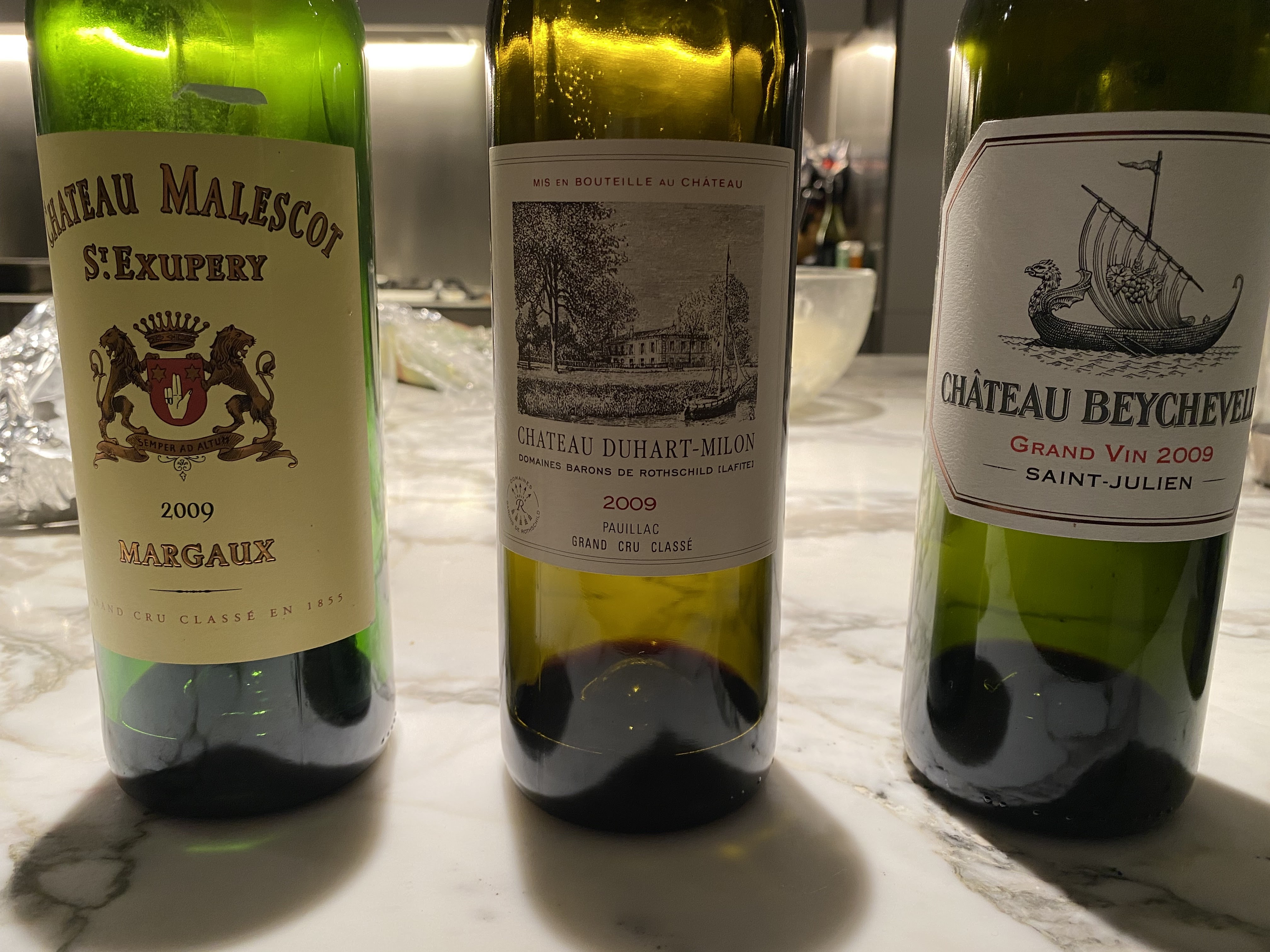
Three Wines From Bordeaux 2009

 Having had the pleasure of the mature Lynch-Bages, I wanted to explore how the 2009 vintage stacks up by tasting three wines from different left bank subregions.


The results were surprising to me. The favorite from these three wines was the 2009 Chateau Beychevelle from St. Julien. This is quite a dark fruited wine with cassis and plum flavours on the palate. Tobacco augments the long finish. This is a well balanced wine with lively acidity promising a long future. The highlight for me was the equal power and elegance of this wine (97 points). 

The 2009 Chateau Malescot St Exupery is a wine I have reviewed before. In this tasting, I found it quite muscular, somewhat surprising for the Margaux subregion. The blackcurrant, redcurrant and espresso flavours are quite concentrated. Still, this is an elegant wine with a satisfying mouthfeel and a long finish (95 points).

The 2009 Chateau Duhart-Milon Rothschild from Pauillac does not have the same intensity, but the blackberry and blueberry flavours deliver a silky texture. This is quite a smooth wine as you would expect from the Lafite stable (95 points).

Sub-regionality did not show up in expected ways. The Margaux was concentrated rather than perfumed, the Pauillac smooth rather than tannic. In Bordeaux, the winemaker wins over terroir, at least this time.

Overall, the 2009 vintage certainly delivered at this price point. The fruit flavours are intense, and the wines balanced. I reviewed more value based wines from this vintage before. There, the results were much more mixed.  


Monday, May 30, 2022

Chateau Lynch-Bages Vertical Tasting

This Is A Vertical, But The Years Are On The Back

Verticals of more than 15 year old Bordeaux wines are not easy to come by. This was a special occasion. The four wines were from 2001-2004 Lynch-Bages.

Let me start with two main conclusions. One really needs to be patient with good quality Bordeaux and wait 10-15 years before opening the wines. This is to experience the wine in perfect harmony. I have mentioned this many times on this blog. The second conclusion is that a great producer can make excellent wine in difficult vintages. Wine Spectator rated three of these vintages between 86 and 90 points, only 2003 at 95 points (more on this later).

The best wine was the 2004 Lynch-Bages. It was in perfect balance. The redcurrant fruit still very present. The mouthfeel was surprisingly big. Cedar and tobacco flavours rounded out the palate, while the firm tannins held up the structure (96 points). The 2001 was also very enjoyable. Here I noticed more smoky and earthy flavours. This is a more developed wine with good length and still lively acidity (95 points). The 2002, from a really lean vintage, was holding up, too. It is a leaner wine, with red capsicum prominent - still a fresh and balanced wine (92 points).

The one wine that started to struggle, was the 2003 Lynch-Bages. This was a very hot vintage, in particular pre harvest. The wines were supposed to be powerful, but they were also ripe. And this showed in this wine. Redcurrant fruit was still there, but was overtaken by tertiary flavours, leather in particular. The tannins did not stand up any longer - a (probably) once attractive wine in decline (88 points).

Overall, this was a fascinating tasting. There was a special Lynch-Bages character, certainly in the first three wines mentioned: redcurrant fruit, liveliness, balance, backed by a firm tannin structure.

One more thing: Over 30,000 cases are made each year. Achieving outstanding quality for this volume is different from the minuscule quantities most Burgundy producers dare to handle. 


Tuesday, May 23, 2017

International Cabernet Tasting

Top Australian Cabernets were put against some pretty smart Bordeaux from excellent vintages and a few Napa wines. Two French wines came out on top (not just in my opinion) against Australian wines, which many 'independent' wine critics have given 98 points plus. Does this mean the French were 102 points? It goes to show how ridiculous the rating system has become in Australia. It seems only the www.winefront.com.au keeps to a sensible scoring system.

The best wines were the 2000 Chateau Palmer, Margaux and the 2005 Chateau Prieuré-Lichine, Margaux. Both wines had plenty of rich and lush blackberry fruit and cassis. The fruit is concentrated, yet elegant on the palate. These wines had silky tannins and a long finish. The Palmer was a bit more reserved, with the Prieuré-Lichine offering a full-bodied mouthfeel.

My favorite Australians were the 2015 Cullen Diana Madeline, which I reviewed in a recent post below, and the 2014 Lake's Folly Cabernets, from a 100 year vintage in the Hunter Valley. This is the first time I tasted this wine. The palate is complex, with dark fruits, cedar, and a hint of Christmas cake. Impressive is the stylish long finish.

In the next category would be the 2015 Te Mata Coleraine with its soft, feminine features: an elegant wine with good length. The 2005 Chateau Montrose is elegant, but with a strong tannic backbone. I also liked the 2012 Matthiasson Oak Knoll District Napa Cabernet Sauvignon. It is very aromatic with beautiful fruit on the palate, and a slightly uneven finish. The 2014 Yeringberg Cabernet is impressive. This is an elegant wine, with good depth and some grip. I preferred it to the Mount Mary.

The next group was still very good, but my choices would obviously be the wines above. It included the 2014 Mount Mary Quintet, the 2010 Chateau Latour le Pauillac de Latour (3rd level wine), 2012 Mount Eden Cabernet (Santa Cruz Mountains), 2013 Stonestreet Cabernet Sauvignon (Alexander Valley).

I was less impressed with the ??SC Pannell Cabernet/Shiraz (too fruity), the 2011 Man O War Ironclad Bordeaux Blend (a bit simple), the 2008 Puriri Hills Reserve (fruity and alcoholic), the 2014 Rockford 'Rifle Range' Cabernet Sauvignon (sweet), and the 2012 Mount Brave Cabernet (alcoholic).

Friday, May 12, 2017

Cullen - New Flagship Wines

What a day Tuesday was for the wine enthusiast in Sydney. There was the Hill of Grace release dinner, and separate tastings of Xanadu, Cape Mentelle, and Cullens: a Maragret River invasion. Spoilt for choice. I went to the Cullen tasting of its flagship wines with the remarkable, but quite shy Vanya Cullen.

The opening act were the current release of the Mangan Vineyard Semillon/Sauvignon Blanc and the Amber wine (reviewed in this blog previously). The Semillon/Sauvignon Blanc was impressive. It was fresh as expected, but also seamless and elegant.

Then came the 2015 Cullen Kevin John Chardonnay. I have in the past not warmed to this wine as a leading Australian Chardonnay brand. However, I enjoyed this vintage. The flavours are complex: citrus, grapefruit, white peach, and almonds. The wine was matured in 73% new oak, which is quite noticeable, but smartly treated. The wine has a precise line, and is penetrating with a long finish.

Is it at Leeuwin's level? Not quite.

Score: 95/++

The 2015 Cullen Diana Madeline has been reviewed a lot already. The points-master and other reviewers have gone to the top drawer as usual. I won't dwell on general descriptors too much. The wine has hints of vibrancy, but is a little closed at present. The bouquet of red and black berries flows onto the palate. The main point I want to make is that this is a more concentrated wine than recent releases with more ripeness and depth of fruit, supported by fine tannins.

I think in a number of years, the power and intensity of the wine will blend with the finesse and elegance in a potentially amazing way. This wine needs to be put away for at least five years. I will not drink it before 10 years.

Score: 96/+++ 

Monday, May 25, 2015

Three Bordeaux First Growths In One Day (2)

I am having significant difficulties with the internet here in France, so I had to break up the last post.

The third stop was at Chateau Latour. They took a different approach to the tasting again. here I tasted the three wines from different vintages. The third wine is the 2011 Pauillac. Unusual for the left bank, it consists of 63% Merlot and 37% Cabernet Sauvignon. The fresh blueberry flavours give in quickly to the acidity. This is a pleasant wine, not big and the finish fades relatively quickly (90 points). The 2008 Les Forts de Latour consists of 66.5% Cabernet Sauvignon, 31.5% Merlot and 2% Petit Verdot. This is a darker wine, with blackberry tastes. It is quite tannic with a very dry, mouth-puckering finish (90 points). The 2004 Grand Vin de Chateau Latour has even more Cabernet dominance, with 90%, and 10% Merlot. There is quite dense blackcurrant flavour on the palate. This is a big bodied wine, with some complexity, such as mocca and licorice flavours. The wine is very tannic and dry. The flavours are interesting, but I don't find the wine totally balanced (94 points).

Tasting at Latour

This first day leaves me a little puzzled. All three chateaux are close together, on similar soil. Yet we have the strong wines of Mouton, the more feminine wine of Lafite, and the brute force of Latour. The winemaking seems to be similar as well. What is creating these differences? Very interesting.

Saturday, January 31, 2015

Chateau Lynch-Bages

The millennium vintage was anything but memorable in Australia, but produced great wines in Europe, in particular in Bordeaux. The 2000 Chateau Lynch-Bages shows a surprisingly developed colour, but on the palate, the wine shows off its fruit in perfect ripeness. Blackcurrant and black cherry flavours are added to by strong  dark chocolate and tobacco notes. Secondary flavours have developed and add earthy undertones to the complex palate. The main aspect of this wine is its elegance and smoothness. The tannins have softened leading to a harmonious finish. The wine is good drinking now, but it is quite developed. Will the structure hold another 10 years?

Score: 94/++

Saturday, August 10, 2013

Craggy Range New Premium Releases

Craggy Range is New Zealand's preeminent winery across a wide range of wines. Tasting the new releases demonstrates the high quality across the board, although lacking absolute high points.

The 2011 Te Muna Pinot Noir from Martinborough tastes of cherry and strawberry. The fruit is a bit simple and straight forward and the wine quite light-bodied. It has an ethereal texture and quite silky tannins (91 points).  

The 2010 Calvert Pinot Noir from Central Otago is bigger in fruit weight and more complex. The dark cherry flavours are augmented with forest floor, but the finish is not as smooth as I would have liked (92 points).

We are now moving to Hawkes Bay, the home of Craggy Range, and where the grapes for the fuller bodied reds are grown. The 2010 Gimblett Gravels Syrah is very spicy and the fruit is a bit lean with slightly metallic flavours. The finish is quite satisfying (90 points).

The 2011 Le Sol Syrah is the flagship wine. It is more generous and elegant, not as intense as in some other years, with a smooth finish (92 points).

The star of the tasting was the 2011 Sophia. This Bordeaux style blend is dominated by Merlot and therefore fashioned similar to right bank Bordeaux. This wine has great depth of blackberry fruit, a sweet core, and firm tannins to provide a solid structure which will allow the wine to develop more complexity with time. An excellent effort (94 points).

Wednesday, June 20, 2012

Cullen vs. Moss Wood

By chance, I had an opportunity to taste recent releases by Cullen and Moss Wood within three days. As it happened, these wines were a very similar line-up, so I thought I might put short reviews side by side. One thing to point out is that in a couple of cases, the Cullen wines are released a year younger, but all the vintages represented are pretty good.

1) Semillon

The 2011 Cullen Sauvignon Blanc Semillon was no doubt picked very young. It tastes almost like grape juice. The wine is very fresh and clean (86 points). The 2011 Moss Wood Semillon is richer, with a focus on texture and a mineral finish. This style is more Barossa than Hunter Valley (88 points). Both wines would not be my picks of this variety.

2) Chardonnay

The 2010 Cullen Kevin John Chardonnay tastes of a complex set of fruits: citrus, peach and passion fruit are prominent. The wine is quite fruity and I am missing the structure of earlier vintages (89 points). The 2009 Moss Wood Chardonnay is a step up in the Chardonnay stakes for this producer. The flavour is similar to the Cullen, but with more weight. 40% new oak adds creaminess to the wine, but it is well balanced with sufficient acidity on the finish (92 points).

3) Cabernet/Merlot

The second Cabernet label of both producers is disappointing. In previous years, some provided great value for money. The  2010 Cullen Cabernet Merlot is fruity, with a short finish (85 points). The 2010 Moss Wood Amy's Cabernet Blend includes 20% of Petit Verdot. As a result, the wine is quite inky, fruit forward, with a flat mouthfeel and a short finish (86 points).

4) Cabernet Sauvignon

I reviewed the 2010 Cullen Diana Madeline in detail on 11 June, no need to repeat this here. For the 2009 Moss Wood Cabernet Sauvignon, it is early days yet. Blackcurrant flavours dominate. There is mulberry and some attractive spice. This wine is much more extracted than the Cullen. Some reviewers may find this too much, but I like the rich fruit and ripe tannins in this wine. Will it be an all time great, as claimed by Keith Mugford? I am not going there, yet, but I will enjoy reviewing the wine again in a few years time (94 points).

Cullen and Moss Wood are the pinnacle of Margaret River wines (add Leeuwin Chardonnay). On this basis, these tastings were a little disappointing. Only the flagship wines were really good, without being classics, in my view. You make a clear choice between producers. Cullen is about freshness and linearity, Moss Wood about fruit concentration and weight.

Monday, June 11, 2012

Has Vanya Cullen gone too far this time?

We like people with character or personality. By this we mean people who stand out a bit, be it with their features, points of view or other personality traits. For me, it is similar with wine. I like my wine to stand out, to be different.

Vanya Cullen has been a prominent spokesperson for the organic and biodynamic movement. I reported in an earlier post that I felt the vibrancy of fruit in the flagship Diana Madeline wine has increased during the last 10 years. She has also been very focussed on reducing alcohol levels with an objective to get them under 13%. The highly acclaimed 2009 had 12.5% alcohol. With these objectives, she is right in the trend of all the major wine critics. It is therefore no surprise that the 2010 wine achieved very good reviews as well.

Leaving all trendiness aside, how attractive is the 2010 Cullen Diana Madeline? It is instructive to start with the vintage. 2010 continues the run of good vintages at Margaret River. It is reported as another warm vintage. However, in reality, spring and autumn were relatively cool, interrupted by a heat spike in February.

Now on to the wine. It has a lovely, quite floral nose. On the palate, the flavour is predominantly redcurrant. It is the first Australian Cabernet I would describe as light bodied, and the result is that the mouthfeel is somewhat lacking. The tannins are very soft for a Cabernet, and while there is some length on the finish, it seems to fizzle out. This is clearly a wine of great purity, but I ask myself: if the grapes had been picked a little later, would the wine have had more flavour or personality? I think, yes. No doubt, the fruit is good and the wine is well made. It is therefore a matter of preference. I think potential greatness has been left on the table here.

Another matter: Cullen releases its wines very early. I find it almost impossible to appreciate a Cabernet at less than two years of age. Given the success of the winery, could the red wines not be held back for another couple of years?

Score: 93/0     

Tuesday, April 24, 2012

Cullen Cabernet/Merlot

Not long ago I reviewed a Moss Wood Cabernet, now it is Cullen's turn. The 1998 Cullen Cabernet/Merlot was still called just that, before it became the Diana Madeline a couple of years later. This wine opens up with quite an aromatic bouquet. Blueberry and mulberry fruit flavours are elegant, and the wine provides a big mouthfeel, even after 14 years. The tannins are fine, and the finish smooth. An excellent wine, which still has quite a bit of life in it.

Moss Wood Cabernets are often deep in colour and brooding, masculine wines, whereas Cullen is more feminine. The yin and yan of Margaret River.

Score: 95/++

Wednesday, August 17, 2011

Coonawarra Roadshow

I have not been to one of these for a number of years. I found it interesting to taste the wines (I tasted Cabernet and their blends) in such a focused comparison. My notes were short, as I tried quite a few wines and had limited time.

What did I like in general?
- the room was great. Finally some space between winery booths, and well lit.
- the vibrancy of the fruit. It seems the days of watery Cabernet from there are over
- varietal expression. Blackcurrant and redcurrant flavours stood out in most wines

What did not impress me?
- there are still quite a number of green and underripe Cabernets
- the finish of many wines was not distinct and short
- 2009 is clearly not as good a vintage as 2008

The two wineries which impressed me most were Balnarves and Wynns. The Tally is a world class wine. Its fruit is ripe, but delicate, the wine is well balanced and has a fine, silky finish. I slightly preferred the 2006 Tally (94 points) over the 2008 Tally (93 points). This may also be a function of the wine only coming into its own after a number of years. The regular 2008 Cabernet Sauvignon was also attractive, although the finish was light (91 points).

The winemaking at Wynns is strong these days. The high volume 2009 Black Label Cabernet Sauvignon is full bodied and ripe, with a good mouthfeel - a bit unbalanced at this time (92 points). I preferred it to the 2009 V&A Lane Cabernet/Shiraz, which was smoother, but quite oaky (91 points). Wynns has about 25 great vineyard blocks from which it selects a different single vineyard wine each year. In 2008 it was the Davis Block, planted in 1957, the 2nd oldest planting at Coonawarra. The 2008 Davis Cabernet Sauvignon is quite different from the Black Label. It is very elegant, with a soft finish and hopefully enough acidity to last the distance. I liked this wine, as it clearly stood out from the crowd (93 points). I also tried a 1988 John Riddoch. It has obviously mellowed, but had great texture and a soft lengthy finish (94 points). Good Coonawarra should be cellared this long, but how many bottles survive 20 years?

The next bracket was Petaluma, Majella, Parker and Yalumba. The 2008 Petaluma Coonawarra, a Cabernet/Merlot blend, was typically elegant, with ripe fruit and a good mouthfeel (92 points). The Majella 2009 Cabernet Sauvignon showed pretty and ripe fruit with soft tannins - a dependable wine (90 points). Parker is no longer the star it perhaps once was, but the 2006 First Growth was quite a well balanced wine (91 points). Yalumba's main wine from the Coonawarra is the Menzies. The 2008 Menzies is elegant with ripe tannins, but lacks some fruit concentration (90 points).

Now we come to the wines that did not impress me. These include Bowen. The 2009 Cabernet Sauvignon was a bit thin and not quite ripe (88 points). Brand's Laira with the 2006 Patron, a single vineyard Cabernet with elegant fruit, but also prominent oak and a flat finish (89 points). Highbank showed a strong 2005 Coonawarra blend, with good blackcurrant depth, but a harsh and acidic finish (91 points), and a weaker 2006, which was quite light and short (89 points). The Penley wines, an 09 Phoenix, the 2006 Chertsey blend and the 2008 Cabernet Sauvignon Reserve scored between 88 and 90 points, generally lacked structure, with the Reserve being the best wine. The 2006 Reserve Cabernet Sauvignon from Punters Corner and the 2005 Zema Family Selection Cabernet Sauvignon were very minty (89 and 88 points).

The big disappointments were two larger wineries which produced stellar wines in the past: Lindemans and Orlando. Orlando's 2005 Jacaranda Ridge was minty, but had a bit more depth than the Zema (89 points). The 2007 St. Hugo was dry and harsh (87 points). Lindeman's 2009 Limestone Ridge had a pleasant fruity flavour, but neither much depth nor length (88 points). The 2009 St. George was harsh and green (85 points).

So there you have it. A night with plenty of wine, some good, some not so good. Did any other reader attend?

Monday, July 18, 2011

Voyager Cabernet/Merlot

I just reviewed the 2003 Voyager Shiraz and was not convinced. How does its flagship, the Cabernet/Merlot stack up?

The 2003 Voyager Cabernet/Merlot (under screwcap) is still very fresh. It tastes of redcurrant and raspberry and has good depth of flavour. The mouthfeel is satisfying, as a result. The wine has a good structure, but you would not call it overly elegant. The acidic frame overshadows the moderately silky tannins. I am wondering if the screwcap is really helping. Some mellowing of this wine at this point in time would have added pleasure.

Score: 93/+

Saturday, July 2, 2011

Cullen Cabernet/Merlot

One of the popular theories of getting a good wine at a reasonable price is to go for a second or third tier wine of an icon winery/winemaker. This works only sometimes, as in many cases grapes are so young and yields so high that the best winemaking cannot overcome the watery nature of the wine. These wines are made because they need to pay for the more extravagant pursuits.

No such issues with the 2008 Cullen Cabernet/Merlot. This wine is full bodied and tastes of dark berries and olive. The mouthfeel of this seemless wine is terrific. It falls off a bit on the back palate, before it finishes dry and elegantly.

Score: 93/+++

Saturday, June 25, 2011

Chateau Pontet-Canet

I am not a huge Bordeaux fan across the board, but I like a good one. Currently, the 2010 futures are offered from apparently a good vintage, and the prices are high despite the improvement of the Australian dollar. I am lukewarm towards it, but tried a 2005 Chateau Pontet-Canet tonight to see if I can increase my enthusiasm.

Pontet-Canet has been a success story for the last ten years and I was lucky enough to buy some 05's at reasonable prices. Many say that if the Bordeaux classification was redone today, Pontet-Canet would be a first growth. So this should be a good benchmark from a great year.

I decanted the wine only an hour before consumption, so this opens up slowly. The colour is deep red, and the flavour a thick blackcurrant. This is also the impression on the front palate. The wine really comes to its own on the back palate with a very long finish and firm, but elegant tannins.

This wine is still way too early to drink. It is a well structured, full bodied wine. I would have liked the tannins to be silkier and more caressing, and the flavour a bit more differentiated.

The verdict: I am very happy to drink this wine, but it is not a must have or one that bowls me over. This confirms my general assessment of Bordeaux wine. Therefore, at current prices, I will stay on the sidelines for 2010 despite the raving reviews some of the wines have collected.

Score: 95/+

Wednesday, June 1, 2011

Cullen Cabernet/Merlot

One of the nice things for me after coming back from less developed regions of the world is to resume drinking good quality wine. I thought I kick it off with Cullen, which is such a reliable producer.

The 1998 Cullen Cabernet/Merlot (the predecessor of the Diane Madeline) was such a joy to drink. It has a beautiful complex fruit set, which is just starting to mellow, some earthy characters, and lengthy silky tannins. The wine is seamless, and the individual contributions of Cabernet and Merlot are not detectable.

The wine has medium weight, perhaps a little more than more recent releases. It may not be quite as elegant and refined as the latest wines, but this is splitting hairs. This wine is a very fine example of a Bordeaux blend from Australia.

It really pays to cellar the premium red from Cullen. More complexity unfolds while the wine's structure remains strong. This wine will drink well for another 3-5 years.

Score: 96/+++

Monday, February 28, 2011

NSW Wine Festival, part 2

Another winery in the Canberra district which has impressed me over the years is Lerida Estate. The 2008 'Josephine' Pinot Noir is their best barrel selection. The wine has strawberry fruit and gamey and earthy flavours. The wine is quite powerful, but not fruit driven (92 points). Their flagship 2008 Shiraz/Viognier is fashioned in a more powerful style than a number of others in the district. The wine has concentrated plum and mulberry flavours with some eucalypt as well. It is well structured with a firm finish (93 points).

Back to Orange, where Logan has made a bit of noise. The 2009 Pinot Noir is a bit disappointing. It starts with some plummy flavours, and then turns quite savoury backed by pleasant dry tannins. The downfall is the flat mouthfeel of the wine (which is what Pinot should be all about)(89 points). Their current success is the 2008 Cabernet/Merlot. This is a medium bodied wine, tasting of plum and blackberry. It is very smooth with a firm (and slightly hot - alc. 14.5%) finish - an appealing wine (91 points).

Now over to Mudgee, where Thistle Hill is creating interest with preservative free wines. However, I tasted the more traditional wines. The 2009 Cabernet Sauvignon is medium bodied, very middle of the road. Not sure why I would be interested to drink it (88 points). The 2009 Shiraz/Cabernet Erudgere is much more interesting. This is my wine of the day. Its flavours are blackberry and mulberry. The fruit is concentrated, but soft and elegant. I believe it comes from the old Rosemount Mountain Blue vineyard (remember this?), which Fosters let go (93 points).

My next stop was Robert Stein. The reds were disappointing. The 2008 Shiraz showed insufficient tannin structure (87 points), and the 2008 Cabernet Sauvignon had insufficient mouthfeel and, again, backbone (87 points).

I finished up with Huntington, one of the few wineries which consistently delivers good value for money with full bodied reds. My pick was the 2006 Block 3 Cabernet Sauvignon. This wine tastes of ripe blackberry. It is very soft, with velvety tannins, almost like a traditional Hunter Valley Shiraz. I liked the flavour profile, but the wine finished too soft for me (92 points).

Overall, I was encouraged by my tastings. There is a lot of variety, established NSW wineries are finding form again, and some new ones are worth watching closely.

Thursday, February 17, 2011

McIvor Estate Cabernet/Merlot

The McIvor Estate from the Heathcote region has had its ups and downs over the vintages, but this 2004 McIvor Estate Cabernet/Merlot works pretty well. It is full bodied, but quite a soft wine with the Merlot fruit influential in this near 50/50 blend. Blueberry and Blackberry fruit dominates and there is a good balance with acidity. The backbone is not very pronounced, but the wine is still drinking very well and will continue to do so for a few more years.

Score: 90/+

Sunday, October 31, 2010

Margaret River - Cabernet and Blends

A number of newer wineries were showing their Cabernets, some of which collected a fair bit of acclaim for their 2007 wines, including the Jimmy Watson winner Flametree Cabernet Merlot. Three such wineries are Juniper Estate, Flametree and Fraser Gallop. One interesting aspect here is that their Cabernets cost half or even less than those from the leading wineries. So how good are they?

The 2007 Juniper Estate Cabernet Sauvignon has good depth, ripeness and concentration, but I found the eucalypt flavours a bit too strong (90 points). The 2007 Higher Plane Cabernet, from young wines, was quite pleasant, but did not have the same depth (88 points). The 2008 Fraser Gallop Cabernet shows pretty varietal flavours, but the vines are quite young, and the wine lacks some mouthfeel (91 points). This could be very good once the grapes are more mature. The 2009 Cabernet Merlot is lighter, but with interesting earthy flavours (89 points).

The 2008 Flametree Reserve Cabernet is similar to the Fraser Gallop (90 points). The 2009 Cabernet Merlot shows shades of greenness (87 points).

I thought the 2008 Lenton Brae Willyabrup Cabernet was a shocker. It tasted sugary and sweet (82 points). The 2008 Redgate Cabernet was better, but the palate not well rounded (87 points).

The most interesting Cabernets came from Woodlands, Brookland Valley and Cape Mentelle. I always find the Woodlands brand hierarchy and prize points puzzling, and so it was again. The 2007 Woodlands Margaret Reserve Cabernet Merlot was quite polished, a well made wine, although lacking the depth of the best wines of that year (92 points). The flagship 2007 Woodlands Cabernet Sauvignon was dark, mainly tasting of blackcurrant. It had earthy flavours, too (92 points). I scored it the same as the Margaret, but at more than twice the price ($100/bottle), it is simply too expensive.

Cape Mentelle showed the 2007 Cabernet Sauvignon, and it was the best wine I tasted, by a whisker. It displayed typical red- and blackcurrant flavours, and had good fruit concentration. The mouthfeel lacked a little on the mid-palate, and while the finish was long, it lacked complexity or lift (93 points). The 2004 Brookland Valley Reserve Cabernet was an interesting contrast because of bottle age. The fruit was concentrated, with mulberry and minty flavours and a dry, still quite stringent finish (90 points).

I do not feel compelled to add any of these wines to my cellar. A second label Moss Wood or Cullen would have given these wines a run for their money.

Saturday, July 17, 2010

What A Tasting

A few days ago, I attended a pretty amazing tasting. These were the wines I tried:

Kumeu River Chardonnay 2007
Kumeu River Hunting Hill Chardonnay 2006
Kumeu River Coddington Chardonnay 2006
Marchand&Burch Chardonnay 2009

Marchand&Burch Mt. Barrow Pinot Noir 2009
Marchand&Burch Shiraz 2007
Howard Park Abercrombie Cabernet 2008

Te Mata Awatea Cabernet Merlot 2008
Te Mata Coleraine Cabernet Merlot 2008
Trinity Hill Gimblett Gravels Syrah 2008
Trinity Hill Gimblett Gravels The Gimblett 2007

Jasper Hill Cornella Vineyard Grenache 2008
Jasper Hill Georgia's Paddock Shiraz 2008
Jasper Hill Emily's Paddock Shiraz 2008
Jasper Hill La Pleiade 2008

Kalleske Old Vine Grenache 2008
Kalleske Eduard Shiraz 2008
Elderton Command Shiraz 2006
Huntington Estate Block 3 Cabernet 2004

Interestingly, despite good standard, the Chardonnays could not match the red wines, which showed more complexity and were simply more interesting.

Three stand-outs for me: The 2009 Marchand & Burch Mt. Barrow Pinot Noir was brilliant. The wine has great finesse, and the sour kirsch flavours carry through to a fine finish backed by silky tannins. The 2008 La Pleiade stood out because it had good fruit concentration, but was not heavy (French influence?). And finally the new 2008 Kalleske Eduard Shiraz is quite a profound wine. Maybe a bit sweet for some, but great texture and elegance, and a long finish. Having said this, I would have happily drunk any of the tasted wines, if you had brought a bottle along.