Showing posts with label Burgundy. Show all posts

Thursday, August 21, 2025

Two Exceptional Wines

 In a recent tasting of benchmark wines I came across two wines which I thought were exceptional. The first wine was a 2009 Lucien Le Moine Clos de la Roche Grand Cru.


Clos de la Roche is one of the best terroirs in Morey-St-Denis. Lucien Le Moine is a high quality negociant house who picks one hundred barrels or so from each vintage. There is no winemaking here. They are bought after fermentation. 2009 was a warm and highly regarded vintage.

In Burgundy, the view is that Grand Cru wines need to fire on three cylinders; fruit, tannins, and acidity. And this is what this wine does, almost. This is a concentrated, yet elegant wine with strong aromatics of rose petals and red cherry. There are interesting secondary flavours here, bacon stands out for me. The fruit has started its downhill run, but only just. The wine is quite tannic, like a Gevrey-Chambertin. So: fruit 9, tannins 10, acidity 7. The finish is long.

Score: 96/+++ 

The second wine was a 2016 Podere S. Giuseppe Brunello di Montalcino Stella di Campalto


The grapes come from a 25 year old vineyard, organically/biodynamically farmed. The combination of Stella di Campalto's uncompromising farm management and the Podere San Giuseppe winery make this one of the standout Brunello producers.

The wine is red and black fruited, black olive and some herbal notes. It is still quite youthful. The wine is incredibly elegant, while underneath its flavours sits restrained power. It is so harmonious. The tannins are very firm. The wine is 100% Sangiovese, but in the tasting a number of us thought this wine to be Nebbiolo. 

The best Sangiovese I have ever had.

Score: 97/+++

These two wines are expensive. Are they worth two or three Mt. Edelstones? I think so.


Wednesday, June 12, 2024

Domaine Castagnier Clos Saint Denis Grand Cru

 There are essentially two strategies for the wine enthusiast wanting to experience good, but not exorbitantly expensive Burgundy. 1) To buy a village wine from a good producer or subregion;                2) To buy a Grand Cru from a lesser vineyard and/or producer. Both strategies have obvious limitations, but then the market and pricing basically works, although not perfectly.

The wine I reviewed last followed the first strategy. Today we look at a wine from the second strategy. It is the 2018 Domaine Castagnier Saint Denis Grand Cru.


Morey-Saint-Denis is perhaps one of the lesser appellations of the Cote de Nuits, the Clos Saint Denis a lesser grand cru there, and Domaine Castagnier is certainly not one of the top Burgundy names. However, the plot is in the historical and original part of Clos Saint Denis, and the winery has made great progress according to Jasper Morris.


Let's look at the wine. The colour is a darker purple, and the aromas on the nose are fruity, rich, and ripe.

On the palate, this is a more concentrated wine than the one reviewed in my last post. Ripe raspberry and dark cherry flavours deliver a pleasant and energetic mouthfeel, which is not too demanding or complex. The silky tannins lead to a medium finish with firm blackberry flavours. For the right price, this is an attractive wine.

Score: 94/++ 


Monday, June 10, 2024

Domaine Jean Grivot Vosne-Romanée Burgundy

 The 2016 Domaine Jean Grivot Vosne-Romanée shows a pretty purple colour. The wine is perfumed and fruity on the nose.


On the palate, generous black cherry and plum flavours are very clean. This is an almost voluptuous wine, but the mouthfeel is a little simple. There is a great entry, but then the wine falls off a bit. A show pony? But then, on the finish, tannins are persistent and lengthen the finish.

Overall, this is a good village wine, with a typical Vosne-Romanée profile of fleshy fruit.

Score: 92/++


Thursday, June 6, 2024

Domaine Jaeger-Defaix

 Vineyards in Rully in the northern part of the Côte Chalonnaise are the second interest of Hélène Jaeger-Defaix. Wines from the Côte Chalonnaise create interest, because one tries to find the same quality of Chardonnay or Pinot Noir as in Burgundy 'proper', but at a fraction of the price.


Two whites and two reds are available for tasting. The 2022 Jaeger-Defaix Rully 1er cru Le Cloux is light and fresh, with an elegant mouthfeel. This is a pleasant, well made Chardonnay without a lot of impact (91 points). The 2022 Jaeger-Defaix 1er cru Rabourcé Blanc sits right above the Le Coux vineyard. There is less of the white clay soil here. This is a fuller and more powerful wine with a longer finish (93 points).

The first red is the 2022 Jaeger-Defaix Rully Rouge. This is a village wine. It is light, well made, but not complex (91 points). The best wine of these is the 2022 Jaeger-Defaix Rully Rouge 1er cru Clos du Chapitre. The soil is clay. This wine is 100% barrel fermented, with 10% new oak. Strawberry flavours dominate. This is a bigger wine, but still energetic, with quite a tannic finish (94 points).

Overall, the Jaeger-Defaix wines are well made: balanced, with delicate flavours, and an elegant mouthfeel.


Wednesday, March 8, 2023

Chartron et Trébuchet Pouilly-Fuissé

 When people think of White Burgundy, they mostly think of the Montrachet and Meursault subregions. However, prices of these wines have increased just as much as for Red Burgundy, making these wines special occasion wines for most. A bit further south, as part of the Mâconnais subregion, is the appelation of Pouilly-Fuissé. Only Chardonnay is grown here, and offered at a fraction of the price of its more famous neighbours.

The 2021 Chartron et Trébuchet Pouilly-Fuissé is not a very complex Chardonnay, but it is very clean. Yellow flower scents are attractive on the nose. Stone fruits and lemon zest hit the palate first. The wine is enriched with oatmeal and hazelnut flavours, probably delivered by light to medium toasted oak. This is a good quality food wine, not too demanding on the palate.

Score: 91/+

Monday, June 6, 2022

Domaine Faiveley Clos-de-Vougeot Grand Cru

 Clos de Vougeot of 50ha is the largest single vineyard of premium red wine in the Côte de Nuits. At the same time, it is very divided and has more owners than any other. It is generally believed that the upper parts of the vineyard produce better wine, but there are many variables in the soil and between producers. I have been to the famous Château of the vineyard, but must admit I have never tasted any of the wines until this time.


The Faiveley plot is at the bottom of the vineyard, so in a less favourable position. However, Domaine Faiveley is a very experienced producer with many Burgundy holdings. As I will outline now, I was very impressed with this wine.

The colour of the 2014 Domaine Faiveley Clos de Vougeot is dark ruby, but quite transparent. On the nose, very perfumed floral and fruity notes emerge from the glass.

On the palate, black cherry, raspberry, and mild spices arise from a powerful texture. This is quite an opulent and velvety wine, quite rich for a Pinot Noir, and a little sweet. The wine is in good harmony with some oak flavours in the background. It is still quite youthful, but good to drink now. The fine, but firm tannins form an excellent structure. The finish is not too long, but expanding in a satisfying way.

This grand cru is priced at premier cru level and well worth seeking out.

Score: 95/+++


Wednesday, December 29, 2021

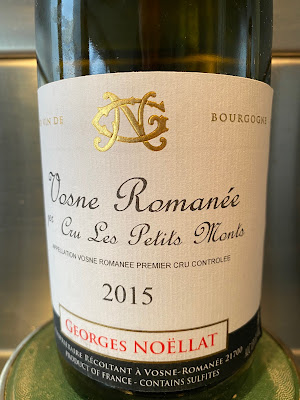
Georges Noëllat Les Petits Monts

 The Les Petits Monts is a relatively high altitude 1er cru vineyard in Vosne-Romanée, situated just above the famous Richebourg. This was a good place to be for the warm vintage of 2015. The following year, when I visited Burgundy, I met Maxime Cheurlin, the young winemaker of Georges Noëllat. He is perhaps most famous for having stood up Jancis Robinson at a prestigious lunch in London, but I digress. The wine which impressed me was the 2015 Georges Noëllat 1er cru Les Petits Monts. It was not easy to get some of this wine to Australia, but I managed via a friend in Switzerland. Hopefully this effort was worth it.


The colour is a brilliant crimson. The nose is a little closed, with red cherry notes emerging slowly.

The flavours explode on the palate. This wine is vibrant! Red cherry, strawberry, and some smoky savoury notes dance on the tongue. This wine is upbeat all the way. Silky tannins deliver an exquisite mouthfeel, and the elusive peacock's tail emerges a bit shyly on the finish.

This is an elegant and delicious wine, quite generous. A bit more cut-through would have delivered an even higher assessment. Will reach peak in 3-5 years.

Score: 96/+++


Monday, December 27, 2021

What Have We Been Drinking This Christmas?

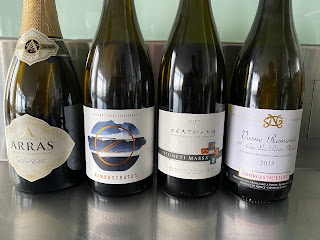
 Christmas gatherings this year have been much smaller in many countries, as we are still in the grip of covid-19. However, I am sure this community has still been enjoying their wine. My drinkings are shown below.


The Arras Sparkling was sadly disappointing. It was fresh, but had little complexity and no biscuit flavours. The Nimbostratus Chardonnay is an unusual wine, which I will report on separately. I enjoyed the Derthona again, which I have reviewed previously. It is a bigger white wine without having buttery flavours. It went well with the prawns. But the wine of the day was the Georges Noëllat Burgundy. Again, I will review it separately.

What have you been drinking? Please comment. I am also interested in comments from the Northern Hemisphere, where different temperatures no doubt lead to different choices. 


Thursday, September 9, 2021

Domaine des Croix Beaune Les Cents Vignes

 It is not easy to buy a high quality red Burgundy at a reasonable price. As I mentioned a number of times before, producer selection is just as or even more critical than terroir. The 2015 Domaine des Croix Beaune 1er cru Les Cents Vignes was attractive to me for a number of reasons: good vintage, 1er cru, 50 to 70 year old vines. The vineyard is close to Beaune, below the well known Les Bressandes,  on the valley floor.

Note: No alcohol level on the label, neither on the back

Red and black cherry, some blue fruits attack the palate. The fruit is quite fresh and pure, but is quickly overwhelmed by quite sharp tannins, leaving the mid-palate a bit hollow. As a result, the wine is not totally balanced and the finish a little harsh. It is surprising, as the year and location should have developed generous fruit. This is not a bad wine by any means, but not quite what I had hoped for.

Score: 90/+


Thursday, July 1, 2021

Benjamin Leroux 1er Cru Clos de la Cave des Ducs

 This is likely to be my last post on Burgundy for a little while. Monopoles (a vineyard completely owned or controlled by one producer) are rare in Burgundy. They are precious, because the producer can really influence the vineyard management. If you only own a couple of rows, your neighbour's decisions will have an influence on your own parcel.


This vineyard is a small plot right next to the village of Volnay. This is more obvious in the next picture. It is biodynamically farmed.


It is not often talked about, but many producers rip out older vines, say at 50 years of age, to increase yield. Well, Benjamin Leroux, the Wunderkind of Burgundy, has kept the old vines.


I must say, Volnay is not my favourite subregion for red Burgundy, as you often need to help the wine out of the glass, but the warm 2015 is different. So, on to the 2015 Benjamin Leroux 1er cru Clos de la Cave des Ducs. There is about 60% wholebunch in this wine.


This is a picture book Pinot Noir. It is medium-bodied, very pretty and perfumed. The wine is red fruited, elegant, silky, with great length. Forest floor and mushroom flavours add to complexity. The stars aligned.

If you are intrigued and would like to buy this wine, good luck to you!

Score: 95/+++


Tuesday, June 22, 2021

The Hill of Corton, Red Wines

 The Pinot Noirs of Corton are grown in the mid to lower parts of the hill, mostly east facing, on red marl, limestone, and iron infused soils. These are the only grand cru wines of the Côte de Beaune. The pricing, generally speaking, is much more attractive than grand cru wines of the Côte  de Nuits. The larger vineyards, as shown in the map below, are the better known grand cru.


Six wines from different producers, age, and vineyards were tasted, discussed here in the order of tasting. If wines are sourced from a single vineyard, its name may be appended to the designation ' Corton'.


We started with the 2012 Domaine Poisot Corton-Bressandes. This wine showed a complex palate of black cherry and licorice, but also herbaceous and exotic spice flavours. The oak was noticeable in this powerful wine. This wine showed the expected muscularity of the largest lieu-dit of Corton really well (96 points).

This was followed by the 2017 Jane Eyre Corton-Maréchaudes. Jane Eyre, an Australian winemaker, has now been in Burgundy for some time, and is increasingly highly regarded. This wine has lifted aromas and is quite fruit forward. It is a pretty wine with velvety tannins. It could not be more different than the previous wine. The style suits the vineyard, which is at low altitude and warmer, quite well (94 points).

The next two wines were from two different sites and different years, both made by Thibault Liger-Belair. The first was the 2010 Thibault Liger-Belair "Les Renardes". This was quite an alluring wine, feminine, red cherry fruit, gamey flavours (for which this vineyard is known) as well. The wine had an ethereal feel, with silky tannins and an expanding finish (95/96 points).

But the wine of the night was the 2005 Thibault Liger-Belair "Les Rognets". Its full-bodied cherry flavours were concentrated and lush. This is a powerful wine, which is now in perfect balance, as the oak flavours have softened. The wine has a firm line leading to a long finish. This is an excellent example of a grand cru Pinot Noir (97 points).

The last two wines split the tasters. I found that the 1999 Chandon de Brialles Clos du Roi was past its best. Clos du Roi is perhaps the most highly regarded lieu-dit of Corton. The site is quite steep and pebbly, delivering wines which require ageing. But maybe not as much as in this case. Flavours of vegetables, roots and herbs dominated the palate. Fruit flavours were no longer very present. Having said this, the structure of this wine was well intact (92 points).

The last wine was the 2006 de Montille Clos du Roi. This was a tough wine, quite old school. Muscular and earthy, it tasted a bit like burnt rubber, with astringent tannins and oak quite present. Again, the structure still good (92 points).

This was a very enjoyable tasting of six grand cru. It showed a wide range of flavours. You need to know what you are looking for, and an old maxime is more true for Burgundy than anywhere else: "try before you buy". Of course, this is not always easy.

It was good to see when the interest of the wine maker is matches by the characteristics of the terroir, as was the case with Jane Eyre and Les Maréchaudes or Poisot and Bressandes, for example. 


Sunday, June 20, 2021

The Hill of Corton, White Wines

 Burgundy is widely regarded as the most complex wine region in the world. However, all you have to initially understand are three principles about its structure. One, it is vineyard based (as opposed to winery based). Two, there are distinct subregions, displaying quite distinct characteristics. Three, there is a hierarchy of wines, starting from grand cru and going down. What makes it complicated for non French people is the labelling, but let us just ignore this here.

However, within Burgundy, there is one region which is really complicated, and this is the Hill of Corton. The following map shows its terroir. As can be seen, vineyards can point in all directions other than North. There are also major differences in altitude.


Corton is the largest grand cru area in Burgundy. The white wines are mostly labelled Corton-Charlemagne. I will review three of those wines here. The first is the 2010 Louis Jadot Domaine des Héritiers Corton-Charlemagne.


Louis Jadot has a negociant business with varying quality. This wine, from a south facing owned vineyard, is excellent. It has the hallmarks of a white grand cru: good fruit weight, good length, and power. Yet it starts with a fragrant nose, but then builds on the palate via intense fruit flavours and minerality to a lasting finish.

Score: 95/+++

The second wine, the 2012 Henri Boillot Corton-Charlemagne, is vastly different.


This wine is two years younger, yet the colour is more advanced and golden. Primary fruit is not the prominent feature here any more. The flavours are creamy, with nougat and hazelnut on top of wet stone minerality. This wine has a big mouthfeel (like Meursault) and good intensity.

Score: 94/+++

The third wine is the 2015 Buisson-Charles Corton-Charlemagne. This wine is the total opposite to the last wine. This is a delicate wine, despite hailing from a very warm vintage. The colour is quite pale.
Pineapple and passion fruit flavours dance lightly on the palate. The wine has good drive, but is perhaps a little thin on the back palate.

Score: 93/++

Conclusion: We have three wines here from the same subregion, yet they are totally different: the Jadot a grand cru classic, the Henri-Boillot a big and ripe wine, and the Buisson-Charles delicate and light. 

Let me come back to my introduction. The Burgundy principles are not that hard, but the key to understand and appreciate it, is to understand the producer. If you had tasted one of these wines, and you thought you knew what Corton tastes like, you could not have been more wrong. And this is what makes the Hill of Corton particularly difficult. The range of expressions here is probably wider than anywhere else in Burgundy.  


Friday, April 2, 2021

Jane Eyre Volnay


The weight of this bottle suggests this is a serious Burgundy. The Australian outpost in Burgundy, Jane Eyre, has managed access to good fruit. It shows in this bottle.

This 2015 Jane Eyre Volnay is a medium-bodied wine. It is red fruited, with some black cherry notes as well. This wine, from a warm vintage, is well balanced and not overdone. The tannins are finely grained, and the wine goes on for a while on the finish. 

So what is the difference between this wine and a grand cru? Fruit intensity, tannins and acidity are in synch, and reach a 6 or 7 out of 10. They are not dialled up as high as a grand cru at 9 or 10. Having said this, this profile works well in this warm vintage: recommended.

Score: 92/++    


Monday, January 18, 2021

Three Outstanding European White Wines

 In a recent tasting of examples of 8 different white wine varieties, three wines stood out. The move in Germany to designate some sites with GG (Grosses Gewächs), and imposing some regulations for these, has clearly been successful. The example in this tasting was the 2015 A. Christmann Koenigsbacher IDIG GG Riesling. 


From a warm vintage, this wine is now showing some age, but also complexity which has generally not been seen say, a decade ago. This is an aromatic and rich wine, with a blend of citrus and honey flavours. A little sweetness is kept in check by unobtrusive acidity. This is a very balanced wine from a producer who can't do wrong.

Score: 95/+++

The second wine was the 2013 Louis Jadot, 1er cru, Meursault Genevrières.


The tasting was blind, but it was immediately clear this was a Burgundy Chardonnay due to the obvious oak treatment of this wine. As a result, the wine was creamy with some toast on the palate, but at the same time, the wine showed pineapple fruit and minerality. This is quite an intense wine with a long and persistent finish.

Score: 94/+++

The third wine was a Chenin Blanc from the Loire. The Loire Valley is quite complex, with different subregions and varieties. This example came from Savennières, specifically the famous Coulée de Serrant vineyard of Nicolas Joly. This 17ha 'monopole' has been planted by Cistercian monks in the 12th century originally, and still includes old vines on ungrafted rootstock.


The 2011 Nicolas Joly Coulée de Serrant Chenin Blanc is based on biodynamic vineyard management. It is a dry version of Chenin Blanc and shows an array of flavours: lemon, apple, herbs, ginger, walnut, and perhaps sherry. I sometimes struggle with the 'salad' of flavours in Chenin, but this is a balanced wine of very good maturity.

Score: 94/++


Sunday, December 20, 2020

David Moreau Santenay 1er cru

 It is impossible to find 'cheap' 1er cru Burgundy, but if you are prepared to spend money on the best Australian Pinot Noirs, you can make 1er cru comparisons from less fancied regions in Burgundy. One such region is Santenay, at the southern end of the Côte de Beaune.


Yesterday, I tried the 2015 David Moreau Santenay 1er cru Clos des Mouches. Dark cherry flavours dominate the palate. This is quite a savoury wine with substantial minerality, a bit surprising. I expected more fruit weight, given the warm 2015 vintage. This is an elegant medium-bodied wine with good energy along the palate. It finishes with fine grained, medium intensity tannins.

This wine has less sunshine in the glass than a typical Australian Pinot Noir, but the drive and shape of the wine compares well.

Score: 93/++


Friday, October 23, 2020

Maison Leroy Bourgogne


Maison Leroy is the négociant business of the Leroy family, the famous half owner of DRC. It is increasingly difficult to source great grapes in Burgundy, but the legend of Lalou Leroy is enough to achieve this.

The 2015 Leroy Bourgogne is quite an unusual wine in a couple of ways. It is very intense for a Bourgogne and very savoury for the warm 2015 vintage. Dark cherry fruit attacks the front palate, but the dominant flavours are mushroom and earthy notes. This is a very dry wine, quite tannic, with a long piercing finish.

Score: 93/++
 

Tuesday, September 22, 2020

Chardonnay Shoot-Out

 Three great Chardonnays were pitted against each other, a Giaconda, a Leeuwin Estate, and a Meursault.  


Giaconda was perhaps the first Australian winery which modeled its Chardonnay on Burgundy principles. This 2010 Giaconda Chardonnay, looking back from today's perspective, looks old-fashioned, though. The structure is fine, but the wine feels heavily worked in terms of malolactic fermentation and oak treatment. This wine is quite broad. Previous fruit flavours have given way to honeycomb, almond and marzipan notes. The mouthfeel is good and the finish satisfying.

Score: 94/+

The Burgundy representative is a 2014 Remoissenet Père et Fils Meursault 1er Cru 'Perrières'. This wine is more refreshing than some Meursault with fine citrus and pineapple fruit. It feels a little aged already, but has good drive and persistence in the mouth. The finish is long.

Score: 95/++

The 2010 Leeuwin Art Series Chardonnay is unmistakably Margaret River: white flower and warmer climate fruit flavours: ripe lemon, pineapple, passionfruit. However, the colour is still light, and the wine tastes fresh and young. This is a beautiful wine, full flavoured, yet dancing on the tongue: power and grace.

Score: 96/+++ 

And the winner is Leeuwin Chardonnay.


Wednesday, August 19, 2020

Domaine Faiveley 1er Cru 'Le Clos Du Roy'

 Yesterday was International Pinot Noir day. And while these days are a marketing nonsense, I decided to open a red Burgundy. Domaine Faiveley is a larger producer and manages to make 1er cru at a value price, at least for Burgundy. This has to be applauded.


The 2016 Domaine Faiveley 'Le Clos Du Roy' is from a Mercurey vineyard from the Côte Chalonnaise, just south of the Côte de Beaune. Red cherry and light forest floor flavours are overwhelmed by acidity and salt bush notes. The elements of a very good wine are there, but this wine is not in full balance. Apart from the lighter vintage, could high yields be a reason?

Score: 89/0

Saturday, May 18, 2019

Lucien Le Moine 2016 Releases

Lucien Le Moine is a small negociant in Burgundy, yet he releases over 50 1er Cru and Grand Cru each year. I had a rare opportunity to taste 11 of them from the 2016 vintage.

There are a number of things which set Lucien Le Moine apart from most other Burgundy producers; most significantly his long élevage period of 18-24 months. He lets the wine sit on lees and does no racking. With this method, he requires no sulphur. All wines undergo malolactic fermentation and are aged in 90-100% new oak of low toast.

The first bracket of four wines are Chardonnays from Chassagne-Montrachet and Meursault. The quality of these wines is very high. Apart from the first wine, I rate them 94-95 points. Charmes was my favorite from this bracket. As expected from a 1er cru of Meursault, this is quite an opulent wine, but it is elegant as well, with good drive. The Chassagne-Montrachet wines and the Porusot are leaner, showing attractive minerality.  


In the first red bracket, there is a difference between the first two wines, and the next two. The first two wines are a little lean, reflecting the cooler condition of the 2016 vintage, with acidity being a strong feature. The Les Cazetiers is a complex wine from almost 100 year old vines. It is expressive , with spiciness and earthy flavours, and a long finish (94 points). The first Grand Cru from Latricières is even more elegant, with silky tannins (95 points). 


The two Grand Crus in the last bracket really shine. Clos de Vougeot is the largest Grand Cru in the Côte-de-Nuits and can be quite variable. Lucien Le Moine has access to fruit from the lower, middle, and upper part in order to achieve a balance between the different influences of fruit weight and elegance. The 2016 wine has good depth of fruit, silky tannins and a long lasting finish (96 points). The top wine is the Bonnes Mares Grand Cru. A similar profile to the Clos de Vougeot, it has additional smoothness, and therefore an outstanding texture. This wine has been described as the signature wine of Lucien Le Moine, but you have to pay about $A800/bottle for it (97 points). The Feusselottes was sandwiched between these two, and could not match them in fruit depth and mouthfeel. 


Wednesday, June 13, 2018

Domaine Buisson-Battault


Meursault is one of the most famous and prestigious regions for Chardonnay in the world. Interestingly, this subregion of Burgundy does not include any grand cru vineyards; however, there are a number of 1er cru vineyards, as shown on the map below.The Chardonnays of Meursault are known for being big, sometimes buttery, and built predominantly with new oak. As such, they are geared to the American palate and Robert Parker reviews. Does this reflect the terroir, which the Burgundians are so obsessed about? It is questionable, given the wines from Puligny-Montrachet are totally different and not far away.

The wines of Domaine Buisson-Battault are made in a more traditional way, with only 20% new oak applied. They are not the most fashionable nor the most expensive, and I was looking forward to taste four of the wines from the warm 2015 vintage.

The 2015 Buisson-Battault Meursault Vielles Vignes is quite a light wine, in the apple spectrum, a bit juicy and not much drive. Having said this, the dry extract lingers attractively on the palate (90 pts). The 1er Cru Porusots (see map) has much more depth and fruit concentration. It is also in the apple spectrum. The wine is more complex with its toasty flavours and fleshiness. The finish is smooth (94 pts). The 1er Cru Gouttes dÓr is broader, with less definition and the fruit is more exotic (peach) (91 pts). The 1er Cru Genevrieres comes from a rockier vineyard, and this translates into the wine. It is fresh, not a big wine, with apple and pear flavours, and good energy. There is minerality and a sour edge on the finish (94 pts).

This tasting raises as many questions as it answers. The wines are much lighter and fresher than the vintage and location would suggest. The 1er cru wines are all different, but how well do they reflect the terroir? I think the Genevrieres does - not sure about the others. In all cases, the winemaker influence is significant.