Thursday, November 19, 2020

Vietti Barolo Castiglione

 Vietti used to be a family business of mid-prized, high quality wines, in particular Barbera and Barolo. It was equally famous for its bright fruit and flower labels. Elena Vietti was very proud of them. Then, in 2016, the American Krause Holdings bought the business, while the family stayed involved. It very successfully lifted the prices of the single vineyard Barolos dramatically, while at the same time pricing the blended entry level Castiglione attractively. So now the winery is regarded as an absolute top producer. I am not sure if this is because of a quality or price lift.

In any case, I am reviewing an older wine here, the 2010 Vietti Barolo Castiglione. Like many producers with a number of great vineyards, Vietti produces single vineyard wines, and then uses 'surplus' fruit for a blend. The Castiglione is a blend of five vineyards, mainly from villages in the middle of the Barolo region. In 2010, the quality difference to the single vineyard wines was not large, and the attraction was to capture different terroir elements, such as elegance and power in one wine.


This wine shows some ageing, both in the colour, as well as on the nose, where tar and dried herb notes rise from the glass. On the palate, red berry flavours, dried cut flowers, mushroom, and anise build an intriguing flavour mix. More prominent, though, is the texture in this wine, soft and silky, building an elegant wine with typical firm and dry tannins on the finish. 

This wine is good drinking now, but will show well for another five years.

Score: 93/++  

Saturday, November 14, 2020

Mount Mary Réflexion

A few years ago, Mount Mary did something bold. Mount Mary is one of a few Australian wineries which only wants to produce super premium quality at super premium prices. Then it was decided to bring out a new wine, a seldom done straight Cabernet Franc, and at half or less the usual price point. Risky, trashing the brand? Let's find out.


The 2017 Mount Mary Réflexion from relatively young vines has a ruby colour of medium intensity. It is fruity on the nose, with aromas of violets.

On the palate, varietal raspberry and red currant flavours stand out. They are not sweet, and accompanied by spices, cedar and acidity. There is good energy, driving this medium-bodied wine down the palate.

This wine is a perfectly serious red wine for the summer months. The tannins are quite light, and overall this wine delivers finesse with quite a persistent finish.

The Réflexion stands separate in a crowded Australian wine market, and this can only be a good thing.

Score: 94/++


Friday, November 13, 2020

Felton Road Riesling


When you think about Riesling, you think about Germany, of course. You may also think about Austria and Australia, but New Zealand? And if the producer is Felton Road, you think about their Pinot Noir. Yet it can produce world-class Riesling as well.


The 2017 Felton Road Dry Riesling is such an example. Lemon citrus, green apple, five spice, and oyster shell create a great flavour mix, supported by pronounced minerality. The key is how precise and steely this wine is, before it leads to a long, long finish.

This wine is still young, and will easily live for 10 years or more from now - for those who prefer some brioche and toasty flavours.

Score: 94/+++

Wednesday, November 11, 2020

A. Rodda Willow Lake Chardonnay

It took me a while to like this label, but I do now. It so starkly depicts the hard work in the vineyard. Why not?


The 2018 A. Rodda Willow Lake Chardonnay is a worthy successor to the excellent 2017 (reviewed on this blog). The colour is green-golden, but not as pale as a Riesling I opened at the same time.

Citrus, green apple, and some warmth from passionfruit delivers complexity and good fruit weight. The wine has great drive due to its acidic backbone. It is more long than broad in the mouth, but I would not describe it as linear.

This is an excellent modern Chardonnay.

Score: 95/+++


Saturday, November 7, 2020

Dalwhinnie Moonambel Shiraz


The Dalwhinnie vineyard is situated at the end of a valley, in a natural amphitheater. It is one of the top three most picturesque vineyards in Australia. Lately, this outstanding winery has been swimming under the radar. It may change in the future, as the Fogerty Group bought the winery a few months ago.

I always enjoyed their Shiraz, because it is not as big as a South Australian monster, but fuller-bodied than most cool climate Shirazes.   

The 2012 Dalwhinnie Moonambel Shiraz delivers concentrated plum and blackberry fruit. This is a medium- to full-bodied wine at an attractive 13% alcohol level. Black pepper and some earthy notes combine to an elegant mouthfeel, but the key feature are the silky, yet firm tannins. This is a very smart wine which delivers a long smooth finish leaving a black fruited and peppery aftertaste. I enjoyed this a lot.

Score: 96/+++


Saturday, October 31, 2020

Tyrrell's Vat 47 Chardonnay

 It is nice to drink a Chardonnay different from the many crispy Yarra Valley Chardonnays which seem to dominate the market. Not that do not like them, on the contrary, but Chardonnay can be much more than that. Enter the 2019 Tyrrell's Vat 47 Chardonnay.


This Chardonnay is medium-bodied, but quite full in the mouth. There is white peach, passionfruit, and grapefruit on the palate. While this is a somewhat bigger wine, there is no butterscotch here whatsoever. The smart oak integration adds hazelnut and vanilla. This is a very balanced wine with a medium plus finish.

This Chardonnay will benefit from a couple more years of bottle age, and can easily be cellared for 7-10 years.

Score: 95/++  


Sunday, October 25, 2020

Brokenwood Pinot Noir

 Brokenwood is one of the Hunter Valley's leading wineries. It  branched out to McLaren Vale to craft different types of Shiraz quite some time ago. And then it thought about Beechworth. Why? Well, no bad wines come from Beechworth. Enter the Brokenwood Pinot Noir.


The 2018 Brokenwood Pinot Noir is not a bad wine. Brokenwood is not a Pinot Not specialist. This is clear. However, the flavour profile of this wine is attractive. Dark cherry and mushroom deliver good Pinot Noir typicality. The flavours are pleasant and elegant. What the wine lacks is intensity. There is some compensation from the smooth finish.

Score: 90/+


Friday, October 23, 2020

Maison Leroy Bourgogne


Maison Leroy is the négociant business of the Leroy family, the famous half owner of DRC. It is increasingly difficult to source great grapes in Burgundy, but the legend of Lalou Leroy is enough to achieve this.

The 2015 Leroy Bourgogne is quite an unusual wine in a couple of ways. It is very intense for a Bourgogne and very savoury for the warm 2015 vintage. Dark cherry fruit attacks the front palate, but the dominant flavours are mushroom and earthy notes. This is a very dry wine, quite tannic, with a long piercing finish.

Score: 93/++
 

Thursday, October 22, 2020

Rioja, Part 5

 Bodegas Bilbainas control 250ha in 50 plots in Rioja Alta. This points to a typical Rioja blending operation. Two aspects stand out. Bilbainas is organic, and it has vineyards in limestone soil.   


I tasted a white wine and a rosé under the Viña Pomal brand. The white was made predominantly from Viura, the rosé from Tempranillo, of course. These were ok wines, but nothing special.

I then had the classical line-up of Crianza, Reserva and Gran Reserva. The 2016 Crianza is matured in American oak, and tastes of fresh fruit and vanilla. 80,000 cases of this are drunk mainly in bars in the afternoon, with something to nibble on. The 2014 Reserva is half this volume and sells for an astonishing 12 €. It has more intensity and firm tannins. Then we have the 2011 Gran Reserva. It is a 90/10 Tempranillo/Graciano blend, spends three years in barrel, then three in bottle, before it is marketed. Only 2500 cases are made of this, at 26 € per bottle. This is a more rounded an elegant wine, still quite fresh, with silky tannins.

If you want to experience traditional Rioja winemaking at good quality, this is the winery for you. But now we step it up a bit.

Muga is sometimes described as Rioja's First Growth, and I got to experience why. The winery was founded in 1932. It owns 150ha, and contracts another 150ha. One special feature is its own cooperage.


They build 900 casks per year, 90% from French, 10% from American oak. It is a very laborious process. To start with, the wood gets dried for 5! years. The big advantage is that you can customize the building and toasting to your requirements. And Muga does not do things by halves. They also own 250 large American vats, which have been in use for 50 years for alcoholic fermentation. Total production is 130,000 to 170,000 cases per year.


The 2018 Muga White, made from 90% Viura is fresh and harmonious, with medium acidity. With red wines, Muga makes traditional wines, but also modern ones.


The 2015 Reserva is made in the traditional style. It is a blend of 70% Tempranillo, 20% Granacha, 10% Mazuelo and Graciano. It is matured in their own light to medium toasted barrels. 60,000 cases made. The wine is red fruited, with some spice, smoke and vanilla. I found the finish a little rough. The 2014 Reserva Seleccion Especial is a similar blend. This wine is matured for over two years in French oak (40% new), 15,000 cases made. The red fruit is more concentrated, and the spice and mocca flavours more intense. This is a more elegant and silky wine.

The next wine, the 2011 Prado Enea Gran Reserva is a step up and really a great wine. It comes from special clay-limestone vineyards at high altitude. The wine is picked late. The wine is aged for one year in American oak, then for three years in French oak. This wine tastes of blackberry fruit, with forest floor and cocoa notes rounding out a ripe, yet elegant flavour. The wine provides a big mouthfeel. It is still fresh and balanced with a lingering finish. You have to put 70 € on the table for this.

The 2015 Torre is a blend of 75% Tempranillo, 15% Mazuelo (Carignan), 10% Graciano. The wine is aged for 18 months in 100% new French oak. This wine is a bit of a monster, very concentrated and not totally balanced at this point. It needs time.

Overall, Muga is a very impressive winery. The blending adds to the complexity of the wines, and the oak treatment, while substantial, is quite light.

The last winery visit is at CVNE, sometimes called Cune.  It is one of the original railway station wineries in Haro. So I come back to where I started. It is another large winery with 500,000 cases from many plots in Rioja Alta and Alavesa. It includes in fact five wineries.


Most of the wines made are in the traditional style, but the Contino winery has branched out into single vineyard wines. The first wine I taste is the Viña Real Crianza, a fresh, simple wine of dark cherry fruit. This is followed by the 2015 Contino Reserva. This wine is quite concentrated with strong tannins. The 2012 Cune Gran Reserva is made in the old style with American oak quite prominent.


The Imperial winery is kind of the premium winery with a smaller production of 18,000 cases. The Imperial Gran Reserva is the only Spanish wine which was named number 1 in the Wine Spectator Top 100. It was in 2013, but for a different vintage from the one I taste, which is 2012. This is a very good wine. The vineyards have different soil profiles, adding to complexity. The blend is 85% Tempranillo, 10% Graciano, 5% Mazuelo. This is similar to the other wines. Maturation took place in old French and American oak. Black cherry and forest fruits form the flavour. The tannins are velvety and soft, delivering an elegant mouthfeel.

I then taste the Contino single vineyard wines. This is the chateau concept with a large vineyard surrounding the winery. The wines are made from this 62ha vineyard.


The 2017 Contino Granacha is fermented in concrete eggs and then matured  in used large French oak vessels. The result is a raspberry fruity, quite sweet wine. The 2015 Contino Graciano is the last to be harvested. The grapes are thick skinned with intense colour. This wine needs medium to high toasted French oak. Black cherry and eucalypt flavours are packaged in firm tannins and high acidity. It is not easy to make a very pleasing wine from 100% Graciano. This variety is usually added to give Tempranillo additional structure, but on its own, it is pretty tough. 

The final wine is the 2016 Contino Viña del Olivo, a 90/10 blend of Tempranillo/Graciano. The wine is matured for 18 months in  French oak. Dark cherry and blackberry fruit is dominant, but there is also black pepper, anise and mint. This is a very smooth wine of great length. When I tasted the previous two wines, I could not quite see the benefit of the single vineyard concept, but this wine is something special.

OVERALL CONCLUSION: I only touched the surface of the Rioja region. It delivers incredible value for money; Crianza wines at 12 to 15 €, 5-10 year old Reservas and even Gran Reservas at 20 to 30 €. I actually preferred the fruit forward Crianzas in most cases. But a modern style Reserva, such as from Muga can still be fresh, and deliver good complexity. When it comes to single vineyard wines, there is a great variety of styles. I liked the precision of Valenciso, and the modernity of Altari. Pricing varies dramatically, from 20 € up to 300 € for the Altari El Pison. 

THE END 


Wednesday, October 21, 2020

Rioja, Part 4

 Artadi is a young winery based in Rioja Altavesa, founded in 1985. It is not steeped in tradition. It left the Rioja Appelation in 2015. Today, it is one of  Rioja's, in fact Spain's icon producers. The man behind this is winemaker Juan Carlos Lopez de Lacalle.


He described that when he made El Pison, their flagship wine, it was meant as a wine for his grandfather, not as a single vineyard wine. But in any event, they went single vineyard in 2009 and stopped blending in 2014. Today, they make El Pison (which I did not get to taste) plus five single vineyard wines plus three village wines for local consumption from 80ha of 80 plots. They are all 100% Tempranillo. Ageing is no more than 10-12 months.

The 2.4ha El Pison vineyard; yield 3t/ha

The village wine 2016 Viñas de Gain White is based on the Viura grape, small parcels of 25 to 100 year old vines. The flavours are complex; citrus, orange blossom, hazelnut. This wine has quite a big mouthfeel, but balanced with good acidity. The 2017 Viñas de Gain Red is a fresh and aromatic wine. It is a little foward, but has a good tannic backbone.


The 2016 Valdegines comes from a 30 year old 4ha vineyard with sandstone rock in part, and clay-limestone in another part. The wine is quite floral and fresh tasting. The red berry fruit is delicate, and the wine quite elegant. Gentle tannins and good acidity complete the picture. The 2016 La Poza is quite different. The vines from this 1.2ha vineyard are 60 years old. The soil is silty-clay. This explains the much bigger palate. The wine is black fruited, peppery and with elegant mocca notes. Round and dense tannins make this a much more powerful proposition.

It was fascinating to experience such different tastes from the same grape variety and vineyards not far from each other. Altari is clearly right to explore and show this.

A brief visit at Viñedos de Paganos showed the differences with sister winery Sierra Cantabria. Sierra Cantabria makes 50,000 cases of traditional wine. I tasted the 2015 Crianza, which is typical of this style. It is fresh, showing pure Tempranillo fruit, backed by American oak. The 2014 Colleccion Privada is from older vineyards. It is made 50% by carbonic maceration and 50% traditional methods. Maturation 50% in French, 50% American oak. This is a big wine. I found it a bit unbalanced and the finish harsh.

In front of the Paganos winery is the 25ha El Puntido vineyard. It was planted in 1975 and is organic. The company makes small volume special wines from here plus the Calados del Puntido, which actually takes fruit from three vineyards (yes, the Spanish can be a bit confusing).


The 2014 Calados del Puntido is matured for 14 months in used French oak barriques. The red fruit tastes very pure. The wine has a good drive with medium intensity. The finish is a bit thick and tannic.

A visit to Valenciso was an absolute highlight. His wines are all about finesse. I reviewed my visit on this blog before, so I will skip it here.

Three more wineries to go!! 


Monday, October 19, 2020

Are Grape Varieties Really Important?

 Are you serious, I hear you say. Well, this question arose in my mind after a tasting of high quality wines of less prominent grape varieties recently.

The most famous regions in France do not feature grape varieties. The argument there is between terroir and producers. Burgundy features terroir, but there is no doubt, producers make a difference. The famous example is the vineyard of Clos de Vougeot, where different producers produce wines of vastly different quality. In Bordeaux, the chateau reigns supreme, but are the differences between Mouton and Lafite all due to winemaking? In any case, grape varieties may not feature, because it is well known that red wine in Burgundy means Pinot Noir, and on the left bank of Bordeaux it is a Cabernet Sauvignon dominant blend, while on the right bank it is Merlot led. 

Two varieties which were presented at this tasting were Malbec and Blaufraenkisch. The Malbec I want to talk about here was the 2016 Cloudburst Malbec from Margaret River. 


This wine tasted like no Argentinian or French Malbec. The fruit profile went the gamut from red over blue to black, and the tannins were powdery and silky. The vineyard sits between forest and ocean and the soil has never seen any pesticides or chemicals in thousands of years. The vineyard is densely planted like no other Malbec vineyard. Was I drinking Malbec or a particular viticulture? 

Intriguing was the tasting of three Blaufraenkisch wines from Austria. Two were from Moric Lutzmannsburg, 2013 and 2007, one the 2014 Gut Oggau Joschuari. 


My expectation of Blaufraenkisch has been: fruit dominant, easy drinking, a quaffer. This was totally different. The Lutzmannsburg wines showed beautiful perfumed aromas and finesse. The young one tasted like a premier cru Gammay, the older one showed Piedmont like aromas. This tasted of terroir, not the grape. 

The Joschuari is an alternative wine, biodynamic, no fining, no filtering, no sulphur. Here the winemaking 'made' the wine not the grape.

Does this mean the grape variety is irrelevant, no, of course not. But it shows that with special attention and skill, the terroir can define a wine, no matter what the grape, and equally winemaking can define a wine, no matter what grape. 


Sunday, October 18, 2020

Rioja, Part 3

 From Haro I drive east to Marques de Riscal. The Frank Gehry designed  building is perhaps the most famous winery building in the world. The colour scheme is supposed to represent a wine bottle, with the beige cork above a red wine bottle. In contrast to this modernity stands the history and tradition of this winery, founded in 1858.


During the visit, I was reminded of dining at a waterfront restaurant, where due to the great location there is no need to present excellent food. Because of its fame, Riscal may think they get away with ordinary wine - and probably they do.

The 2015 Reserva is aged in American oak for two years. Vanilla flavours dominate the fruit. This is their bread and butter wine with over 300,000 cases per year, I think. The 2013 Gran Reserva, from 80 year old vines, has more intensity and better rounded tannins. When I get to the 2015 Baron de Chirel, I find some enjoyment. This wine is a blend of 70% Tempranillo and 30% other varieties, Cabernet Sauvignon the second biggest. The fruit comes from 100 year old vines, and the juice spends two years in new oak. This wine has more of a modern feel, with blueberry and black cherry fruit in an elegant frame. The silky tannins lead to a smooth finish. Only 4,000 cases are made of this wine.

Overall, the main attraction is the architecture here. The building houses an expensive hotel. I suggest you look, don't taste and move on.

Back in Haro for a visit at Lopez Heredia. This is the most astonishing traditional winery I have ever seen. Wine is matured in used American oak only, 8-15 years old. Alcoholic fermentation takes place in 100 year old vats. The argument about the old oak is that the pores are very thin by then, and there is less oxidation. What I found disconcerting was the amount of mold everywhere. There is a (dubious) argument this is good for wine, but it is definitely not good for the people working there.


The 2007 Bosconia Gran Reserva spent 10 years in oak. It is a blend of 80% Tempranillo/15% Granacha. This is quite a powerful, red fruited wine, and still fresh. The tannins are quite coarse. The 2007 Tondonia Gran Reserva spent 'only' six years in oak. It is a similar blend. This is a more elegant wine with good persistence. It is darker fruited, but a lighter wine than the Bosconia. If you want to experience the Rioja of yesteryear, this is the place to go. Overall production: 40,000 cases.

From the traditionalist to the innovator Luis Cañas. They started to bottle wines in the late 60s; now 150,000 cases. There is a strong emphasis on viticulture. The vineyards are 60-100 years old. They rescued 30 different varieties from the early 20th century. A typical Rioja scenario: they pick 450ha from 1000 tiny plots. They are committing to the new regulatory regime, which will allow them from the 2017 vintage to bottle wine from three subregions, then village wine, and single vineyard.


My tasting was still based on the old classification. The 2013 Reserva was black fruited and quite tannic. The 2014 Seleccion de la Familia includes Cabernet Sauvignon. It showed more fruit intensity. The 2017 El Palacio was by far the best wine. There is more emphasis on the fruit, less ageing and in larger 500l barrels.  

They own a second winery in Rioja, Amaren. They go back to the past as a gateway to the future. They use concrete tanks to make the wine plus French and American oak for maturation. The vineyards are located in Alavesa, as is the case for Luis Cañas. The 2009 Reserva 60 is made in a more traditional way, and is very enjoyable. The concentrated fruit is still fresh, and the structure strong. A special treat was to taste the 2014 El Regollar, a single vineyard wine. This is the name of the less than 1ha plot, planted 116 years ago with 9 varieties on rocky soil. So this is a classic field blend, dominated by Tempranillo. It is very elegant, with silky tannins and a velvety mouthfeel. A clear highlight.

In case you are confused. There can be single vineyard wines before 2017, but they are 'non-conformist' and sit outside of regulations. In the future, Luis Cañas and Amaren will introduce close to half a dozen single vineyard wines, I think.

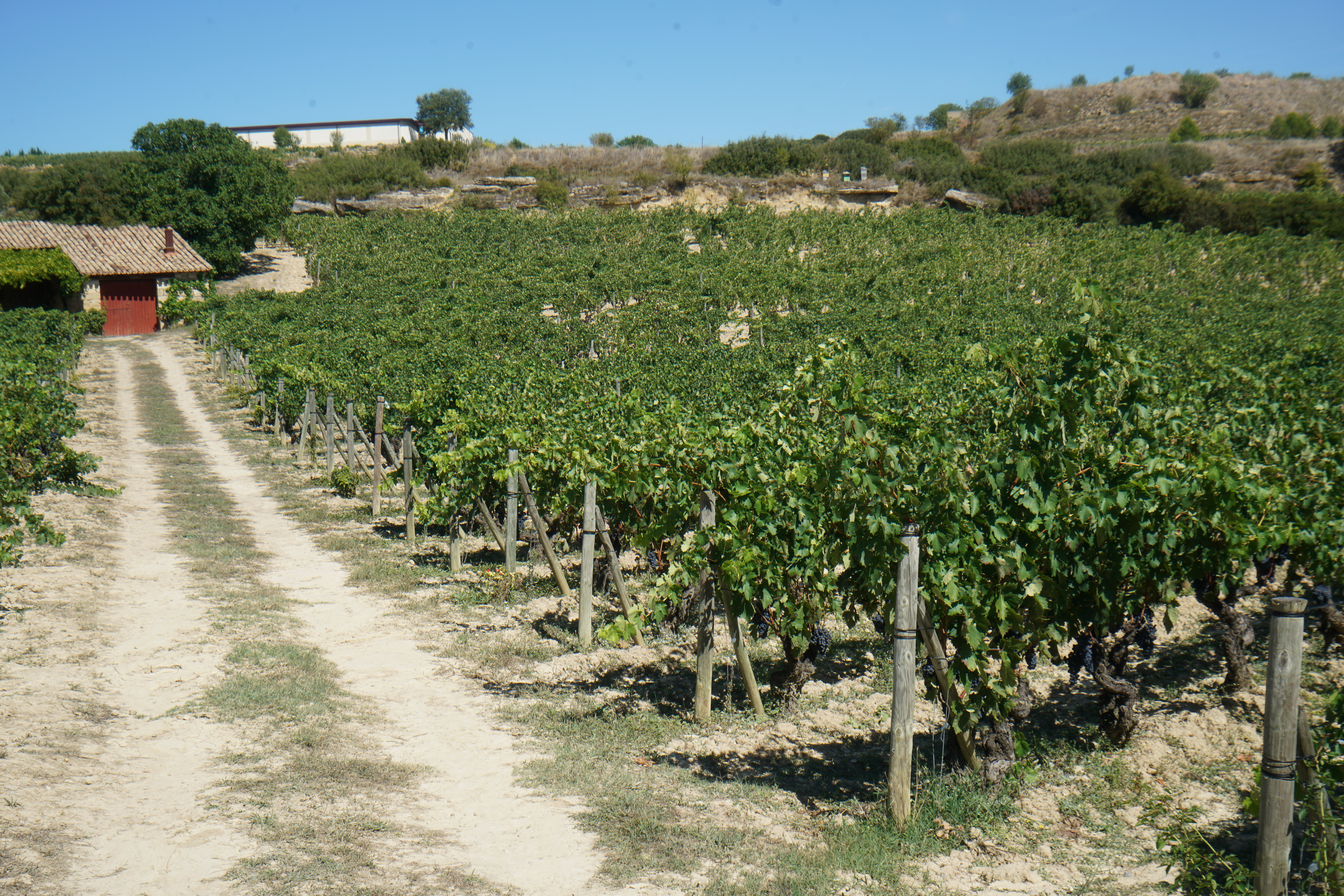
I spent more time at Luis Cañas than I anticipated, so the last stop of the day was a short one at Finca Valpiedra, and I could not make it to one of the sister wineries. One peculiarity is that they own an 80ha vineyard, otherwise unheard of in Rioja. And doesn't the picture remind you of La Craux in Chateauneuf-du-Pape?


Unfortunately, the wines I tasted from all four related wineries do not reach the heights of Chateauneuf-du-Pape. The most interesting wine was the 2016 Petra de Valpiedra, a 100% Grenache - yes, this exists in Rioja. This wine is matured for 6 months in new French oak, then 19 months in old oak. The alcohol is a surprisingly low 13.5% (for Grenache). There are raspberry flavours, but also dark fruit, cassis. There is good acidity to balance the mouthfeel, and the tannins are finely grained.

A cross section of wines from Finca Valpiedra, Finca Montepedroso, Viña Bujanda