Many wine regions have developed as the result of the success of one winery. The imitators flog in and try to emulate the success of the pioneer. Often the objective is to develop a cult wine, based on small production and slick marketing. Certainly Central Otago has attracted many companies as a result of the Felton Road success. And some, such as Ostler, are even in a different area by quite some distance. A good way of assessing the quality of such wineries is tasting wines at a more mature age.
So I was interested to open Ostler's premium Pinot Noir, a 2009 Ostler Caroline's Pinot Noir. The colour worried me a bit. This is a screw capped wine, yet the colour is showing some age: garnet near the rim. This is a full-bodied wine, quite powerful and somewhat alcoholic. The wine opens with dark cherry fruit, but is quite savoury. Acidity is dialed up, and the result is a wine which is not elegant, not supple, and at 6 years, probably past its best.
Now, I would not judge a winery by one wine from one vintage, but this leaves me unimpressed, in particular in the context of the significant care that is taken, according to the winery.
Score: 88/-
Sunday, December 20, 2015


Saturday, December 19, 2015
Idlewild Grenache Gris
If you are looking for something different, this wine could be for you. Grenache Gris is an obscure grape, a derivative of Grenache, grown as bush vine, but seldom bottled separately. Idlewild is based in Sonoma and sources grapes from different Sonoma and Russian River vineyards. They must have found enough Grenache Gris to make this bottling. Remarkable.
The 2013 Idlewild Grenache Gris is probably best classified as sitting between a Rose and Pinot Noir or as a Rose with something extra. This is a pale, dry pink wine with an interesting flavour spectrum. There is blood orange, apricot, but also raspberry and red cherry. The acidity ensures the fruit is fresh and not confected. The wine has a fine line on the palate and fine tannins engulf the flavours. The finish shows minerality, with a hint of fruit. It reminds me of a very light Nebbiolo. I suggest drinking this now or in the next couple of years.
Score: 92/+++
The 2013 Idlewild Grenache Gris is probably best classified as sitting between a Rose and Pinot Noir or as a Rose with something extra. This is a pale, dry pink wine with an interesting flavour spectrum. There is blood orange, apricot, but also raspberry and red cherry. The acidity ensures the fruit is fresh and not confected. The wine has a fine line on the palate and fine tannins engulf the flavours. The finish shows minerality, with a hint of fruit. It reminds me of a very light Nebbiolo. I suggest drinking this now or in the next couple of years.
Score: 92/+++
Wednesday, December 16, 2015
Felton Road Calvert Pinot Noir
The Calvert vineyard is a relatively late addition to Felton Road. It was planted in 2001, and has now entered middle age. The soils consist of sandy loams, silts and quartz gravel. I am drinking a 2008 Felton Road Calvert Pinot Noir, which at that point came from quite young vines. I remember tasting it when the wine was very young and remember how surprisingly closed it was.
This is a good example, where the early indications point to later characteristics of the wine as well. The flavours are actually quite complex.There is some dark cherry fruit, but the character of the wine is savoury, with more minerality than typical for Central Otago Pinot Noir. I taste quite a bit of salt on the palate as well. The main point is, however, there is not much of a sensation on the tip of the tongue. This wine is quite lean. But it develops on the back palate, leading to a long finish, supported by good acidity, firm tannins and smart oak treatment.
The Calvert is the outlier in the Felton Road line-up, or would be in a Central Otago line-up. But the wine has character and individuality.
Score: 93/++
This is a good example, where the early indications point to later characteristics of the wine as well. The flavours are actually quite complex.There is some dark cherry fruit, but the character of the wine is savoury, with more minerality than typical for Central Otago Pinot Noir. I taste quite a bit of salt on the palate as well. The main point is, however, there is not much of a sensation on the tip of the tongue. This wine is quite lean. But it develops on the back palate, leading to a long finish, supported by good acidity, firm tannins and smart oak treatment.
The Calvert is the outlier in the Felton Road line-up, or would be in a Central Otago line-up. But the wine has character and individuality.
Score: 93/++
Sunday, December 13, 2015
Wynns Davis Cabernet Sauvignon
The two leading wineries these days in Coonawarra are Balnarves and the much larger Wynns. Wynns owns at least 25% of the vineyards on the famous Terra Rossa strip. In the last 20 years, it did two major things to revitalize wines from this area. First of all, it reduced yields significantly to increase the concentration of fruit in the wines. Secondly, it identified particular blocks of vines which delivered a special expression of the terroir in each year.
One of these is the Davis vineyard, right in the core of the Terra Rossa. In 2008, the Davis Coonawarra Cabernet Sauvignon was bottled separately. This is a juicy drop with an inky colour. It shows typical varietal blackcurrant fruit. The wine is quite concentrated and ripe, but also bright and vibrant, which is typical of the Terra Rossa terroir. The wine is still quite fruity (screw capped), but matched by firm tannins. There is nothing backward about this wine. It is not delicate and quite full-on.
Score: 92/+
One of these is the Davis vineyard, right in the core of the Terra Rossa. In 2008, the Davis Coonawarra Cabernet Sauvignon was bottled separately. This is a juicy drop with an inky colour. It shows typical varietal blackcurrant fruit. The wine is quite concentrated and ripe, but also bright and vibrant, which is typical of the Terra Rossa terroir. The wine is still quite fruity (screw capped), but matched by firm tannins. There is nothing backward about this wine. It is not delicate and quite full-on.
Score: 92/+
Wednesday, December 9, 2015
Sottimano Curra Barbaresco
No other noble grape splits the world as much as Nebbiolo. As it is far off centre, many in the wine drinking world do not get it, or even hate it, while others will drink very little else after having had the experience.
The 2004 Sottimano Curra Barbaresco sets a good example for these extremes. On its own, it is too tannic, even too savoury to enjoy. It is certainly not delicious. But matched with protein food, it is a different story. Sottimano is not a top tier producer, but this wine has attractive flavours of dried fruits. On the palate, secondary components are now dominant. Figs and tobacco match the plum and dark cherry fruits. The firm tannins blend well into protein food. Unfortunately, there is too much alcohol in this wine (14.5%). This level could be fine with big bodied wines, but overwhelms the fragrant Nebbiolo. The finish is just hot.
Score: 90/+
PS: I will be drinking and reviewing quite a bit more Nebbiolo over the next few weeks.Stay tuned.
The 2004 Sottimano Curra Barbaresco sets a good example for these extremes. On its own, it is too tannic, even too savoury to enjoy. It is certainly not delicious. But matched with protein food, it is a different story. Sottimano is not a top tier producer, but this wine has attractive flavours of dried fruits. On the palate, secondary components are now dominant. Figs and tobacco match the plum and dark cherry fruits. The firm tannins blend well into protein food. Unfortunately, there is too much alcohol in this wine (14.5%). This level could be fine with big bodied wines, but overwhelms the fragrant Nebbiolo. The finish is just hot.
Score: 90/+
PS: I will be drinking and reviewing quite a bit more Nebbiolo over the next few weeks.Stay tuned.
Sunday, December 6, 2015
Summer of Riesling
Riesling has never really taken off in Australia, although it is popular with wine lovers, and good with Asian food, which we eat a lot. A few years ago, the producers came up with the 'Summer of Riesling' slogan and held many promotional events. This clearly lifted the profile of Riesling. It has been repeated ever since. I attended the first such event for the year about a week ago.
25 Rieslings were on show and demonstrated the diversity of expressions from this grape. The Eden Valley wines showed classical floral flavours, wines from Clare Valley were dry and steely and some from other areas saw inventive winemaking techniques.
Of the three wines I tasted from Eden Valley, I liked the 2015 Chaffey Brothers Zeitpunkt the best (91 points). It was very balanced and less floral than the 2014 Heggies and the 2015 Rieslingfreak No. 4 (88 points).
The 2015 Springvale and Polish Hill wines from Grosset showed the usual class. This time I preferred the Springvale (93 points), with the Polish Hill quite lean and closed, and lacking the acidity and line of the best years (92 points). The 2015 Mount Horrocks was dry, with good length (91 points).
The Tasmanian wines were quite different from each other. The 2015 Parish Vineyard had apple next to the citrus, but lacked line and finish (89 points). The 2015 Stargazer was a fuller wine with better length, and some residual sugar (91 points). The most interesting wine was the 2013 Moorilla Muse. This Riesling sees some old oak. It is quite a big wine with complex fruit and earthy characteristics (90 points).
The one wine from New Zealand was the 2014 Charteris Hunt Vineyard. It had attractive white flower and minerality, with some residual sugar (91 points).
The most interesting Rieslings I tasted came from MacForbes. He is really an exciting winemaker. His Rieslings come from the Strathbogie Ranges in Victoria. The 2015 Spring is a funky wine, but quite balanced with a bit of sweetness (92 points). My favorite was the off-dry wine (unusual for me). The 2015 RS29 was again well balanced, with great length and underlying acidity matching the sweetness very well (94 points).
The overall quality standard was good, with MacForbes providing the wow! factor. This was only the first round of Rieslings, plenty more to come in the next few weeks.
25 Rieslings were on show and demonstrated the diversity of expressions from this grape. The Eden Valley wines showed classical floral flavours, wines from Clare Valley were dry and steely and some from other areas saw inventive winemaking techniques.
Of the three wines I tasted from Eden Valley, I liked the 2015 Chaffey Brothers Zeitpunkt the best (91 points). It was very balanced and less floral than the 2014 Heggies and the 2015 Rieslingfreak No. 4 (88 points).
The 2015 Springvale and Polish Hill wines from Grosset showed the usual class. This time I preferred the Springvale (93 points), with the Polish Hill quite lean and closed, and lacking the acidity and line of the best years (92 points). The 2015 Mount Horrocks was dry, with good length (91 points).
The Tasmanian wines were quite different from each other. The 2015 Parish Vineyard had apple next to the citrus, but lacked line and finish (89 points). The 2015 Stargazer was a fuller wine with better length, and some residual sugar (91 points). The most interesting wine was the 2013 Moorilla Muse. This Riesling sees some old oak. It is quite a big wine with complex fruit and earthy characteristics (90 points).
The one wine from New Zealand was the 2014 Charteris Hunt Vineyard. It had attractive white flower and minerality, with some residual sugar (91 points).
The most interesting Rieslings I tasted came from MacForbes. He is really an exciting winemaker. His Rieslings come from the Strathbogie Ranges in Victoria. The 2015 Spring is a funky wine, but quite balanced with a bit of sweetness (92 points). My favorite was the off-dry wine (unusual for me). The 2015 RS29 was again well balanced, with great length and underlying acidity matching the sweetness very well (94 points).
The overall quality standard was good, with MacForbes providing the wow! factor. This was only the first round of Rieslings, plenty more to come in the next few weeks.
Wednesday, December 2, 2015
A Romanian Red Wine
It can be enlightening to drink wines from non classical wine regions. I loved to discover Assyrtiko from Santorini. The wines I tried from China and Georgia over the last couple of years were mixed, but interesting. A couple of weeks ago, I was given this Romanian wine, a blend of Merlot, Cabernet
 Sauvignon and the local Feteasca Neagra (Black Maiden), a pre-phylloxeric variety.
The wine is from 2011, and the ruby colour shows some sign of ageing already. The wine feels a bit plump in the mouth, with concentrated plum flavours. It is earthy, even a bit dirty, with coarse tannins and an alcoholic finish (14.9%). I would not call it faulty, but it is not very attractive. The Faurar is a curiosity for us, but unfortunately, has not much going for it.
Score: 82/---
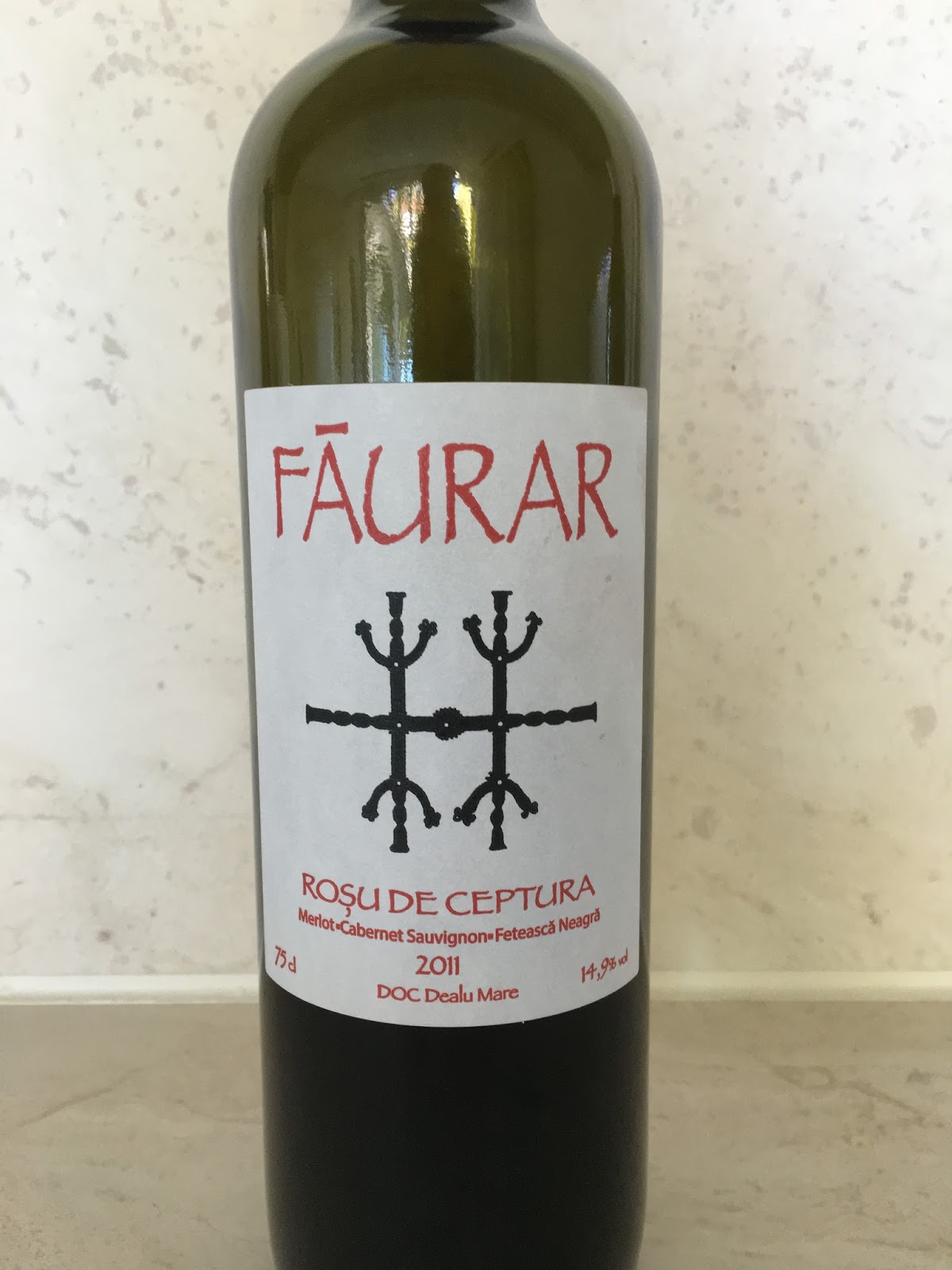
The wine is from 2011, and the ruby colour shows some sign of ageing already. The wine feels a bit plump in the mouth, with concentrated plum flavours. It is earthy, even a bit dirty, with coarse tannins and an alcoholic finish (14.9%). I would not call it faulty, but it is not very attractive. The Faurar is a curiosity for us, but unfortunately, has not much going for it.
Score: 82/---
Monday, November 30, 2015
Brimoncourt Champagne

Brimoncourt is a relatively new name, but one you should remember, I suggest. It has access to all three Champagne grape varieties from top vineyard locations.
The Brimoncourt Brut Regence is very fresh on the front palate, with citrus flavours and mineral components dominating. On the mid-palate, it develops some creaminess. Overall, this Champagne is nicely balanced and refreshing.
Score: 92/++
The Brimoncourt Extra Brut is dominated by Pinot Noir, whereas the Brut includes 80% Chardonnay grapes. It has more weight. Citrus flavours and minerality are still there, but the creamy feel is now ‘replaced’ by stronger toasty and yeasty textures. This is a more intense Champagne with an attractive dry finish.
Score: 94/++
I would happily drink the Brut at the
beginning of an event or evening, and the Extra Brut at the end. They are fairly well priced.
Sunday, November 22, 2015
Querciabella Chianti Classico
You know you are getting cherry flavours and plenty of acidity from Chianti Classico. But then, the mouthfeel is often dusty, as the fruit does not stand up to the tannins.
This 2012 Querciabella Chianti Classico is different. The red and black cherry flavours are vibrant and have considerable depth. The overall impression is savoury, though. This wine has a beautiful mouthfeel, with all components in harmony. Neither acids nor tannins are overblown, but provide an excellent structure. At present, the wine is very lively and enjoyable. It will be even better in a couple of years, when the fruit aromas integrate and the tannins soften.
Score: 93/+++
This 2012 Querciabella Chianti Classico is different. The red and black cherry flavours are vibrant and have considerable depth. The overall impression is savoury, though. This wine has a beautiful mouthfeel, with all components in harmony. Neither acids nor tannins are overblown, but provide an excellent structure. At present, the wine is very lively and enjoyable. It will be even better in a couple of years, when the fruit aromas integrate and the tannins soften.
Score: 93/+++
Wednesday, November 18, 2015
12 Bindi Pinot Noirs
Bindi has been on a steep path to excellence for quite some time now, but as a small producer is not as widely experienced by consumers as it deserves. This tasting went across the different Pinot Noir bottlings as well as across young and older vintages. Thus it allowed a good overall assessment of their Pinot Noirs, which is Bindi's main grape. They also do Chardonnay.
My conclusion is that all wines have a common signature, which is site- as well as winemaking specific. The wines from this cool, isolated location, at 500m altitude in the Macedon Ranges, are not classified organic, but the soil treatment follows those principles. There is no addition of yeast, enzymes or acid in the winery. What all 12 wines have in common is line length, a very elegant texture and fine silky tannins.
After that, vintage variation and vineyard play their part. From 2014, I tried the Dixon (former Composition) Pinot Noir, the Original Vineyard and the Block 5. The yield was very low, and as a result, the fruit is quite intense and dark. These wines need time to develop the typical savoury character of Bindi wines. The Block 5 is the richest of the three, but retains its elegance (92,93,94 points respectively). The general conclusion was that these wines will develop exceptionally well.
This contrasted strongly with the wines from 2011, a cool vintage. The colour of these wines was much lighter, almost with an orange rim. Strawberry and orange peel characters showed. The Kayne Pinot Noir, a new addition from the highest altitude and rocky vinyard, delivered the minerality of the site, but was a little short (91 points). The Original Vineyard was better placed in that year, as the vines are now over 25 years old. The flavours were similar, but the wine had more depth (93 points).
The older wines showed really well. The 2005 Composition Pinot Noir was still quite vibrant, with red and black cherry flavours, as well as forest floor, and a long, soft finish (93 points). The 2004 Original Vineyard Pinot Noir was my wine of the night, with dark fruit and a creamy texture. This is a very elegant and silky wine (95 points). The 2008 Block 5 Pinot Noir comes from a very warm year. It is quite open and opulent, and has a slight alcoholic finish (93 points).
Another remarkable wine was the 2010 Kaye Pinot Noir. It is bigger than the 2011, with an excellent frame and structure. It almost had a Barolo profile, with tar and roses flavours - very savoury. The silky texture gave it away as a Bindi (93 points).
There was no disappointing wine in this line-up. Quite an achievement for a small producer with one site, in a marginal climate.
My conclusion is that all wines have a common signature, which is site- as well as winemaking specific. The wines from this cool, isolated location, at 500m altitude in the Macedon Ranges, are not classified organic, but the soil treatment follows those principles. There is no addition of yeast, enzymes or acid in the winery. What all 12 wines have in common is line length, a very elegant texture and fine silky tannins.
After that, vintage variation and vineyard play their part. From 2014, I tried the Dixon (former Composition) Pinot Noir, the Original Vineyard and the Block 5. The yield was very low, and as a result, the fruit is quite intense and dark. These wines need time to develop the typical savoury character of Bindi wines. The Block 5 is the richest of the three, but retains its elegance (92,93,94 points respectively). The general conclusion was that these wines will develop exceptionally well.
This contrasted strongly with the wines from 2011, a cool vintage. The colour of these wines was much lighter, almost with an orange rim. Strawberry and orange peel characters showed. The Kayne Pinot Noir, a new addition from the highest altitude and rocky vinyard, delivered the minerality of the site, but was a little short (91 points). The Original Vineyard was better placed in that year, as the vines are now over 25 years old. The flavours were similar, but the wine had more depth (93 points).
The older wines showed really well. The 2005 Composition Pinot Noir was still quite vibrant, with red and black cherry flavours, as well as forest floor, and a long, soft finish (93 points). The 2004 Original Vineyard Pinot Noir was my wine of the night, with dark fruit and a creamy texture. This is a very elegant and silky wine (95 points). The 2008 Block 5 Pinot Noir comes from a very warm year. It is quite open and opulent, and has a slight alcoholic finish (93 points).
Another remarkable wine was the 2010 Kaye Pinot Noir. It is bigger than the 2011, with an excellent frame and structure. It almost had a Barolo profile, with tar and roses flavours - very savoury. The silky texture gave it away as a Bindi (93 points).
There was no disappointing wine in this line-up. Quite an achievement for a small producer with one site, in a marginal climate.
Sunday, November 15, 2015
Castagna, Seghesio, Wendouree

First up was the 2008 Castagna La Chiave. This is a Sangiovese grown at altitude in Beechworth, Victoria. It showed typical varietal characteristics with red cherry flavours and acidity. Being Australian, the acidity was less than from a typical Chianti, but there was enough to 'cut' through the cheese.
The 2004 Seghesio Barolo La Villa offered a different experience. The flavours of this wine are quite complex, more savoury, and with mushroom and earthy components at the forefront. This wine added taste experiences to the cheese. It was food friendly and an excellent compliment to the food.
The 2002 Wendouree Shiraz/Mataro was different again. This is a big and quite 'fat' wine with strong plum and other dark fruit flavours. It matched well with soft, 'fat' cheeses. My main impression here was that the cheese made it easier to drink the wine, which - on its own - was very bold.
So while cheese may numb the palate, cheese/wine combinations can still be rewarding. The wines tried expressed their terroir and grape variety in a very typical fashion and offered different, yet sensible combinations.
Tuesday, November 10, 2015
Cloudy Bay Sauvignon Blanc
I do not often review a Sauvignon Blanc. This could be, you might speculate, because I do not enjoy this variety or because it is mostly not cellar worthy and therefore not in my collection. You would be right on both counts. But last night, in a hot location in Queensland, it felt like the right choice. Cloudy Bay seemed like a safe option.
As soon as the 2014 Cloudy Bay Sauvignon Blanc was opened, a full-on fruity aroma escaped the bottle. On the palate, it screamed gooseberry, gooseberry, gooseberry! This was no grassy style, as is often the case with New Zealand Sauvignon Blanc, but a simple fruit bomb. This wine is quite big, not the more restrained style I remember of yesteryear. This wine, unfortunately, did not support the fish flavours, but dominated them. There is no flaw in the winemaking here, but the result is quite unattractive to me.
Score: 87/--
As soon as the 2014 Cloudy Bay Sauvignon Blanc was opened, a full-on fruity aroma escaped the bottle. On the palate, it screamed gooseberry, gooseberry, gooseberry! This was no grassy style, as is often the case with New Zealand Sauvignon Blanc, but a simple fruit bomb. This wine is quite big, not the more restrained style I remember of yesteryear. This wine, unfortunately, did not support the fish flavours, but dominated them. There is no flaw in the winemaking here, but the result is quite unattractive to me.
Score: 87/--
Subscribe to:
Posts (Atom)


