The other night I drank the 2005 Giaconda Warner Vineyard Shiraz. Rick Kitzbrunner recently pushed his Shiraz from the newer Estate Vineyard, but this Warner Vineyard Shiraz is hard to beat.
Redcurrent and red cherry flavours dominate. Spicy and fragrant notes are on the front of the palate as well. Primary fruit is still dominant, but the wine has aged beautifully. It has good intensity without being broad. The wine is well balanced and the tannins very fine.This wine has a good mouthfeel and a long satisfying finish.
This is an outstanding wine. It has many of the characteristics of a cold climate Shiraz, but is quite intense at the same time. It would give any premium Northern Rhone wine a run for their money. There are easily 10 more good years in this wine (under cork).
Score: 97/+++
Wednesday, May 7, 2014


Tuesday, May 6, 2014
Tertini Pinot Noir Reserve
The 2009 Tertini Pinot Noir Reserve is the first ever wine I tasted from the Southern Highlands (snob!). I approached this very skeptically despite a recommendation from a trusted friend - in fact, he gave me the bottle. I was in for a surprise.
This wine is medium-bodied, with red cherry flavours and attractive underlying secondary forest floor contributions. The tannins are quite fine, providing a lengthy finish. While the structure seems solid, the wine (and its colour) is quite developed. Better drink now, while it is so attractive.
This Pinot Noir can hold its own in any serious line-up. I never expected this from a Southern Highlands wine. I know nothing about this winery, but I think a visit is on the cards.
Score: 92/++
This wine is medium-bodied, with red cherry flavours and attractive underlying secondary forest floor contributions. The tannins are quite fine, providing a lengthy finish. While the structure seems solid, the wine (and its colour) is quite developed. Better drink now, while it is so attractive.
This Pinot Noir can hold its own in any serious line-up. I never expected this from a Southern Highlands wine. I know nothing about this winery, but I think a visit is on the cards.
Score: 92/++
Monday, May 5, 2014
The Wines of Dean Hewitson
Where do Hewitson wines fit in in the crowded space of Australian wine? They are probably best known for their 160 year old Mourvedre vineyard near Rowland Flat, from which the Old Garden Mourvedre is made, the oldest Mourvedre in Australia. Otherwise, there is a focus on Rhone varieties and the Barossa and McLaren Vale regions. Here is a review of their current red wines.
The 2012 Hewitson Miss Harry is an attractively priced GSM, which tastes very fresh, with red fruit and interesting herb flavours. Great value for money (92 points). The 2012 Hewitson Ned and Henry's Shiraz is darker, with savoury characters and a rustic finish (90 points). The 2012 Hewitson Baby Bush Mourvedre is made from cuttings from the old vines, but they are quite young at this point, and the wine is not well balanced (88 points). In contrast, the 2009 Hewitson Old Garden Mourvedre has the balance of old vines, which often seems to come naturally. The wine is savoury, with attractive spice and good length. It does not match an old vine Shiraz in complexity and expression, though (93 points).
Then there are three other single vineyard wines. The 2012 Hewitson Basham's Beach Tempranillo comes from the Fleurieu Peninsula. It is the first vintage from there since 2006. The wine is quite fruit forward and does not match the quality of the other wines (86 points). The 2012 Hewitson Mad Hatter Shiraz from Blewitt Springs, McLaren Vale is a lighter style of Shiraz, with red fruit flavours dominant. There is spice in this wine and you could take it for a cooler climate Shiraz (91 points). I found the 2012 Hewitson Mother Vine Shiraz more satisfying. This wine originates from a single old Shiraz vine, which was found in the Mourvedre vineyard. New buds were then grafted onto other rootstocks. This wine tastes of black fruit, it has deeper flavours, yet is fresh (92 points).
Overall, this was quite a consistent line-up. The wines showed good varietal characteristics and are well made. They did not hit a particular high note, however.
The 2012 Hewitson Miss Harry is an attractively priced GSM, which tastes very fresh, with red fruit and interesting herb flavours. Great value for money (92 points). The 2012 Hewitson Ned and Henry's Shiraz is darker, with savoury characters and a rustic finish (90 points). The 2012 Hewitson Baby Bush Mourvedre is made from cuttings from the old vines, but they are quite young at this point, and the wine is not well balanced (88 points). In contrast, the 2009 Hewitson Old Garden Mourvedre has the balance of old vines, which often seems to come naturally. The wine is savoury, with attractive spice and good length. It does not match an old vine Shiraz in complexity and expression, though (93 points).
Then there are three other single vineyard wines. The 2012 Hewitson Basham's Beach Tempranillo comes from the Fleurieu Peninsula. It is the first vintage from there since 2006. The wine is quite fruit forward and does not match the quality of the other wines (86 points). The 2012 Hewitson Mad Hatter Shiraz from Blewitt Springs, McLaren Vale is a lighter style of Shiraz, with red fruit flavours dominant. There is spice in this wine and you could take it for a cooler climate Shiraz (91 points). I found the 2012 Hewitson Mother Vine Shiraz more satisfying. This wine originates from a single old Shiraz vine, which was found in the Mourvedre vineyard. New buds were then grafted onto other rootstocks. This wine tastes of black fruit, it has deeper flavours, yet is fresh (92 points).
Overall, this was quite a consistent line-up. The wines showed good varietal characteristics and are well made. They did not hit a particular high note, however.
Thursday, May 1, 2014
Penfolds St. Henri
This time everybody sings from the same hymn sheet. The 2010 Penfolds St. Henri is a stunner. It opens up with intense fruit flavours. They are quite a cocktail: blackberry, blueberry, plum and mulberry. While these flavours are intense, the wine is not super big, as a result of the maturing in large used oak vats. The palate is well defined, the tannins are fine and the finish just does not stop. It stayed in my mouth for at least two minutes. This is a superb wine, which can only be achieved with exceptional fruit, which Penfolds can source from pretty much anywhere in South Australia. Where I differ from some reviewers is the drinking window. Sure, this wine will live for a long time, but you do not have to put it away for at least 10 years. This wine is quite approachable now, and would be outstanding drinking with great complexity in three years. Highly recommended.
Score: 97/+++
Score: 97/+++
Wednesday, April 30, 2014
Australian versus New Zealand Pinot Noir (a mini comparison)
It is very interesting to compare Australian and New Zealand Pinot Noir. In my opinion, there are interesting parallels, for example between Central Otago and Mornington Peninsula on the one hand, and Martinborough and the Yarra Valley on the other.
This was a brief tasting of six high quality wines.
The 2010 Picardy Pinot Noir from Pemberton, W.A. is expected to be a little different. I thought this was an excellent wine. The colour has a tinge of orange, and the flavours are savoury. What makes this wine exceptional is the elegance on the palate. Picardy's best? (94 points)
The 2012 Bindi Original Vineyard Pinot Noir shows more fruit by comparison. It is quite acidic and tannic and linear on the palate. This wine will live for many years (93 points).
The 2012 Yabby Lake Block 2 Pinot Noir is the little brother of the Jimmy Watson winner. I have not tasted these wines before. I found this wine to be quite earthy and lacking some elegance when compared with the first two. It is a well structured wine (92 points).
The 2011 Akarua Pinot Noir from Central Otago was the weakest in this line-up. The wine is a little fruity and lacked structure and length (90 points).
The 2011 Mount Edwards Pinot Noir from Central Otago was a more appealing wine. It has softer strawberry flavours and fine tannins. It reminded me of Mt. Difficulty. (93 points)
The star of this line-up, the 2011 Ata Rangi Pinot Noir, did not disappoint, although it is not their strongest wine ever. It is of medium weight, with good length and soft tannins. The oak integration is excelllent. This wine will live for many years (94 points).
So how about Australia versus New Zealand? The tasting showed, not surprisingly, the very high standard Pinot Noir has achieved in both countries. I call it a draw.
This was a brief tasting of six high quality wines.
The 2010 Picardy Pinot Noir from Pemberton, W.A. is expected to be a little different. I thought this was an excellent wine. The colour has a tinge of orange, and the flavours are savoury. What makes this wine exceptional is the elegance on the palate. Picardy's best? (94 points)
The 2012 Bindi Original Vineyard Pinot Noir shows more fruit by comparison. It is quite acidic and tannic and linear on the palate. This wine will live for many years (93 points).
The 2012 Yabby Lake Block 2 Pinot Noir is the little brother of the Jimmy Watson winner. I have not tasted these wines before. I found this wine to be quite earthy and lacking some elegance when compared with the first two. It is a well structured wine (92 points).
The 2011 Akarua Pinot Noir from Central Otago was the weakest in this line-up. The wine is a little fruity and lacked structure and length (90 points).
The 2011 Mount Edwards Pinot Noir from Central Otago was a more appealing wine. It has softer strawberry flavours and fine tannins. It reminded me of Mt. Difficulty. (93 points)
The star of this line-up, the 2011 Ata Rangi Pinot Noir, did not disappoint, although it is not their strongest wine ever. It is of medium weight, with good length and soft tannins. The oak integration is excelllent. This wine will live for many years (94 points).
So how about Australia versus New Zealand? The tasting showed, not surprisingly, the very high standard Pinot Noir has achieved in both countries. I call it a draw.
Monday, April 28, 2014
Barossa Buys 2012
I normally report on mature wines which come from my cellar and sometimes on tastings I participate in, but I am thinking to maybe venture out and give a heads up on wines I bought from the fabulous 2012 vintage in the Barossa. These are wines which offer good value for money and have a beautiful fruit expression in this year. These wines are on the fresh, not on the overripe side. They are
Head, The Brunette
John Duval, Plexus and Entity
Spinifex, Bete Noir
Caillard, Mataro.
Any thoughts?
Head, The Brunette
John Duval, Plexus and Entity
Spinifex, Bete Noir
Caillard, Mataro.
Any thoughts?
Barossa Shiraz
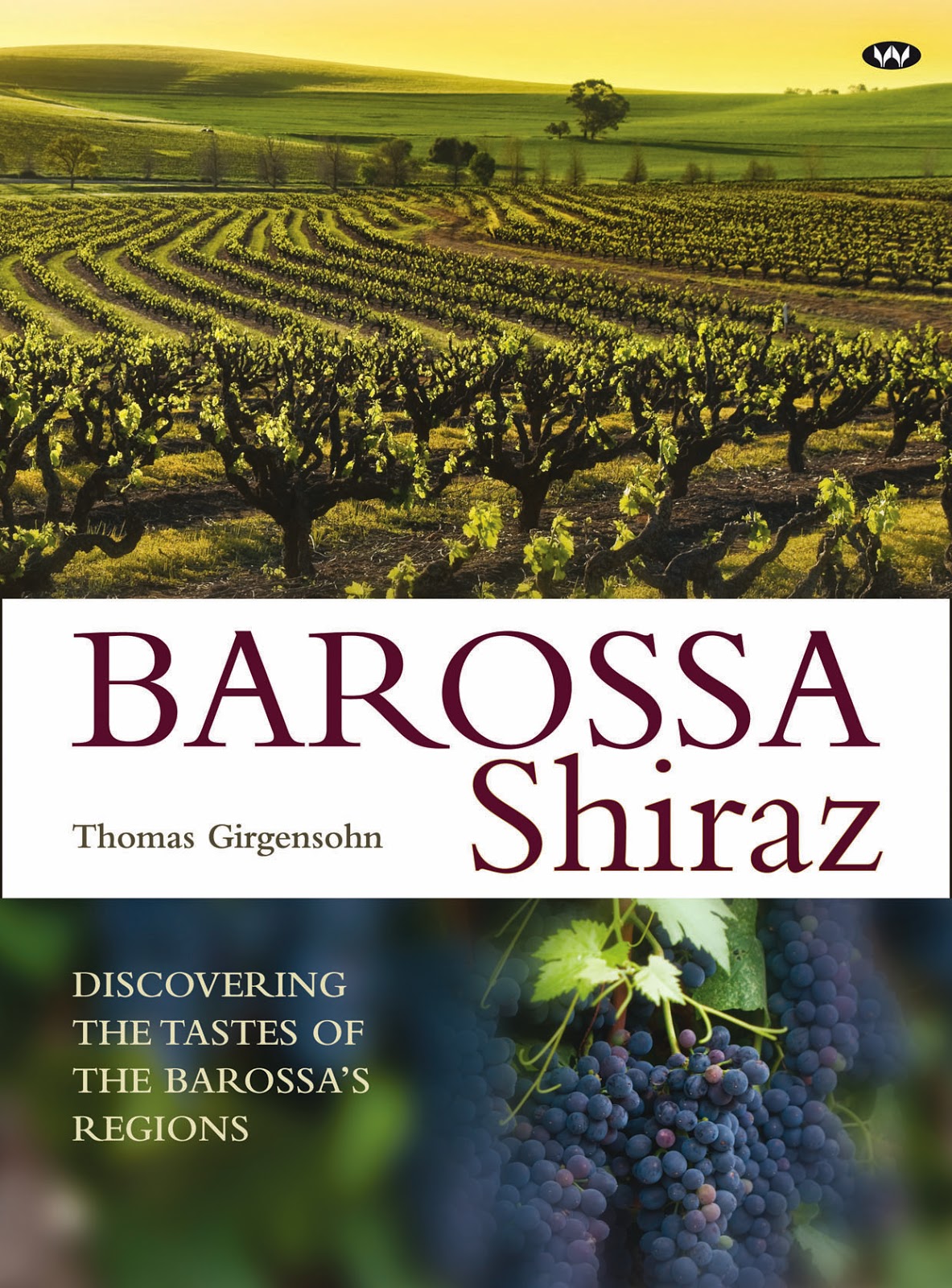
A new and quite detailed review of my book has been published by visitvineyards, a highly popular website with over 50,000 subscribers. The link is
Saturday, April 26, 2014
Spinifex Indigene
The hallmark of Spinifex wines is their vitality, as the grapes come from higher lying vineyards in the Barossa and as they are picked early. As I open a bottle of the 2005 Spinifex Indigene, I therefore expect graceful aging.
This Indigene is a 55% Mataro, 45% Shiraz blend. The colour is dark and somewhat mellowed. This is a big wine. It is still fruit dominant, with blackberry and plum flavours dominating. It has a big mouthfeel and it runs seemlessly to the back palate before finishing long. The tannins are quite noticeable on the finish.
In a blind tasting, I would not have picked this as a Spinifex wine. Its profile is more that of a typical Barossa, with considerable weight. It shows Peter Schell's considerable talent in fashioning well balanced blends.
Score: 94/++
This Indigene is a 55% Mataro, 45% Shiraz blend. The colour is dark and somewhat mellowed. This is a big wine. It is still fruit dominant, with blackberry and plum flavours dominating. It has a big mouthfeel and it runs seemlessly to the back palate before finishing long. The tannins are quite noticeable on the finish.
In a blind tasting, I would not have picked this as a Spinifex wine. Its profile is more that of a typical Barossa, with considerable weight. It shows Peter Schell's considerable talent in fashioning well balanced blends.
Score: 94/++
Thursday, April 24, 2014
d'Arenberg The Coppermine Road
d'Arenberg is known for quirky names for some of their wines, but why would you name a wine Coppermine? As I drank the 2009 d'Arenberg Coppermine Road Cabernet Sauvignon, I found the association to be closer than probably intended.
The wine kicks off with typical varietal redcurrant characters, but becomes a little metallic on the back palate. The fruit of the wine is of good quality, but ultimately, the wine lacks elegance, and the finish is a little harsh.
Score: 89/-
The wine kicks off with typical varietal redcurrant characters, but becomes a little metallic on the back palate. The fruit of the wine is of good quality, but ultimately, the wine lacks elegance, and the finish is a little harsh.
Score: 89/-
Wednesday, April 23, 2014
Mount Mary Quintet
Apologies for another delay. I have come down with a heavy flu and could not taste any wines.
Today's review is likely to be controversial, but one of the benefits of blogging is the independence and the lack of peer pressure one has to take into account in reviewing wines. So here is a not so great experience with an Australian icon wine.
I had great expectations when pouring the 2010 Mount Mary Quintet. A highly regarded wine from a great vintage, what can go wrong? The wine opens with attractive complex forest berry aromas. Little did I know that this was the highlight of the experience. The wine turned out to be quite lean on the palate, not green, but it simply lacked mouthfeel. I also felt there was some brett in the wine, which dulled the flavours, but I doubt it made a huge difference in this case. On the positive side, the wine had a fairly long finish and a fine overall structure. But it was simply not enough to overcome the lack of mouthfeel. There are certainly much better buys of top level Cabernets from Margaret River, be they full- or medium-bodied. I should probably try another bottle of this wine, but I am not inclined to spend this amount of money on it.
There is a line of thought that Yarra Valley Cabernet can be as good, relatively speaking, as the best Pinot Noir from the area. I have never experienced this. I bought the Quintet from the year 2000, which is supposed to have excelled in that difficult year. I am looking forward with some trepidation to open the first of my three bottles. I should do it sooner than later.
Score: 91/-
Today's review is likely to be controversial, but one of the benefits of blogging is the independence and the lack of peer pressure one has to take into account in reviewing wines. So here is a not so great experience with an Australian icon wine.
I had great expectations when pouring the 2010 Mount Mary Quintet. A highly regarded wine from a great vintage, what can go wrong? The wine opens with attractive complex forest berry aromas. Little did I know that this was the highlight of the experience. The wine turned out to be quite lean on the palate, not green, but it simply lacked mouthfeel. I also felt there was some brett in the wine, which dulled the flavours, but I doubt it made a huge difference in this case. On the positive side, the wine had a fairly long finish and a fine overall structure. But it was simply not enough to overcome the lack of mouthfeel. There are certainly much better buys of top level Cabernets from Margaret River, be they full- or medium-bodied. I should probably try another bottle of this wine, but I am not inclined to spend this amount of money on it.
There is a line of thought that Yarra Valley Cabernet can be as good, relatively speaking, as the best Pinot Noir from the area. I have never experienced this. I bought the Quintet from the year 2000, which is supposed to have excelled in that difficult year. I am looking forward with some trepidation to open the first of my three bottles. I should do it sooner than later.
Score: 91/-
Wednesday, March 26, 2014
Biodynamics
In simple terms, biodynamics in the vineyard refers to soil treatment and reflecting certain cosmic influences in viticultural practices. I certainly noticed increased freshness and vibrancy in wines where more organic practices were applied, such as Cullen or Clonakilla, but I have been a sceptic in relation to the impact of moon cycles etc. The argument of the impact of the moon on tides does not really wash with me (pun intended), as this happens every day. And are the hight differences between days really that significant.
But then I came across something amazing in the highlands of Peru a couple of weeks ago. I walked along some fields, and a farmer told me about the planting of some crop, which would be planted at a certain time during the moon calendar. If he would plant at the wrong time, the plant would grow 50% higher, but put all energy into growth and leaves. There would be a lot less seeds. WOW! Makes you think, doesn't it? Unfortunately, I did not ask which plant it was, or in which cycle this would occur. It came so unexpected.
Any thoughts or comments?
But then I came across something amazing in the highlands of Peru a couple of weeks ago. I walked along some fields, and a farmer told me about the planting of some crop, which would be planted at a certain time during the moon calendar. If he would plant at the wrong time, the plant would grow 50% higher, but put all energy into growth and leaves. There would be a lot less seeds. WOW! Makes you think, doesn't it? Unfortunately, I did not ask which plant it was, or in which cycle this would occur. It came so unexpected.
Any thoughts or comments?
Monday, March 24, 2014
Achaval-Ferrer
I am sorry for the long break. I am travelling in South- and Central America and just did not feel like blogging. I spent time in Mendoza, the wine capital of Argentina, and must say that the top wines, most of them Malbec, are very impressive.
The most exciting company is Achaval-Ferrer. The company is only 13 years old, but the vines in their vineyards average about 100 years. Achaval-Ferrer was formed by three friends, but sold to Russian interests four years ago. So far their involvement has been minimal, but it looks like this could change now.
Achaval-Ferrer picks its grapes quite early and fashions three very distinctive single vineyard Malbecs.
The 2011 Achaval-Ferrer Finca Mirador Malbec comes from a vineyard at 700m altitude (this is low over there), and the soil is predominantly clay. This Malbec is full- bodied, with meaty and smoky overtones. The climate of this vineyard is hot, and the flavours are quite ripe, with firm tannins. This is a wine that would appeal to drinkers of California Cabernets and South Australian Shiraz (94 points).
The 2011 Achaval-Ferrer Finca Bella Vista Malbec is grown on limestone soil at 1000m altitude. This is a very different wine: sensuous, soft and velvety. What a contrast! This is simply a delicious world-class wine (95 points).
The 2011 Achaval-Ferrer Finca Altamira Malbec is the most exciting to me. It comes from the Altamira region of the Uco Valley. The vines grow at 1300 metres. The grapes defend themselves against the UV intensity with thick skins, thereby increasing the pulp-to-juice ratio. This gives the wine extra intensity. However, as the grapes are picked relatively early, this does not come at the expense of freshness and vitality. I tasted figs and chocolate apart from the cherry dominated fruit flavours. This is a complex wine, which will further improve with ageing (95 points).
Check out these wines or the Quimera, which is an excellent blend.
The most exciting company is Achaval-Ferrer. The company is only 13 years old, but the vines in their vineyards average about 100 years. Achaval-Ferrer was formed by three friends, but sold to Russian interests four years ago. So far their involvement has been minimal, but it looks like this could change now.
Achaval-Ferrer picks its grapes quite early and fashions three very distinctive single vineyard Malbecs.
The 2011 Achaval-Ferrer Finca Mirador Malbec comes from a vineyard at 700m altitude (this is low over there), and the soil is predominantly clay. This Malbec is full- bodied, with meaty and smoky overtones. The climate of this vineyard is hot, and the flavours are quite ripe, with firm tannins. This is a wine that would appeal to drinkers of California Cabernets and South Australian Shiraz (94 points).
The 2011 Achaval-Ferrer Finca Bella Vista Malbec is grown on limestone soil at 1000m altitude. This is a very different wine: sensuous, soft and velvety. What a contrast! This is simply a delicious world-class wine (95 points).
The 2011 Achaval-Ferrer Finca Altamira Malbec is the most exciting to me. It comes from the Altamira region of the Uco Valley. The vines grow at 1300 metres. The grapes defend themselves against the UV intensity with thick skins, thereby increasing the pulp-to-juice ratio. This gives the wine extra intensity. However, as the grapes are picked relatively early, this does not come at the expense of freshness and vitality. I tasted figs and chocolate apart from the cherry dominated fruit flavours. This is a complex wine, which will further improve with ageing (95 points).
Check out these wines or the Quimera, which is an excellent blend.
Subscribe to:
Posts (Atom)


