Showing posts with label GSM. Show all posts

Saturday, October 7, 2023

Powell & Son GSM


Powell & Son did not exist for long. David Powell is now Neldner Road, and Callum is Agricola. When David Powell was winemaker at Torbreck, he sometimes mentioned that making GSM was his favourite, in particular the Steading. This 2018 Powell & Son GSM is very similar.

The Grenache flavours of strawberry and red cherry dominate the front palate. Then the sweet core of Shiraz plum fruit takes over, and finally the savoury flavours of the Mataro. This is all seamless and well integrated. The wine delivers a full mouthfeel. It is generous and balanced, not overblown and not complicated. Firm tannins and enough acidity deliver a solid structure.

Score: 93/+++


Saturday, July 29, 2023

Utopos New Releases

 When I traveled to the Barossa last year to visit some newer wineries, I missed Utopos. The visit was arranged, but owner and winemaker Kym Teusner fell sick. It was therefore a welcome opportunity to taste these wines in Sydney this week. 

The wines come from a vineyard on Roennfeldt Road in Marananga, previously leased out to Penfolds and next door to David Powell's property. It is a special plot, reaching to the top of the ironstone ridge at 300 meters. Three types of soils allow a lot of options. There is red-brown earth at the bottom, a strip of black biscay in the middle, and depleted top soil exposing ironstone and quartz in the top region. Most of the 30 acres under vine were planted in the early 1990s. Shiraz is planted to the East, Cabernet Sauvignon to the North, and Grenache and Mataro to the West. The average yield is a low 1t/acre. 


The 2021 Grenache is a pretty and fresh wine, tasting of red and black cherry, with a balanced structure and silky tannins. The finish is soft and long (94 points).

The 2021 Mataro/Shiraz/Grenache (40/30/30) is quite different, with the Mataro component quite prominent. Dark fruited and savoury, this wine delivers a firm grip (93 points).

The 2021 Cabernet Sauvignon is quite savoury as well, with the ironstone soil making its presence felt. The wine is medium weight and quite smooth, well made, perhaps lacking some impact (92 points).

The 2021 Shiraz is dark, with blackberry, mulberry and earthy flavours. The wine is fresh and elegant, of medium concentration. It is perhaps a bit fruit forward (94 points).

The 2021 Cabernet Sauvignon/Shiraz (60/40) is blue and black fruited with a fresh mouthfeel. The tannins are fine and dry. This wine is a good example of the benefits of this famous, now slightly neglected blend (95 points).

The 2018 Shiraz, from this excellent vintage, has a very aromatic bouquet. This is a very pretty wine, black fruited and savoury, with silky tannins and a long finish (96 points). 

I was then shown the first wines from 2016. They were nowhere near the quality of the younger wines. Apparently a lot of work was required in the vineyard to get the vines up to scratch. 

If I were to generalize, Utopos wines are characterized by purity and the aromatics of the fruit, as well as savoury influences. On this site, there has been some discussion of the merits or otherwise of traditional ripe Barossa Shiraz on the one hand and leaner wines made by young winemakers on the other. Kym Teusner with Utopos wines seems to strike a happy medium. 


Sunday, January 22, 2023

Three Châteauneuf-du-Pape

 I am continuing the theme of Grenache a bit more. It is not often you find a 100% Grenache in the Southern Rhone and possibly not at all in Châteauneuf-du-Pape, the most highly regarded region there. Still, this is where I am heading today. I drank three Chateauneuf-du-Pape wines over three consecutive nights, all from 2016. This is what I found.


Those who have followed my blog for some years will know that I have a soft spot for Vieux Télégraphe. The 2016 Vieux Télégraphe is quite a ripe wine, yet it is balanced with complex flavours of blackberry, black cherry, olive, tobacco, and spice. Despite being full-bodied, it is an elegant wine. It feels very settled, with finesse and a smooth finish. The Grenache component in this GSM is 65%. These old vines are grown on the famous rocky soil of La Crau. This wine is quite dark and savoury, maybe not quite expected for a Grenache dominant wine.

Score: 96/+++

The 2016 Château de Vaudieu Châteauneuf-du-Pape is not the top bottling of this chateau, and it certainly did not measure up to the Vieux Télégraphe. The grapes are grown on sandy soil. This wine appears bigger in the mouth, reflecting the very dark colour. It is a juicier, more forward wine with earthy flavours. I would have anticipated a larger Shiraz component. However, this wine is 80% Grenache, most of the rest is Shiraz, with some Mourvedre. So it is a dark wine, but Grenache dominant, and grown in sand. Go figure?

Score: 92/++

The 2016 Château de Beaucastel Châteauneuf  is a more energetic wine. It is a lifted wine with pronounced acidity. I see a bigger Grenache influence in this wine. However, the Grenache component is only 30%, the lowest between these three wines.

Score: 94/+++

I found this wine comparison totally baffling.


Wednesday, July 27, 2022

Barossa, Part 3

 On day two in the Barossa, I kicked off with Brothers At War. The Wardlaw brothers have different preferences in wine, one favouring the bigger Barossa Valley wines, the other the sleeker Eden Valley wines. Again, my tasting was extensive, and I need to summarize somewhat.

The two Rieslings from the Eden Valley, the 2021 The Grape Grower, and the 2021 Nothing In Common, were excellent. The first is very delicate, with lime fruit and light acidity. The second is firmer, with more depth of fruit (both 92 points).

Then we come to the red wines of the family range and the premium range. I tasted the 2020 Some Other Guy GSM, the 2020 The Old Man Eden Valley Syrah, the 2020 I'm Always Right Eden Valley Cabernet, and the 2020 Fist Fight Barossa Shiraz. These wines are all quite fruit forward. They do not have enough structure for me (86 to 90 points).   


I have similar issues with the 2020 Single Vineyard Eden Valley Mataro and the 2020 Single Vineyard Syrah. These wines come from the Pendee Farm vineyard in Springton. The Syrah is very austere, and the mouthfeel thin, the Mataro is dominated by strong coarse tannins (90 points).

I preferred the 2020 Single Vineyard Barossa Valley Shiraz from a 60 year old Lyndoch vineyard. It is red fruited, infused with some mocca notes, still made in a fresh style with firm acidity (93 points).

Some production notes, not sure you can read them

The star of the tasting was the 2021 Single Vineyard Eden Valley Grenache. It comes from the 160 year old Stonegarden vineyard (there it is again!). 50% whole bunch is used in this wine. Red cherry, and a little fruity raspberry and cranberry flavours open up beautifully on the back palate, supported by silky tannins (95 points).

The final wine is the 2018 Icon Eden Valley Syrah/Grenache. 'Icon' seems a bit rich for a wine nobody knows. This wine has more concentration, but shows still fresh raspberry and red cherry flavours. The barnyard notes, which I have not tasted in a wine for some time, are not out of place. The finish is quite long (94 points). 

My next visit is to Eisenstone. There are a couple of things I like about this new winery from the start. This winery makes only Shiraz; focus until you master it! Secondly, it labels one series of wines by subregion, and a second by special vineyards. Stephen Cook used my book on Barossa Shiraz to develop his approach!


The first wine I taste is the 2019 Ebenezer Shiraz. The fruit comes from the famous Hoffmann vineyard. It is a mix of 1965 Dallwitz fruit (also used by Sami-Odi) and young vines. All wines are matured in French oak, this one has 50% new. There are blackcurrant, blueberry and some mocca flavours on the palate. The fruit weight is good. Savoury notes come from the oak. The wine tastes long in the mouth (93 points). The 2019 Hoffmann Single Vineyard Shiraz wine is similar in style, with red and black fruit flavours. The wine is more opulent, yet quite elegant with good complexity. This is a classic full-bodied Barossa Shiraz (95 points). The 2019 Roenfeld Rd. Shiraz, from the vineyard which also produces the new Opulus label, is surprisingly aromatic, but the structure is quite tight and linear (92 points).

The 2020 wines, from a more difficult vintage, appear more generous, with a lighter touch perhaps. The 2020 Gomersal Shiraz is lively and fruity with blackberry and blueberry flavours (93 points). The 2020 Koonanga Shiraz, from the Beckers vineyard) is very dark with mocca notes - a typical Northern Barossa Shiraz (94 points). The 2020 Hoffmann Single Vineyard Shiraz is the star of this line-up. It has a big mouthfeel, with blackberry and blueberry flavours. A very opulent wine with some lifted character and finely grained, yet firm tannins (96 points).

The style of this winery is classic Barossa Shiraz with excellent fruit sources. The winemaking could lighten up a bit more. The addition of acidity feels a little forced and not totally harmonious. It will be interesting to see the wines of 2021, when vintage conditions were perfect.

My final tasting was with Dave Powell of ??? After leaving Torbreck, he formed Powell & Son. This went well for a few years, before he had a falling out with Callum Powell. Callum now makes lighter style wines under the Agricola label. Dave Powell is still being pursued for using his own name by the Torbreck owners. So he now formed Neldner Road. However, some wines are still marketed under Powell & Son. 


The first wine is the 2018 Barossa Valley GSM. It is a classical blend with 60% Grenache. This wine is very fresh, very drinkable with great texture. The wine is quite fruit orientated with  darker flavours than typical for Grenache. The wine has good length, like a Torbreck Steading from a good year (94 points). The 2019 Barossa Shiraz spends 18 months in French foudres. It is very dark, with chocolate flavours dominant. This wine is great value for money (93 points). The 2019 Neldner Barossa and Eden Valleys Shiraz is like the Struie. Matured in foudres as well, the Eden Valley component shines through, with lifted aromatics and blue fruit (94 points).

My  second favourite of the line-up is the 2019 Loechel Eden Valley Shiraz. This wine sees 67% new oak, matured in barriques. The vineyard soil is  predominantly granite. This is a full-flavoured wine, but it has an element of lightness. The wine is elegant with great length (96 points). The 2019 Kalimna Shiraz, from 80 year old vines, is a good counter point. This wine has big fruit weight and quite coarse tannins - the big Barossa (94 points).

The 2018 Chatterton Shiraz comes from four Barossa and two Eden Valley vineyards. All vines are more than 100 years old, and the sources are largely the same as what David used for RunRig. The wine spends two years in French new oak. I found this wine already quite drinkable. The wine arrives in distinctive layers on the palate. The wine is rich, but is slightly lifted as well. It is beautifully crafted (96 points). It is tough for the 2017 Kleinig Mataro to follow. This wine displays typical Mataro flavours of meat, earth, and spice. It has a surprising fresh and expanding finish - really nice (94 points).

When you taste David Powell wines you know what to expect. There is a widespread view that his wines are too big to be enjoyed by more than a glass. I found these wines quite drinkable, however, and the winemaking is first class.

This ends the Barossa trip. I enjoyed many beautiful wines. There is a widening of styles and a new excitement in the valley, and some notable evolution at Penfolds. One thing has to be said. Most wines tasted here above 93 points are $80/bottle or more. Enjoying good wine has become quite expensive.  


Monday, July 25, 2022

Barossa, Part 2

 The main purpose of my visit this time is to get to know some of the newer wineries and their wine styles. Eperosa is a small operation by winemaker Brett Grocke. It shot to some fame when Brett Grocke was named winemaker of the year by James Halliday in 2021. Most wines come from the two owned vineyards in Krondorf and the Magnolia vineyard in Vine Vale. He makes mainly Semillon and the Rhone varieties. I will cover the most important wines below.


The 2020 Magnolia 1941 Semillon is grown in deep sand (as is common in the Hunter). The wine spent 16 months on lees and is barrel fermented. This means it is getting quite a bit of treatment. Lemon and oyster shell flavours lead to a bigger texture than often associated with Semillon. There is some slight oxidation in this wine. It has some waxiness on the back palate. I found this an attractive style (92 points).

The leading Grenache is the 2020 Stonegarden 1858 Grenache. As is the case with fruit from the Hoffmann vineyard in Ebenezer, suddenly everybody wants fruit from this old Springton, Eden Valley vineyard. The vineyard is high altitude, with rocky soil. This wine is red fruited, as you would expect, with red cola flavours. It also has a dark presence with licorice notes. I must say I expected more from this (92 points).

The most important wines are the Shiraz wines from the Magnolia vineyard. It sits at the base of Menglers Hill at over 300m altitude. A number of gullies run through the property and split the vineyard into distinctive blocks, planted at different times. The soils vary, with deep sand the most common.

The 2020 Magnolia 1965 Shiraz comes from the highest part of the vineyard. It is farmed organically. It is quite a concentrated wine, with violet notes, blue fruited (similar to Eden Valley) with some iron flavours, and very elegant. Brett compared the wine to Cornas (94 points).

The 2020 Magnolia 1896 Shiraz is grown on rockier soil. Again, it is blue fruited and shows an ethereal elegance, which one seems to only get from very old vines. The tannins are fine and the finish long (95 points).

I enjoyed the two flagship wines. They taste more like Eden Valley than Barossa Valley. The other wines are fine, but not so special (except for the Semillon).

The next stop was Alkina. Alkina is the talk of the valley right now. The 60ha property near Greenock was purchased by Argentinian billionaire Alejandro Bulgheroni about 10 years ago. He also owns wineries in Argentina, Uruguay, France, USA and Italy. 6ha on the property was planted in 1950. Another 37ha have been planted by now, some parts going back to 1970, some only a few years old. The vineyard is managed biodynamically, and extraction in the winery is on the light side. Significant investment in concrete eggs, Italian Amphorae and Georgian Qveri give the winery a look unlike any other in the Barossa Valley.


The entry level wines from young vines are called Kin. I tasted the 2022 Semillon, and the 2021 Grenache and Mataro from this range. The Semillon is fuller bodied than the Hunter wines. The reds show great typicity. There is great freshness and fruit purity in these wines (92-93 points).

I did not like the 2020 Birdsong Shiraz much. It was matured in old foudres. The wine is very fruity, followed by drying tannins (89 points).

I now need to talk about the Polygon project. Electro conductivity mapping technology has been used on the original 6ha vineyard to separate out in fine detail different soil types. This is done by sending electromagnetic impulses into the ground. This project is lead by Chilean soil scientist Pedro Parra and Italian winemaker Alberto Antonini. Based on the mapping, a number of soil pits are excavated. Different profiles were identified. These small blocks now form the basis for individual wines. It is expected they will show differences, depending on the schist, clay, limestone and quartzite compositions.

The first wine I taste from this area is a blend, however: the classic GSM. The 60% Grenache comes from Polygon 4, comprising clay and degraded schist. It is called 2020 Old Quarter. The wine is fresh, very elegant, pretty, and complex. It is very balanced between components, which have 70-100% whole bunch. There is excellent minerality on the finish (95 points).


The 2019 Polygon 5 Grenache is made in a similar way. The soil is schist with clay and iron. It translates into a firmer structure. This is a dark and elegant wine with intense raspberry and red plum flavours.  The tannins are very fine (95 points). This is supposed to contrast with the Polygon 3 Grenache. These wines are made in minuscule quantities, and unfortunately, no more Polygon 3 was available. The 2019 Polygon 1 Shiraz comes from a schist  and quartzite block. This is a bigger wine, blackberry, mocca, and licorice flavours, with firm and chalky tannins (95 points). There will never be much of these wines, we are talking about 50 cases each.

Overall, Alkina is an innovator, bringing something new to the Barossa. The wines are positioned on the beginning of the ripeness spectrum, with great fruit purity and finesse.


Monday, March 7, 2022

Special Tasting At Penfolds


 A few days ago, I was hosted at Magill Estate to a tasting of some special wines. 

The whites were the 2021 Cellar Reserve Polish Hill Riesling and the 2020 Bin 20A Chardonnay. The white wines have always lived in the shadow of the red wines, maybe until now. Cellar Reserve are one-off wines. They do not create restrictions which the major labels can do. This Riesling shows the expected lime and lemon flavours of Polish Hill. In comparison with Grosset, this wine has a wider mouthfeel, not quite as steely (this is a matter of personal preference). Having said this, it has a beautiful line of acid (94 points). 

The Bin 20A Chardonnay is the little brother of Yattarna. A stands for Adelaide Hills, where always 100% of the fruit comes from. This wine is nothing like any other Chardonnay I have tasted from Adelaide Hills. It is a much more powerful and quite funky wine.Whereas Yattarna seems carefully crafted, this wine lets loose. It comes from the Piccadilly area, and has been matured in 60% new French oak. The wine can clearly take it. Ripe melon flavours and a flinty minerality dominate the palate. This wine has personality (95 points).

The next section was a comparison of cork and stelvin closure, based on the 2013 Bin138 SGM. The wine is composed of 75% Shiraz, 15% Grenache and 10% Mourvedre. As expected, the wine under cork showed more development, with a slightly garnet colour. The stelvin wine showed red and purple. The wine under cork felt big in the mouth, with raspberry flavours. It had a sweet, somewhat fat core (92 points). The screw-capped wine was much fresher, with a more interesting flavour profile, including aniseed and some vegetable notes, such as fennel (94 points).

The result was not what I expected. For red wine, I prefer cork because of the more natural development (in my mind), whereas I have had a number of 10 year old red wines under screw-cap which showed frustratingly little development at all. However, in this comparison, the wine under cork was further developed than I would have liked, and ‘reduced’ to a sweet core. The wine under stelvin showed some development, and kept an interesting flavour profile.

I will skip over the Bin 28 wines. The comparison here was difficult because of the significant difference in age.

Finally, I tasted two wines from the new California Collection. The 2018 Bin 704 is the Penfolds Napa Cabernet. Sourced predominantly from Oakville and Rutherford i.e. the valley floor, and matured in 100% new French oak, this wine is positioned, if you will, against the premium Napa Valley Cabernets (and priced attractively by comparison). It has the boysenberry flavour I associate with Napa Cabernet, but it is not as open as the American wines. I feel it is tighter. The different fermentation style with Penfolds typical punch-downs, may explain this. The wine is quite long and has an elegant mouthfeel, which makes it quite approachable now, maybe because of the maturing in hogsheads (95 points).

Penfolds legacy is founded by risky experiments. The Max Schubert story of Grange is well known where Shiraz was used instead of  the Cabernet Sauvignon of Bordeaux. RWT was aged in French oak against all Penfolds tradition. Do we have another example here, when red wine maker Steph Dutton ‘threw’ 13% of ultra premium Shiraz fruit from Australia into the best Napa Cabernet fruit they had to create Quantum? This 2018 Quantum is called wine of the world, maybe a bit presumptuous, but no large wine company had ever done this before. This wine is matured in 100% French barriques. Is this a Napa Cabernet? Is this a Penfolds wine? What I would say is that it is a very high quality wine, with layers and layers of fruit, with blackcurrant dominant. It is much too early to drink now, but will unfold very well, I have no doubt. It will be longer lasting than most Napa Cabernet. It is Penfolds’ best Cabernet, but a Grange equivalent? Not sure (97 points).

 The reception by Penfolds was most enjoyable, and the expert comments by Zoe Warrington very much appreciated. This tasting was a real treat.

Tuesday, March 16, 2021

Vieux Télégraphe 'La Crau' Chateauneuf-du-Pape

 How do you photograph a label with writing around almost half the bottle? I tried something a little different. Not very professional, but quite psychedelic, don't you think?


The 2010 Vieux Télégraphe 'La Crau' is already quite developed. The colour is a blend of purple, brown, and orange.

This full-bodied wine still has primary fruit tasting of raspberry and plum. As always, savoury characteristics are strong in this wine, with earthy notes and spice adding complexity on the palate. The structure of this wine is still quite balanced, but it feels like it may not hold together that much longer. The tannins are firm and grainy, and the wine finishes long.

I recommend to drink this wine now.

Score: 93/++

Saturday, February 27, 2021

A Whirlwind Tour Through South Australia

This is my first interstate trip in a year. It is brief: three South Australian wine regions in three days.

Day 1: Barossa Valley 


On the first day, I visited the Artisans of Barossa to taste Spinifex and John Duval wines, the Standish Wine Company, and Elderton.

Something unusual seems to go on at Spinifex. Peter Schell did not respond to my emails. More importantly, there seems to be quite a change in strategy. He used to be the master blender of the Barossa, identifying small plots of the less common Rhone varieties and creating beautiful fresh wines. Now, there is a marked shift to single varieties wines. I am not sure why.

The 2019 Esprit is still 'old school'. It is a fresh, elegant wine, although a little sweet (91 points). Then I am confronted with the drought vintages of 2019 and 2020. The 2020 Garcon is a robust Grenache, with macerated strawberry flavours and a bit confectionary (89 points). Similarly, the 2020 Syrah is broader than usual and a little harsh (88 points).

In moving away from the blends, Peter Schell has also decided to bottle varieties which arguably are better suited to warmer climate. The labels are different, to maybe indicate a more experimental character of these wines. The 2019 Aglianico has relatively weak fruit weight, certainly in comparison to the firm and very dry tannins (87 points). In contrast, the 2019 Tannat is a revelation. Tannat tends to be very robust in France and Uruguay, but here, this red fruited wine has a lifted character, with an elegant palate and a smooth finish. Who would detect this variety in a blind tasting? (93 points).

Finally, I taste the 2018 La Maline. This Shiraz comes from the northeastern slopes of the Barossa Valley, where winds have a cooling effect and temperatures drop at night. There is 4% Viognier in this wine. The wine is fragrant and perfumed, but not overly so. It has a beautiful core of Shiraz fruit and finishes in an elegant style (95 points).

I tasted the three classical wines of John Duval. The 2018 Plexus, a GSM, shows the Grenache component in particular. It is an entry wine, but shows good harmony and intensity (90 points). The 2019 Entity is another example of the drought vintage. In previous years, this Shiraz was exceptional, but in 2019 it is not balanced. The core is quite sweet, and the finish a bit harsh (89 points). This contrasts with the 2017 Eligo, a best of fruit wine, from a cooler vintage. This wine has a big mouthfeel, but remains elegant with great length (95 points).  


to be continued...


Sunday, July 12, 2020

Teusner Avatar GSM

There has been quite a tradition by now to fashion GSMs in Australia. The winemakers have managed to understand the contribution of each grape variety and create quite seamless blends. So it is with the 2014 Teusner Avatar.


The Grenache contributes upfront raspberry flavours, the Shiraz sweet black fruit and a harmonious mouthfeel, and the Mourvedre firm tannins.

This wine is quite fresh and delicious in the beginning, but by the second glass it starts to get heavy, with the 14.5% alcohol weighing in. The wine has a good length finish.

Score: 91/0  


Saturday, March 14, 2020

Rusty Mutt Wines


Rusty Mutt is a very small producer from McLaren Vale. You may not be able to track down these wines, but they deliver good value.

The 2018 Joven Tempranillo delivers dark cherry flavours with good depth of fruit. The acidity brightens up the wine. It is not very complex, but ticks all Tempranillo boxes. This is a satisfying wine with a balanced finish to boot (92 points).

The 2018 Rocky Ox GSM is very much Grenache dominated. The different flavours of raspberry, blackberry and plum are well integrated. The mouthfeel is smooth, with earthy flavours rounding out the fruit. This is not a challenging wine, but it is pleasantly serious, balanced, and with good acidity. The finish is a little short (93 points).

The 2016 Original Shiraz is a bigger wine. However, the vibrant acidity brightens up the blackberry and black cherry fruit. There is some Shiraz sweetness on the mid-palate in this medium- to full-bodied wine. I enjoyed the refreshing finish (93 points).

The Rusty Mutt wines are not pretentious. They are well made balanced wines with good acidity. As a result, they are quite a satisfying drink.


Monday, March 9, 2020

Torbreck New Releases

It is good to have a first look at the 2018 vintage at Torbreck. I therefore focus on the red wines. The first is the 2018 The Steading. There has been a change in style. Shiraz is now the largest component in this GSM. The winemaker tells me that Shiraz is still the consumers’ favourite; so there. The wine has been matured in French foudres. There is now more fruit weight in this wine, and the alcohol is high at 15%. I am not convinced the style change makes this a better wine (91 points).

The new foudres at Torbreck


I then taste a relatively new wine, the 2018 Harris Grenache. It comes from an east facing block (no late afternoon sun) in Marananga. I drove past this vineyard. The vines are low sitting bush vines, maybe 30-70 years old. The wine is also matured in the foudres shown above. The fruit concentration is good. There is power and vibrancy in this wine, showing the strength of the 2018 vintage. The ironstone soil contributes for the savoury flavours to remain strong along the palate. This wine is both fresh and serious at the same time: an absolute winner (93 points).

We went on to the 2017 Les Amis, to complete the Grenache set. 2017 was a cooler vintage. This has served this normally super concentrated wine from very low yielding 110 year old bush vines well. There is some lightness in this very smooth wine, where the silky tannins shine on the finish (96 points).

The two Mataro wines are first the 2018 Kyloe Mataro. This wine comes from Moppa and Ebenezer. It is a savoury and meaty wine, brooding, with chunky firm tannins. It would not be everybody’s cup of tea, but is a good expression of Mataro (92 points). The premium Mataro, the 2017 Pict, comes from the Materne vineyard in Greenock. There is a bit more fruit weight here with very firm tannins (93 points).

The main Torbreck focus, though, is Shiraz. The 2018 Struie is an excellent wine. The Eden Valley component at 25% is a bit less than normal, due to frost. With blackberry fruit at its core, this wine has good complexity with mulberry flavours and mocca in its mix. This is a smooth wine with depth and a firm, balanced structure (95 points).

I compared this with two much more expensive wines from 2017. The 2017 Factor is red and black fruited, a bit saline, and not as big as the Struie. It finishes tight (93 points). The 2017 Descendant, which includes 8% Viognier by weight, but only 2% by volume is quite smooth, but lacks a bit of fruit weight, with the fruit quite dry (93 points).

The final wine is the 2015 RunRig. 2016 is sold out and 2017 not yet released. As usual, it comes from six vineyards across the Barossa, with the southern vineyards on sandy soil contributing lushness, and the northern vineyards power and tannins. This is quite a good wine, with dark fruit intensity. The wine is very ripe, as usual, but also elegant, with a long finish (95 points).

This was an interesting tasting. The 2018 vintage shows very strongly in the mid priced wines. In Shiraz, it clearly beats 2017. It will be interesting to see, if the 2018 ultra premiums will be too over the top for this reviewer.

Friday, March 6, 2020

A Strange Day In The Barossa Valley

On this day, I tasted wines from Spinifex, John Duval, and David Franz; the first two at Artisans of Barossa, the last at the winery.

The situation with Spinifex was a bit unfortunate, as their highly anticipated premium 2018s would only arrive the following day. I tasted the 2018 Garcon, a light Grenache. This wine is easy drinking. There is some whole bunch in the wine, which makes the mouthfeel more savoury and rounded (90 points). The 2018 Aglianico is actually sourced south of Williamstown, really from the Adelaide Hills. The fruit is late ripening, and the acidity and firm tannins stand out in this wine (88 points). Finally, the 2018 Syrah (notice the spelling) is a very fresh, juicy wine, with good acidity and varietal character, but not much depth (91 points). I am looking forward to tasting the other 2018 wines.

I tasted a fuller range of John Duval wines. The 2017 Plexus shows pretty fruit and good balance. 50% of this GSM is Shiraz, which took over from Grenache to give the wine more weight. The mouthfeel was not as rounded as in some previous years (91 points). The Annexus wines are relatively new. They show particular components of the Plexus, worth bottling separately. The 2017 Annexus Grenache comes predominantly from the 150 year old Eden Valley Stonegarden vineyard. This is a well structured wine, showing raspberry fruit and minerality on the finish. In this relatively cool year and higher altitude, the fruit weight is a little weak (91 points). The 2017 Annexus Mataro, suffering from this vintage, is muscular, and a little bitter and tannic (88 points).

There will be a lot of interest in the 2018 Entity, the follow-up to the outstanding 17. Again, the Shiraz fruit is 50/50 Barossa Valley, Eden Valley. This wine shows good depth of fruit and great harmony. This wine is not overly extracted, which could have been a temptation (94 points). Comparing this wine to the 2016 Eligo, which consists of Duval's best fruit, I give the crown to the Eligo. It is a more powerful wine, with darker fruit and bigger fruit weight. This wine makes a statement. The tannins are firm and the finish long (95 points). We now cannot wait for the 2017 Eligo. Will it beat the 2017 Entity?

The tasting at David Franz was the worst tasting I can remember for many years. Why does this winery show in its premium range wines from the very wet 2011? The 2011 Benjamin's Promise Shiraz is brown in colour and tastes of stewed fruit. There are confectionery notes and the tannins are very soft; unpleasant (84 points). The 2011 Alexander's Reward Cabernet/Shiraz is very similar, a bit more lively with acidity (85 points). I was relieved to leave 2011 with the 2014 Georgie's Walk Cabernet Sauvignon, only to find that the redcurrant flavours were overshadowed by herbal notes. There is a strong American oak influence in this oxidated wine (82 points). Finally, I tasted the Larrikin VII, a non vintage blend of Shiraz, Cabernet, Merlot and Grenache. This wine seemed to include all components that could not be used otherwise (not rated).

The good news is, I can report on two excellent Barossa tastings in posts to come.  

Saturday, November 23, 2019

A Range of Rhône

Rhône wines should really attract more interest in Australia, given the strong showing of Shiraz and Grenache in this country. Comparisons are interesting for many reasons; Grenache on its own is virtually not bottled in France, and the Shiraz styles vary in different Northern Rhône subregions. In a recent tasting, I could look at four quite different wines from the Rhône.


The 2014 Pierre Gaillard Clos de Cuminaille from St. Joseph has a fascinating flavour profile. This is a light and fresh wine, with red fruits, earth, leather, spice and herbs creating a lifted blend, almost like a Pinot Noir. It has length, too. The only disappointment after such a nice taste is the lack of tannins (94 points).

Quite different was the second wine, a 2016 Domaine Santa Duc Habemus Papam Chateauneuf-du-Pape. This is a much bigger wine with dark fruits on the palate and a lush texture. The tannins are firm, and the slightly confected finish gives the Grenache component, otherwise not so obvious, away (93 points).

The third wine was from Cornas, a 2009 Matthieu Barret Domaine du Coulet Billes Rotres. This was a dark fruited wine, 100% Shiraz. There was a lot of pepper on the nose and palate, lavender and sweet honey notes made for an intriguing taste. Overall, this wine was very intense and I thought it was slightly hot, although the quoted alcohol was not especially high (92 points). 

The final wine was the 2015 Bernard Faurie Hermitage (white cap). This is a rare wine, made in small volumes from arguably the best subregion, Hermitage, and a blend of two vineyards. This is quite a delicate wine at this stage whose complexity will only unfold over time.  Violets and delicate raspberry flavours show upfront, but one can detect licorice and meaty notes underneath. Finesse is the dominant theme (95 points).

Four Rhône wines, four completely different expressions. There is a lot of complexity in this long region. This tasting suggests it is worth unpacking. 

Sunday, November 17, 2019

Ruggabellus Timaeus

Ruggabellus is one of a few 'new wave' producers in the Barossa Valley. Abel Gibson, the son of Rob, started off in a garage and decided to produce a trio of Southern Rhone inspired wines, each leading with either Shiraz, Grenache or Mataro. The inclusion of whole bunches is a major signature of these wines.


I reviewed the 2010 Ruggabellus Timaeus, which is Grenache lead, with mixed feelings in 2012. Seven years later, I can report that this wine has matured well and is a much better wine today. The structural elements of the Mataro are much more prominent now. This wine is dark fruited on the front palate, and the  more confected flavours of the Grenache shine through a bit later. But to be clear, there is no sweetness in this wine; it is savoury. The firm tannins give a solid structure to the wine, and the alcohol is a pleasant 13.6%. I am happy to drink a second glass of this, even though the finish is a bit nondescript.

Drinking probably best right now and in the next two years with perfect cellaring.

Score: 93/++  

Friday, May 24, 2019

Torbreck, The New And The Trusted

Torbreck, under new winemaking management, has taken some steps to broaden its offering. I am comparing here two newbies and two oldies from a recent tasting. Nothing has changed on the labels. It is still plain writing on white. Nothing wrong with that.


The first new wine is the 2016 Hillside Grenache, from a very old vineyard in Lyndoch with sandy soils. It is a few special rows which used to go into the Steading. The wine is fragrant, medium-bodied, raspberry fruit of some intensity, also some black fruits. The wine is appealing on the front palate, but then falls off (92 points).

Compare this to the 2017 Steading GSM. This wine offers more intensity and complexity. Raspberry, plum, black cherry and spices compete for your attention. The wine components are well integrated, but lack a bit of mouthfeel. The tannins are silky, but do not have much impact (93 points).  

The first wine is the more expensive wine because of its scarcity, the Steading is the better wine.

Another new wine from the Hillside vineyard is the 2017 Hillside Shiraz Roussanne. This is a typical Torbreck wine of old: big, fat, plum profile with good fruit depth, and an alcoholic finish (90 points).

Compare this to the 2017 Struie. In this vintage, the Eden Valley component is 22%. It may be the junior partner to the Barossa Valley fruit, but it has quite an impact. Next to the intense plum fruit, there are blueberry notes and a perfumed aspect to the flavour. The mouthfeel is big, and the firm tannins are well integrated. This fruit dominant wine is too early to drink, and will come together well with time (94 points).

In this comparison, old wins over new. 


Thursday, April 11, 2019

D'Arenberg Tasting

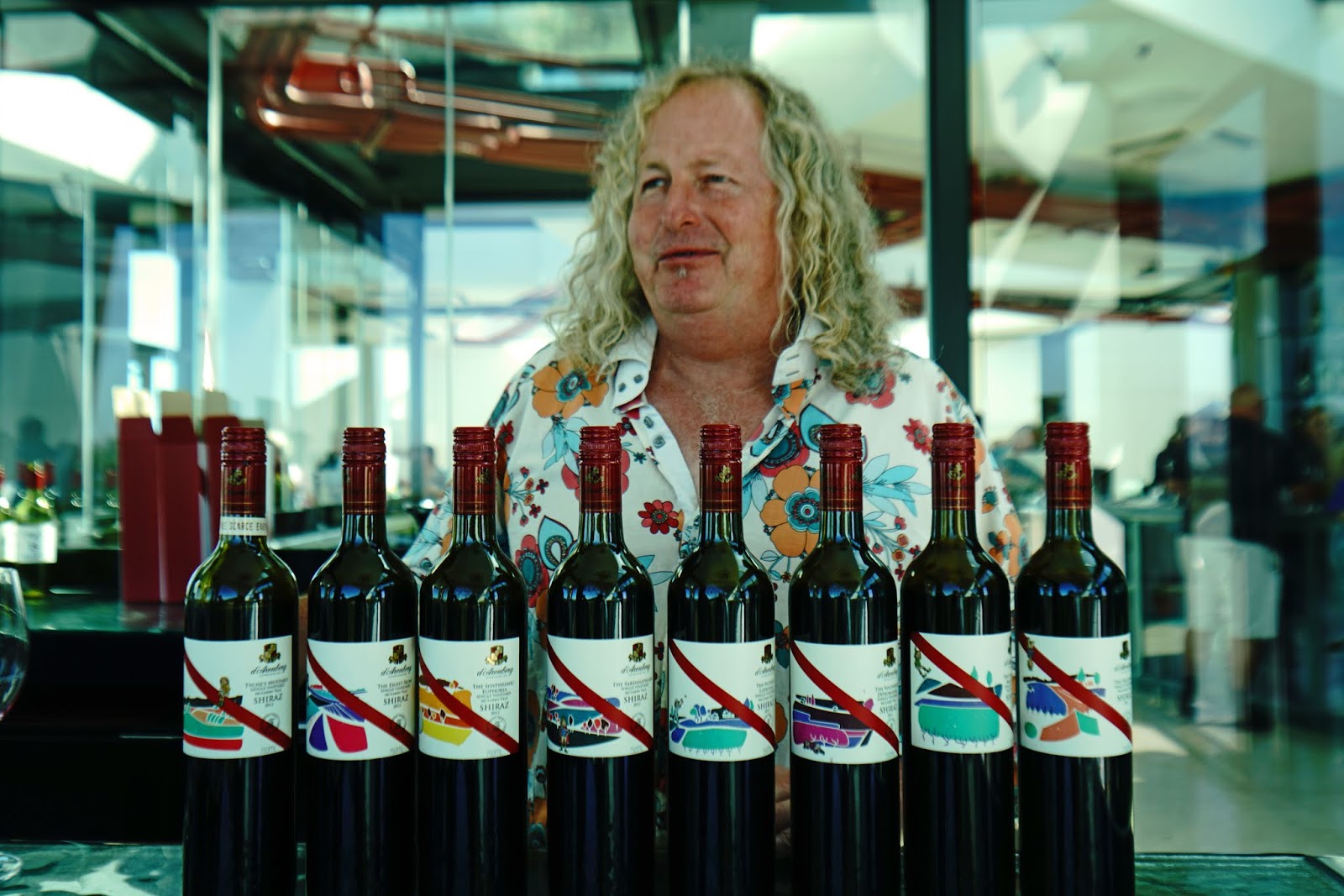
Chester Osborne is a man of wild phantasies. Some of these have been incorporated in the Cube, one of the most innovative wine tasting buildings I have encountered. It has certainly been the talk of McLaren Vale, if not Australia in the last couple of years. Fittingly, as I visited, it also housed a Salvador Dali sculpture exhibition.


At the same time, Chester Osborne is very serious about winemaking, and in particular terroir. As we share these interests, he organized a tasting of eight components of the Dead Arm, d'Arenberg's flagship wine. These components come from different vineyards, all relatively close to the winery, and identified as district 10 and 17 in the scarce earth program. 

The geology plays a major role in McLaren Vale, in contrast to say, the Barossa Valley, where soil is the dominant ground factor. This is because there are areas where the soil is quite shallow, and the geology varies in age significantly between districts.


Wild imagery does not stop at the Cube. The wines I tasted, which can be bought separately, have names such as Fruit Bat, The Swinging Malaysian, Dipsomaniac, The Sardanapalian etc. As these wines are quite rare, I will not review them separately. They were all from the 2012 vintage.

A common trait, and a d'Arenberg signature, is the firm and often coarse tannin structure. Apart from that, these wines were quite different from each other in flavour and texture. There were a number of influencing factors: age of the geology, soil, age of the wines (some 25, some 50 years old) and aspect. Some general observations

- Red brown earth produced a bigger mouthfeel and blocky tannins as opposed to limestone
- The 50 year old vines expressed more spice and earthy flavours
- Sand on sandstone delivered silkier, more elegant wines with a long finish

These differences were as expected, which is a good thing.

My favorite was the 2012 Sardanapalian, from a vineyard on 56 million year old sandstone (this is old) and sandy soils. The vines were only 25 years old. It had interesting savoury flavours, some mint and rhubarb. This is an elegant wine with a silky and long finish.

I would rate all the wines tasted in the 91-94 point range.

The one finished wine I tasted was the 2016 The Ironstone Pressing, d'Arenberg's leading GSM. It has quite a strong raspberry flavour, but is not overwhelmingly sweet. The firm, but fine tannins lead to a long finish (94 points).

Friday, December 14, 2018

Penfolds 2018 Release Tasting

Penfolds is known as a red wine company in the wider world. However, it has chipped away at becoming a major force in quality white wine for over 20 years, since the release of the first Yattarna Chardonnay.

Yesterday, I just tasted four wines of the recent spring release.

First was the 2018 Bin 51 Riesling. This is a 100% Eden Valley wine, and I expected a floral bouquet. However, this wine is about lime, lime, and lime. The wine is very dry, with good linearity and balanced acidity. The minerality on the back palate reminded me more of Clare than Eden Valley. This is a very fresh, modern Riesling (92 points).

The 2017 Bin 311 Chardonnay has three main fruit sources; Coal River, Tasmania, Adelaide Hills, and Tumbarumba. The main flavours are citrus and rock melon, but there is also a green tinge on the palate. The wine is dry and quite acidic, yet balanced (90 points).

Of the four wines, the 2016 Bin 138 GSM was the least impressive. It is actually a bit of a misnomer, as 72% of the wine is Shiraz. The wine is quite fruity, well supplemented by used French oak. The finish is a bit harsh. I would call it a barbecue wine, but in fairness, the ambition does not go beyond that (89 points).

This was a good year for the 2016 Bin 389 Cabernet/Shiraz. This brand will never lose the image of 'baby Grange', but the reasons are different from what is generally believed. Most people think the name stems from the fact that the wine is matured in one year old American oak, previously used by Grange. However, the main reason is that the grapes for Bin 389 come from a Grange and Bin 707 selection, but which ultimately don't make it into the flagship wines. Those grapes can't go into RWT (French oak) or Bin 169 (Coonawarra only). The 2016 Bin 389 is a dark coloured, big, full-bodied wine. The wine hits you like a brick on the palate with blackberry and black currant flavours. The fruit is very concentrated and the flavours are long. The firm tannins need some time to soften (94 points).


Sunday, November 11, 2018

Henschke New Releases

The famous Henschke winery is now a pretty substantial winery with 36 (!) different wines. They have four major vineyards: Hill of Grace, Mount Edelstone, and the Eden Valley vineyard, all in the Eden Valley, and the Lenswood vineyard in the Adelaide Hills. A couple of days ago, I tasted a number of the new releases. Following are some general impressions.

The white wines were all from the Eden Valley vineyard. They were from 2017 the Peggy's Hill Riesling, the Julius Riesling and the Percival's Mill Gruner Veltliner. Then there was the museum's release 2005 Julius Riesling. I found these wines quite Germanic in style. They deliver a broader mouthfeel than, say, Rieslings from the Clare Valley. Lime and floral flavours dominate the Rieslings, with the Julius more intense in style. The 2005 had expected toasted characters on the palate. I did not find the Gruner Veltliner true to varietal character, maybe a work in progress.

Of the medium priced reds, I enjoyed the 2016 Stone Jar Tempranillo. It attacks with very fresh red cherry fruit. This is a vibrant wine, very crisp and balanced. The 2015 Johann's Garden GMS is 70% Grenache, and the raspberry fruit shines through. There is spice as well in this easy drinking wine. The workhorse, the 2014 Keyneton Euphonium was a surprise. This is a blend of Shiraz, Cabernet Sauvignon, Merlot and Cabernet Franc. The Cabernet Franc is a minor component, but it dominated the palate with its spicy and forest fruit character.

Then came three premium priced Shirazes. They were a real revelation. The first two were from the excellent 2015 vintage. The Wheelwright Shiraz from the cool Eden Valley vineyard is a new wine, but the vines are actually 50 years old. And what a wine this is. Elegant and super delicious with bright and pure fruits of the whole spectrum (red, blue and black). The tannins are silky. This wine moves seamlessly along the palate. The spices are sweet rather than sharp, and the finish is long. The Tappa Pass is from three vineyards across the ridge near Light Pass in the Barossa Valley. The fruit is darker and more concentrated and ripe, but the wine is not heavy. Dried fruit and wood mellow the character of this very drinkable and smooth wine.

The 2013 Mount Edelstone is from a very dry vintage and was released later than usual, in fact after the 2014. This is an intense, quite dense wine, showing off the typical character of this wine: dark plum, blackberry, olive, aniseed, mocca and pepper. It is immediately recognizable, and despite the concentration and strong tannins is well balanced and not overwhelming.

Overall, the red Henschke wines have evolved over the last decade from intense wines to wines with beautiful purity of fruit, elegant and still retaining the expected power.     

Saturday, November 25, 2017

Powell & Son Red Wines

It was always clear that David Powell would not disappear from the scene after he lost control of Torbreck. While the 2014 wines of his new venture with his son Callum were a bit uneven, I am pleased to be able to report that the 2015 and 2016 red wines are very strong indeed. This tasting came just after the release of the Wine Spectator Top 100 for the year, where his US entry wine was one of five Australian wines or so to feature.


The 2015 Powell & Son Grenache Blend is very similar to Torbreck's Steading, which was always Powell's favorite wine. Grenache dominates in this GSM. Raspberry, strawberry and cherry fruit engulf the palate with fresh flavours. The components are seemless, and the wine finishes with soft tannins (93 points).

The 2016 Mataro 'Kleinig' for me was the highlight of the tasting. This is because this wine has a very distinct personality. Again, there is a Torbreck analog, the Pict. Fruit is not the key to this wine. This wine is rustic, spicy, meaty and with great weight on the palate. The image I had was to sit on an old, rusty truck driving over a potholed dirt road (95 points).

The 2016 Shiraz 'Loechel' consists of the Eden Valley component of the Torbreck Struie. The vineyard is near the Eden Valley township. From a more balanced vintage than the warm 2015, this wine is fresh and lively. There is the typical Eden Valley spice and the mouthfeel is very satisfying (95 points).

The 2015 Shiraz 'Steinert' comes from an Eden Valley vineyard at Flaxman's Valley, at an altitude of 480m. David Powell believes this to be an amazing wine, and it is certainly priced that way. There is blackberry and blueberry on the palate. The flavour is weighty and juicy. I find the wine a bit big and fat, but it has a lot of depth. Alcohol is noticeable on the finish (92 points).

Overall, the wines are seductive and quite delicious. David Powell is back.

PS: Callum has just had his last exam in Oenology. Let's see what influence he will have in the future.   

Monday, August 21, 2017

Vieux Télégraphe Piedlong

As I am waiting for the apparently amazing 2015 Rhône wines, I thought I might wet my appetite with a wine from one of my favorite producers, Vieux Télégraphe. The 2012 vintage was generally not great in France, with the exception of the Rhône. Therefore I was looking forward to the 2012 Vieux Télégraphe Piedlong.


Daniel Brunier, the half owner and winemaker, is a serious and intelligent man. He is modest and not interested in wine fashion trends. His objective is to make authentic wines speaking of the soil the grapes are grown on (I know this sounds like a platitude these days, but it is true in his case.)

The Piedlong comes from the heart of Chateauneuf-du-Pape, just north of the village, from a vineyard with heavy clay and many rocks or pebbles. This wine is full-bodied, with raspberry and blackberry flavours. It is basically dark fruited. Despite the Grenache dominance,  it is a savoury wine showing a lot of minerality and some leanness. The wine is fresh and elegant and has good length.

I liked this wine a lot.

Score: 92/+++