Showing posts with label Cabernet Blend. Show all posts

Monday, April 14, 2025

Cabernet's from Margaret River and Hawke's Bay


It was difficult to come to generalized conclusions in a recent comparison tasting of Cabernet's from Margaret River and Hawke's Bay. The wines varied wildly in age, grape composition, and screw cap vs. cork also made a difference.

The two Gimblett Gravels wines from Hawke's Bay, the 2021 Tom by Church Road, and the 2013 Sophia by Craggy Range, were full-bodied, with the Sophia quite rich and dense, whereas the 2021 Tom was more red fruited with a silky finish. New oak was significant in both wines.

In contrast, the Te Mata Coleraine comes from vineyards near Havelock North, with a different soil profile. This shows in the wine, which is a bit lighter, savoury, and higher levels of acidity. 

The Margaret River wines were very different from each other. The 2014 Woodlands 'Matthew' is quite open and fruit oriented, the 2008 Howard Park 'Abercrombie' was surprisingly sweet and ripe, whereas the 2005 Diana Madeline from Cullen impressed with its complex palate of various fruits, licorice, dark chocolate and earthy notes.

I could not draw any generalizations from this comparison, maybe other than 'when wines come from similar climates, it is down to the winemaker'.

Thursday, April 10, 2025

Woodlands 'Margaret' Cabernet Blend

 The 'Margaret' Cabernet Blend comes from the estate block where these vines were planted in 1990. A couple of days ago I tasted the 2019 Woodlands 'Margaret' Cabernet Blend. This wine is always around 80% Cabernet Sauvignon, and so it is in 2019. The rest is Merlot and Cabernet Franc.


The red and blackcurrant fruit is very smooth. It is not overly concentrated, but with enough intensity, leading to an elegant mouthfeel. There is a savoury character to this wine as well, almost like a forest floor Pinot Noir character. The tannins are smooth, and the wine surprises with a long finish.

Score: 94/+++


Monday, January 20, 2025

Yarra Yering No1 Cabernet Blend

 I am digging into a number of wines from the 2018 vintage. It is regarded as a very good one with a hot summer early on, but then an Indian summer towards vintage. Today's tasting is of the 2018 Yarra Yering No1 Cabernet Blend. Cabernet Sauvignon, the leading variety in this wine, has always been the flagship of Yarra Yering. How is this vintage shaping up?


I am blown over by my first taste. This is a big wine. Redcurrant and ripe raspberry flavours deliver a big fruit profile. Different in flavour, but similar in fruit weight to the Cirillo I reviewed just before. Despite the fruit concentration, the wine has good energy, and is balanced with fine grained tannins. The savoury characters need to come through to deliver complexity. This is another example where the screw cap slows down development (as I see particularly in Felton Road and Tyrells wines).

This wine has the potential to be great, but if you have it, do not drink before 2028.

Score: 95/++


Saturday, December 21, 2024

TOP NSW Wines

 Wines from New South Wales do not have a great reputation. I do not know if it is the arrogance of Sydneysiders, or what is causing it, but a recent tasting of premium NSW wines demonstrated they can mix it with the best. I will comment briefly on five wines in this tasting.


The first two wines are from Orange, a cool climate region, which produces increasingly exciting wines. The 2022 Canobolas Chardonnay is citrus and floral flavoured. It is a very elegant wine. It does not undergo malolactic fermentation, and is matured in oak. The vineyard slopes down the mountain of Mt. Canobolas, and this translates into an energetic wine with a mineral finish. This wine is absolutely first class (94 points).

The 2023 ChaLou 'Quixotic' Reserve Pinot Noir is equally impressive. This is the first Reserve Pinot Noir from this producer. The wine is obviously very young at this point and quite restraint. The grapes are grown on volcanic soil. They deliver an appealing blend of black cherry and mulberry fruit and some savoury characteristics. The finish is caressing and long (94 points).

Then came the known big guns. The 2019 Tyrrells Old Patch Shiraz was most impressive. It comes from the oldest vineyard in NSW, planted in 1867. This is a medium bodied wine with great purity of  red fruits. The wine has a velvety texture and a piercing drive. The wine is elegant and powerful at the same time. The excellent balance between fruit, acidity, and tannins points to a long future (97 points).

Tasting the 2009 Clonakilla Shiraz/Viognier straight after, was a tough assignment. This is quite a different wine - softer and fruitier, with a bigger mouthfeel, and some five spice. It was quite harmonious at 15 years of age (95 points).

The 2000 Lake's Folly Cabernet Blend from Magnum was equally fresh, after 24 years. What an achievement! The vineyard is on a unique plot in the Hunter Valley, red clay over limestone. The wine is red fruited with a characteristic earthy flavour. The beautifully structured palate delivers great concentration of fruit and a long finish (97 points).     


Sunday, October 13, 2024

Langton's Classification Tasting, Part 2

                                                            There was a lot of space

There were big surprises for me in the main red categories of Shiraz and Cabernet Sauvignon.

Of the 14 Shiraz wines I tasted, the 2018 Henschke Hill of Grace narrowly won out. It is a very elegant and silky wine, which goes on and on. But the next two wines in the top category were the big surprises. I have not tasted these for probably 10 years. This will now change. The 2019 Castagna Genesis Syrah from Beechworth is incredibly aromatic, with a medium body. Violets, spices, a little musk, all beautifully integrated with smooth tannins. And then there was the 2022 Brokenwood Graveyard Shiraz. This wine is fresh, balanced, and super smooth. The finish is very long. When I tasted this brand many years ago, I found it sometimes a bit heavy and worked. None of that in this wine.

In the next category I have the Rockford Basket Press, which was similar on the palate to the Brokenwood, just a bit sweeter. Then there is the 2020 Sami-Odi Hoffmann Dallwitz Shiraz from one of the most famous and very hot vineyards in the Barossa. This is a dark, big and slightly sweet wine, yet well made and balanced. The blackberry fruit stands out. And finally the 2018 Henschke Mt. Edelstone, also a very dark wine, complex, with mocca notes and some sweetness. These three wines a good examples of Barossa Shiraz, big wines, but well made.

Very different wines appear at the next level. There is the highly regarded 2018 Penfolds Grange. This wine is massive in its fruit weight. At this point, it is quite oaky and sweet. I can only judge what I taste now, but it is likely that in 10 years time different elements of this wine will come together better. It is the first time I tasted the 2023 Serrat Shiraz/Viognier from the Yarra Valley. I enjoyed the aromatics and the quality of the fruit, and found the wine slightly more appealing than the Yarra Yering Dry Red No.2 Shiraz. I also rated Sami-Odi's Little Wine #12 in this category. It is a blend of vintages from 2015 to 2022.

In the final category are the disappointments. Chris Ringland is known for making extra ripe, high alcohol wines. The 2016 Chris Ringland Dry Grown Shiraz, the current release, is no exception. The wine tastes like port and a wine from a bygone era. The other two Shiraz which disappointed me, surprisingly, were cool climate wines from Victoria. The 2019 Craiglee Shiraz was sweet and oaky, and lacked structure. I also expected much much from the 2021 Mount Langi Ghiran Shiraz. It is a big and alcoholic wine.

Now to the 12 Cabernets I tasted. Two aspects turn me off with Cabernet; when the capsicum flavours and other herbal flavours are too strong, and when there is a hole mid-palate. Overall, the category was not as strong as Shiraz.

The 2021 Moss Wood Cabernet Sauvignon stood out among this group. This is a wine with depth of fruit, very rounded, but not overripe, a lot of complexity and balance. Outstanding!

In the second group are a number of wines from different regions and with very different characteristics. The 2018 Wynns John Riddoch shows beautiful terra rossa red fruit, and is balanced with chalky tannins. It will live a long time. The 2021 Yarra Yering Dry Red No.1 Cabernet delivers a full, satisfying mouthfeel. It is well balanced and quite long. The 2023 Lake's Folly Cabernet is very young, but promising, with good fruit and an excellent structure.  The 2020 Cape Mentelle Cabernet Sauvignon has a similar profile to the Moss Wood, not surprising given its proximity. The intensity is just one notch down. The last wine in this group is the 2018 Henschke Cyril Henschke Cabernet Sauvignon. This wine surprised by being quite light on its feet, with excellent balance and oak treatment.

The third group includes two wines which are better judged 10 years from now. The 2022 Mount Mary Quintet is simply not very distinctive right now. It is long in the mouth. A recent vertical tasting showed that this wine takes time to come into its own. The 2022 Penfolds Bin 707 Cabernet Sauvignon delivers the darkest black colour of any wine I have ever seen! It is very dense and complex, with blackcurrant and mocca flavours standing out. Then there is the Deep Woods Reserve Cabernet Sauvignon. It has a bit of a hole mid-palate, and I could not rate it as highly as the Cape Mentelle. 

 In the group of disappointments I found the Yeringberg Cabernet Blend. I normally rate this estate highly, but this wine is surprisingly tannic, and the fruit does not stand up to it. Leeuwin's long march to create a Cabernet Sauvignon of equal standing to the Chardonnay is still an ongoing objective, I suggest. The 2021 Leeuwin Art Series Cabernet Sauvignon has a strong capsicum flavour, and yet the alcohol is noticeable - not a nice combination. Finally, the 2021 Balnaves The Tally Cabernet Sauvignon sufferrs a similar fate - quite green and capsicum laden.

This is a long post. The descriptions are brief, I had a lot of ground to cover. Hopefully the notes are still valuable for you.

Saturday, September 14, 2024

Mount Mary Quintet Vertical

 Vertical tastings, not easy to come by, are great opportunities to identify a producer's style, while also appreciating vintage variations. I was lucky to recently participate in a vertical tasting of Mount Mary Quintet from this iconic producer of the Yarra Valley. The Quintet has never been a top pick for me. This tasting has told me why. These wines only come into their own once they are at least 10 years old - and I never had the patience. This tasting spans vintages from 2017 to 2002.


The youngest wine, the Quintet 2017, was the least impressive. The wine is red fruited, with red cherry and raspberry flavours. The fruit has great purity and is enriched by mocca flavours. I notice a whole in the mid-palate, typical for Cabernet Sauvignon, even though the Quintet includes Malbec, Merlot, Cabernet Franc and Petit Verdot. Hard to know if the wine will integrate as well as the older ones on tasting, but judging the wine as it is, I give it 93 points.

The Quintet 2013 impresses with quite a purple colour. The wine is very aromatic on the nose. In the mouth, it feels a little leaner. This is supported by some blue fruit flavours, which add to the raspberry, plum, and mocca character. In this wine, the different grape varieties are well integrated, and the mouthfeel is seamless (95 points). 

The Quintet 2012 is very different. This is quite a big and fruity wine; concentrated, yet very balanced. There is cassis and graphite on the palate and some muskiness. This is complex, with a long finish (97 points).

When we come to the Quintet 2005, we notice a difference due to age. This is now a wine on the plateau of development. It is very settled, a bit more linear than the bigger mouthfeel of the 2012. This wine is dark fruited and very elegant. It offers less generosity than the 2012, but a long and silky finish (95 points).

The Quintet 2002, from a cooler year, is still very much alive. The colour is still dark and intense, not at all flaky. This wine could be taken for a 1st or 2nd growth Bordeaux. Layers of red and black fruits are very smooth on the palate; chocolate and hints of muskiness. I detect some bret, but at this level it is not distracting. This is a beautiful aged Yarra Valley Cabernet (96 points). 

What are the key takeaways? As already mentioned, this wine should be drunk at 10 years plus. Also, as others have suggested, high quality aged Cabernet tends to end up in a similar spot (of taste).


Monday, October 9, 2023

Bordeaux Style Blends New Zealand

 The last post in the series of premium wines from New Zealand looks at quite an eclectic group of Bordeaux style blends from the North Island.


Three wines stood out from this line-up. My favourite wine was the 2019 Church Road TOM from Hawke's Bay, the predominant region of Bordeaux style wines in New Zealand. This Cabernet Merlot delivers red cherry and blackberry fruit flavours against a background of smoky notes. This is an elegant wine with soft tannins and a long finish. It is the most expensive of the wines reviewed here (96/+++ points).

Not far behind is the 2020 Man O' War Ironclad Merlot blend. This winery from Waiheke Island is going from strength to strength. It has a similar fruit profile to the previous wine. The wine is quite big and intense, while still elegant. It delivers attractive lifted notes on the finish (95/+++ points).

I also enjoyed the 2018 Paritua 21.12 from Hawke's Bay. This is a Cabernet blend with a similar tasting profile to the Church Road. The wine has medium concentration, and is elegant with silky tannins and a satisfying finish (95/+++ points).

The 2019 Te Motu Cabernet blend is fresh, with redcurrant flavours, a bit confected. This is a relatively straight forward, smooth wine (92/+ points).

Also from Waiheke Island is the 2017 Tantalus Ecluse Reserve, another Cabernet blend. This wine has medium concentration. It is a harmonious wine, but a bit bland (92/+ points).

Overall, Bordeaux style wines have come a long way in New Zealand. The blends are sophisticated, seamless, and elegant. They should certainly be considered as alternatives to Pinot Noir.


Monday, September 18, 2023

Woodlands Tasting

 Woodlands brands can be very confusing, but there is actually quite a simple logic. The original vineyard, now 50 years old, is the Woodlands vineyard or Caves Rd. vineyard. It is the source of the 'Margaret' and the single vineyard Cabernet blend. The second vineyard is the Woodlands Brook or Puzey Rd. vineyard, some 2km away, purchased in 2007. This is the source of Cabernet Franc and younger Cabernet Sauvignon.

All wines are named after family members, the confusing bit is that the single vineyard Cabernet Sauvignon has a different name every year. Will they ever run out of names?

The Home Block

The 2021 'Emily' is Cabernet Franc based. The vineyard is south facing, based on fine clay. As a result, this wine is light- to medium-bodied and very pretty. Black cherry is the dominant flavour of this elegant, slightly spiced wine. It is very well made, very charming, and I liked it a lot (93/+++ points). The 2018 Clementine, from the same vineyard is a Cabernet/Merlot. It is darker, still only medium-bodied. The tannins are firmer, but there is a bit of a hole on the mid palate, despite the Merlot component (92/++ points).

The Caves Rd. vineyard is north facing. The wines from here, including the core 'Margaret' are more concentrated. The 2018 'Margaret' is a Cabernet/Merlot matured in 40% new oak. It is noticeably more intense than the previous wine, but still quite elegant (93/++ points).

I tasted three single vineyard Cabernet blends (usually 90+% Cabernet Sauvignon) from three different years. The 2017 'Chloe Anne' is matured in 80% new oak barriques. This wine had a long ripening period. Blackcurrant and mulberry fruit sits on the frame of high quality French oak. Like all previous wines, this wine is elegant, but also quite substantial (95/++ points). The 2018 'Xavier' is a darker wine, yet more fruit forward. It has been aged in larger format oak. It has good depth and a satisfying finish. While different, it is equally appealing to the 2017 (95/++ points). The 2019 'Ruby Jane' has a similar flavour profile, and an elegant mouthfeel, but not the same intensity as the other two wines (93/++ points).  


Friday, June 2, 2023

Two Iconic French Reds

 In the tasting of iconic wines, two French reds impressed: from Côte-Rôtie, the 2016 François Villard Le Gallet Blanc, and from Bordeaux the 2002 Lafite-Rothschild.


One Shiraz, one Cabernet blend, but two complete wines, and with increasing age moving towards each other.

The name Gallet Blanc has nothing to do with white wine, but is named after the two original vineyard suppliers, Gallet and Blanc. The grapes come from the Côte-Brune, which normally produces quite masculine wines, but in 2016, a cooler year, everything is very balanced on a fruit profile of raspberry and red cherry. Graphite adds to complexity of this supple, very elegant wine with a long finish (96 points).

The 2002 Lafite is also a very balanced wine, at peace with itself. Red- and blackcurrant flavours are still intense, and the wine still has great drive. Black olive and graphite flavours are here as well. The mouthfeel is elegant and silky, and the flavours go on and on; still a lot of life in this wine (96 points).    


Monday, May 29, 2023

Henschke DNA (Must Read!)

 There has been a lot of talk about the DNA of Penfolds, comprising multi-regional sourcing, the use of small American oak barrels, fermentation straight into barrels. Little is said about the DNA of Henschke, maybe because the focus is on individual vineyards. Yet, at a recent tasting of iconic Australian and French wines, three different Henschke wines were tasted, and they had something in common which the others did not. These wines were a 2012 Cyril Henschke, a 2012 Mt. Edelstone, and a 2006 Hill of Grace.


So what did these wines have in common? I thought mulberry, aniseed, licorice, and some black earth minerality. Another taster saw some deep greens, like kelp in these wines as well. So this is the Henschke DNA, as much a function of old vines as of the winemaking, I think.  

The 2012 Cyril Henschke, a Cabernet Sauvignon blend, tasted of blackberry, olive and some capsicum. The tannins had softened considerably, and the wine was in perfect harmony (96 points). 

The 2012 Mt. Edelstone was quite perfumed. Mulberry flavours lead to a sweeter and riper mouthfeel. This was a deeply layered wine (94 points).

The 2006 Hill of Grace was even more perfumed; a very polished wine with black cherry and aniseed flavours. Harmony and elegance made this wine stand out (97 points). 


Monday, August 8, 2022

Premium Cabernets Comparison

 This is a brief review of some Australian premium Cabernets.


The star of this comparison tasting was the highly acclaimed 2020 Cullen Diana Madeline. It is a Cabernet Sauvignon Merlot blend. This was the most elegant wine, red fruited, with some tannin bite at the same time, and a beautiful finish. This is a world class wine (97 points).

The one closest in style to it was the 2019 Grosset Gaia. It had a similar feel, but was a bit broader in the mouth, less detailed, again with firm tannins (94 points).

The other wine from Margaret River was quite different. It was the top of the range 2018 Vasse Felix Tom Cullity Cabernet Malbec. It showed darker fruit, with mulberry flavours. The Malbec influence is strong. This is a bigger wine, quite fruity (93 points).  

An impressive wine was the 2017 Hickinbotham Clarendon Trueman Cabernet Sauvignon. It comes from the Northern, hillier part of McLaren Vale. This is a smooth wine, ripe, but balanced, with a silky mouthfeel and a medium to long finish (95 points).

I was less impressed with the 2016 Yalumba Menzies Cabernet Sauvignon. The redcurrant flavours are big and ripe. Christmas pudding or mud cake deliver quite a fat mouthfeel (92 points). 

There was also a New Zealand wine, the Merlot dominant 2019 Craggy Range Gimblett Gravels Te Kahu. This is quite a soft wine, but it lacked sufficient mouthfeel (91 points).


Thursday, August 4, 2022

The Penfolds 2022 Collection

 I remarked in my last Penfolds post about the subtle changes in the wines, which boils down to increased accessibility at young age. The other major shift is the positioning as a global luxury brand: one day its handbags, but today it's the launch of the Penfolds 2022 Collection. 


This is done as an event, not a serious wine tasting.


Having said this, the comparison from entry level wines from three different continents was interesting and quite instructive. The 2019 FWT 585 from Bordeaux is a blend of Cabernet (53%), Merlot (34%), and Petit Verdot (13%). FWT stands for French winemaking trial, of course. 585 is more interesting. It is the amount of dollars claimed by Max Schubert on return from his trip to Bordeaux - sounds little, but it was the early 50s. The wine has been matured in French and American oak. How did they smuggle American oak to Bordeaux? Anyway, the wine is medium bodied and impresses with its structure. Thyme and lavender on the nose, redcurrant and cranberry on the palate. It is early days and will be interesting to drink in a few years (94 points).

This was teamed up with the 2020 Bin 28 Shiraz, Penfold's workhorse. This wine is dark and warm: think blackberry, chocolate, mud cake, plum pudding - dependable, but a bit tough from the 2020 drought year (92 points).

The entry level California wine, the 2018 Bin 600 Cabernet/Shiraz includes fruit from Napa Valley, Sonoma and Paso Robles. The blackcurrant fruit flavours are ripe, and the boysenberry points to Napa Cabernet. There is also considerable vanilla from the 40% new oak. A concern is the lack of acidity in this wine (90 points).

The exciting aspect of this tasting was the fact that the wines truly spoke of their country of origin.

One more comment on ratings. Critics rated these wines and others from the collection much higher. It needs to be understood that there is a close relationship between the 'famous' critics and Penfolds. Here you get a truly independent view. I hope to be able to assess the premium wines in a little while. 


Tuesday, May 31, 2022

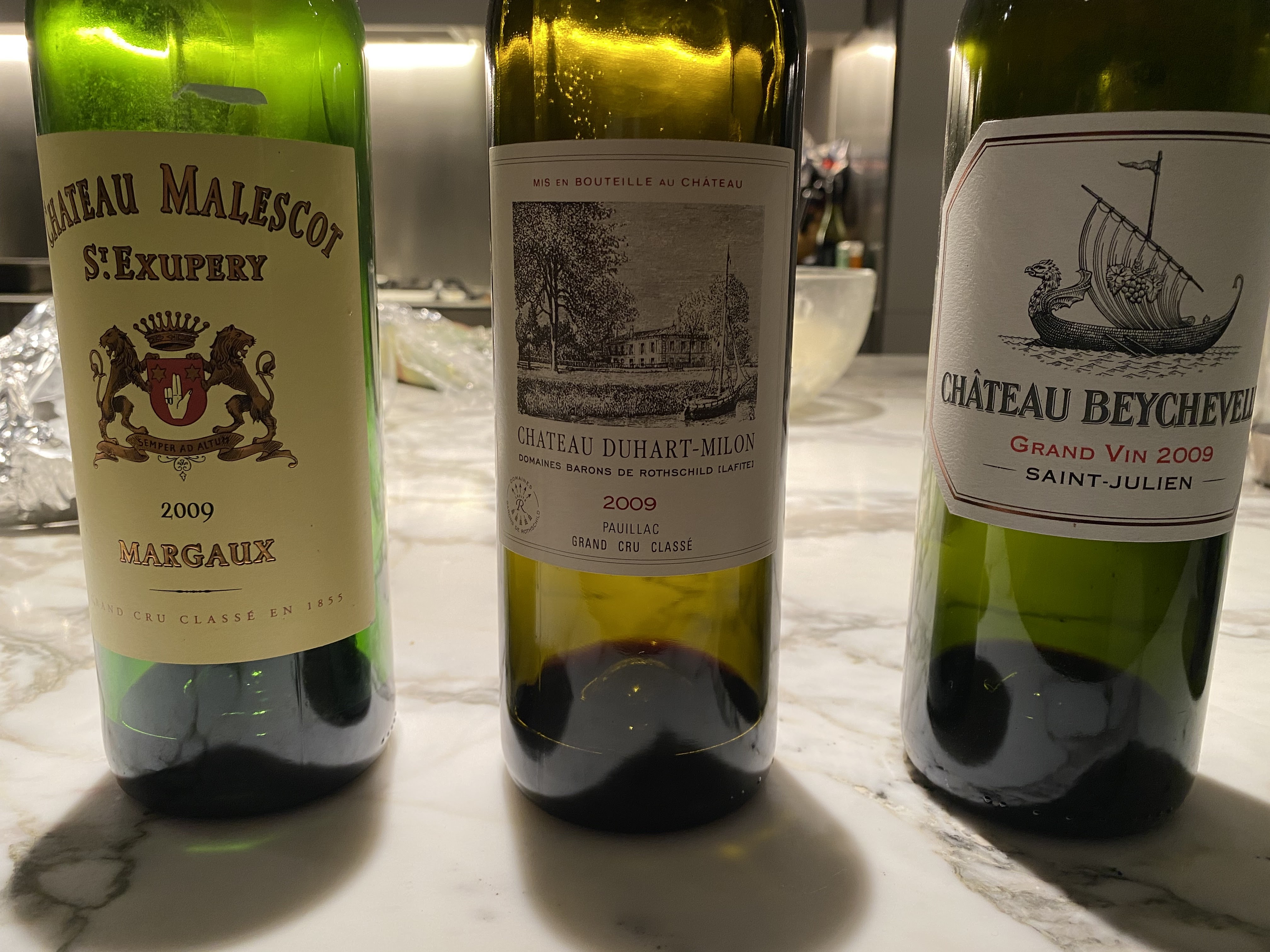
Three Wines From Bordeaux 2009

 Having had the pleasure of the mature Lynch-Bages, I wanted to explore how the 2009 vintage stacks up by tasting three wines from different left bank subregions.


The results were surprising to me. The favorite from these three wines was the 2009 Chateau Beychevelle from St. Julien. This is quite a dark fruited wine with cassis and plum flavours on the palate. Tobacco augments the long finish. This is a well balanced wine with lively acidity promising a long future. The highlight for me was the equal power and elegance of this wine (97 points). 

The 2009 Chateau Malescot St Exupery is a wine I have reviewed before. In this tasting, I found it quite muscular, somewhat surprising for the Margaux subregion. The blackcurrant, redcurrant and espresso flavours are quite concentrated. Still, this is an elegant wine with a satisfying mouthfeel and a long finish (95 points).

The 2009 Chateau Duhart-Milon Rothschild from Pauillac does not have the same intensity, but the blackberry and blueberry flavours deliver a silky texture. This is quite a smooth wine as you would expect from the Lafite stable (95 points).

Sub-regionality did not show up in expected ways. The Margaux was concentrated rather than perfumed, the Pauillac smooth rather than tannic. In Bordeaux, the winemaker wins over terroir, at least this time.

Overall, the 2009 vintage certainly delivered at this price point. The fruit flavours are intense, and the wines balanced. I reviewed more value based wines from this vintage before. There, the results were much more mixed.  


Friday, January 28, 2022

Chateau Lafite Rothschild

 Great producers do well in difficult vintages. An example is the 2003 Chateau Lafite Rothschild. It was a hot year,  and the risk was to make overripe wine. Enter this excellent drop.


This wine is velvety on the nose, very inviting. On the palate feminine flavours of loganberry and mulberry engulf the mouth. This wine is super smooth. It is delicate and fragrant. There is a significant vanilla/oak influence, but it does not detract from the fruit where black currants rule on the back palate. The finish is very long and balanced. This is a complete wine.

Score: 98/+++


Thursday, May 27, 2021

Mount Mary Quintet

The legendary Yarra Valley Cabernet Blend, how would it hold up against the Lafite-Rothschild, previously reviewed? A bit unfair, why? It is one of Australia's leading wines.


The 2004 Mount Mary Quintet shows the strengths and weaknesses of this label all in one. Firstly, the wine is still in good form, which is a relief, as it is under cork.

The wine is red fruited, very pretty and smooth. There are some earthy notes here as well. At first blush, it actually has similarities with the Lafite. But on the mid and back palate it starts to wear a little thin. The structure holds up to a decent finish, but the mouthfeel not as much. 

And this is the issue with Cabernet from the Yarra Valley. I am in the camp with those who say this region is Pinot Noir territory as far as red wine is concerned. Having said this, this Mount Mary Quintet does a pretty good job. 

Score: 94/++


Monday, May 24, 2021

Hawke's Bay Premium Tasting

 Hawke's Bay is the oldest NZ wine region, yet it is not nearly as prominent as Central Otago, Marlborough or Martinborough. A recent tasting of some of its best wines demonstrated that it deserves much better. The region is best known for Chardonnay, Syrah, and Cabernet blends. The wines tasted are shown in the picture below.


The top three wines, in my and the other tasters opinion, were the 2010 Craggy Range 'Le Sol', the sensational 2018 Tony Bish Zen Chardonnay, and the 2014 Craggy Range 'Sophia'

The Tony Bish Zen is unusual in that it is matured in a French oak egg, or Ovum. This gives quite a lot of oak exposure. Not surprisingly, therefore, is the golden colour and the fuller bodied flavour of this wine. There was depth in the yellow peach fruit, and complex nutty flavours added to the rich texture. At the same time, there was a lightness on the finish - intriguing (96 points).

Le Sol is arguably the most credentialed Syrah from New Zealand.This 2010 Le Sol showed very layered red and black fruit flavours and was more generous than the other very peppery Syrahs (see below). This is a very balanced wine with a sweet core, and overall quite a big mouthfeel (96 points).

I reported on the Sophia a few posts back, so no notes here.

I rated the next set of wines all 94 points. The 2017 Blanc Canvas 'Element' Syrah is properly named. The elements must have rattled the vines a lot. This is probably the most peppery wine I have ever tasted. The cracked black pepper was so strong, it overshadowed everything else. It is a medium weight wine with dark fruit and bacon flavours and quite a tannic finish. It gets this good rating for personality.

The 2016 Bilancia La Collina Syrah, with part fruit coming from the Gimblett Gravels, and part from south of Hastings, is also quite peppery. This is a more balanced and elegant wine, partly due to the 2% Viognier. The musky notes are interesting; the finish is long.

The second Craggy Range 'Le Sol' was from 2014. The colour was very inky. This wine was quite closed, may have entered a dormant phase. It had a slightly eucalypt character, with peppery flavours and licorice also present.

Finally, the 2019 Te Mata Coleraine. Cassis was dominant, and we felt the wine had a bit of a vegetal character. The highlight were the very fine and dusty tannins. This wine had outstanding reviews by a number of professional reviewers. At this tasting, it suffered a bit from being last and a bit rushed. It was also quite young by comparison. But 100 points? No, it is not a perfect wine.

The final two wines were the 2014 Te Mata Awatea, Coleraine's little brother. It is a lighter wine, with mint and peppery notes and a bit of a gap on the mid palate. It was quite enjoyable, but was put up against outstanding opposition (93 points).

The first wine was the 2019 Craggy Range Kidnappers Vineyard Chardonnay. It comes from a coastal site. The nose was quite floral, and we were in fact not sure if we were looking at a Chardonnay here (all wines were tasted blind). The wine was quite light on the palate, with an attractive texture - a flinty wine with melon flavours and saline notes (92 points).  


Friday, August 21, 2020

Identifying Cabernet Sauvignon Across The World

 In a recent tasting, a group of us compared premium Cabernet Sauvignon across France, Italy, Australia and the US. A common view is that old world and new world Cabernet is becoming more difficult to distinguish as warmer climate in Europe makes these wines more 'new world', while efforts to reduce ripeness in Australia and the US makes these wines more 'old world'. As we found out, the Cabernet world is more complicated than this and distinctions remain.


Starting with premium French Cabernet (Bordeaux), the most important issue is that one should not open a bottle less than 10 years old. This is the minimum time for its complexity to unfold and the new oak to integrate. So what is typical? Well, in comparison with the Italian Cabernets (we tasted four very good ones), it is the 'completeness' of the wine. Little expense is spared in the winemaking process. The tannin and oak management are excellent, and all this leads often to a house style. If you have been lucky enough to drink a number of vintages of Mouton and Lafite, you would never mix them up in a blind tasting although they are neighbours. 

In comparison with the 'new world', the main difference is the shape of the wine in the mouth and acidity. Acidity is higher in the French wines, and the wines tend to be more linear. The fruit weight has increased with warmer vintages, but the shape of the wine is still 'old world'.

I do not have great experience with Italian Cabernet, and the tasted wines (San Leonardo, Grattamacco, Ornellaia, Guado Al Tasso)  were quite different from each other. Yet they shared characteristics, too. Overall, they were less polished than the French wines, not always balanced, some showing green character and the famous hole on the mid-palate. They had character. As one participant mentioned: "The Italian wines show the vineyard, the French wines the winery." The Ornellaia is perhaps an outlier, being very elegant, and also very sweet, playing to the American palate. Similar to the French wines, acidity in Italian Cabernet tends to be pronounced and the wines long and linear rather than broad.

We tasted only one Napa Cabernet, but it showed the expected profile. These wines are sweet, ripe, and broad in the mouth, even for 'middle of the road' wines as this one was. The blockbuster wines show extremes on these characteristics plus high alcohol.

How does Australia fit in? The key give away is the subdued acidity in most Cabernet, leading to plush wines. They are not on steroids as Napa, but they tend to be more 'sun-kissed' than the European versions and riper.
 

Friday, April 17, 2020

Woodlands 'Margaret' Cabernet Blend


Woodlands 'Margaret' is a second tier wine if you like. The 2014 Woodlands 'Margaret' is a blend of 79% Cabernet Sauvignon, 13% Merlot, and 8% Malbec. The maturation took place for 18 months in French oak, 50% new.

On the nose, there are fragrant and redcurrant notes. Redcurrant is the dominant fruit on the palate. What stands out in this wine is the purity of fruit and its elegance. The wine is very balanced and seamless, oak only in support. The palate weight is only medium, but the flavours expand beautifully in the mouth with hints of dried herbs. Fine grained, but firm tannins round out the polished feel of this wine. It may not have the complexity of a Moss Wood or Diana Madeline, but it is a most enjoyable wine at less than half the price.

Score: 94/+++ 

Wednesday, December 6, 2017

Australia's Finest Cabernet

On the weekend, I organised a tasting to identify Australia’s finest Cabernet. This is, of course, a pretty impossible task. So I decided to pick producers who could be winners and select wines from different vintages, ranging from 2000 to 2014. Each participant had to rank the wines from 1to 9. The one with the lowest overall score would be the winner.

 A number of things emerged:

1) The quality of the wines was exceptionally high. As one participant mentioned: There was one clear favorite, every other wine was number two.

2) Five wines were screwcapped, four wines were under cork. The wines under cork did very well, but there was no systematic difference in the ripening profile between the closures.

3) The top 4 wines came from very different geographical regions,the Barossa Valley, Margaret River, the Yarra Valley and the Hunter.

4) The top wine, by quite a margin, was the 2004 Penfolds Block 42 Cabernet Sauvignon. This wine comes from the oldest known Cabernet Sauvignon vineyard in the world, part of Barossa’s Kalimna vineyard, planted around 1880. It is only made once a decade or so. The flavours are incredibly intense and go on and on, very similar to a great Grange, in fact (99 points).

5) Wines 2 to 4 were very close, with 2007 Cullen Diana Madeline at number two, followed by 2000 Mount Mary Quintet and 2014 Lake’s Folly Cabernet (96-97 points). The young upstart, 2011 Cloudburst Cabernet Sauvignon, was fifth. 

I would drink any of these wines happily any time a Cabernet is suitable. 

Tuesday, August 25, 2015

Mount Mary Quintet

It is quite interesting to drink another of the iconic Australian Cabernet blends not from Margaret River after the Lake's Folly. The difference here is age. I am drinking the 2000 Mount Mary Quintet. I have not had this wine before, but it was described as a wine of the (difficult) vintage.

This wine (under cork) is still amazingly vibrant, with beautiful pure red berry fruit coating the mouth. The acidity is quite noticeable, but not uncomfortable. Tannins are in the background. There are some forest floor flavours emerging, but the wine is still remarkably fresh. The wine is medium-bodied on a light frame and would appeal to all Pinot Noir drinkers. A wine of individuality and finesse with many years in front of it.

Score: 96/++