Showing posts with label Douro Valley. Show all posts

Sunday, July 2, 2023

Quinta Do Crasto


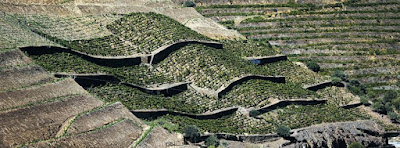
Visiting Quinta do Crasto, Portugal’s leading table wine producer IMHO, first requires a hair raising drive up the Douro mountains. But you are rewarded not only with amazing views, a look at its world famous Maria Teresa vineyard (above), but also a memorable tasting. The Maria Teresa vineyard, over 100 years old, is always voted as one of the world’s top 10 vineyards and the single vineyard wine certainly made the reputation of Crasto. When I visited 6-7 years ago, Manuel Lobo, the winemaker, described a project to identify the different grape varieties of this field blend. He estimated about 35. When I met him now, he mentioned they are up to 54 varieties - astonishing and pretty unique. The care for this vineyard is such that if vines die, and the variety is not known, they replant with the major varieties mix, in order to maintain the profile of this vineyard. It is an amazing story, but not the only one. Total production of table wines has grown dramatically to 1.8 million bottles. Let us taste some.
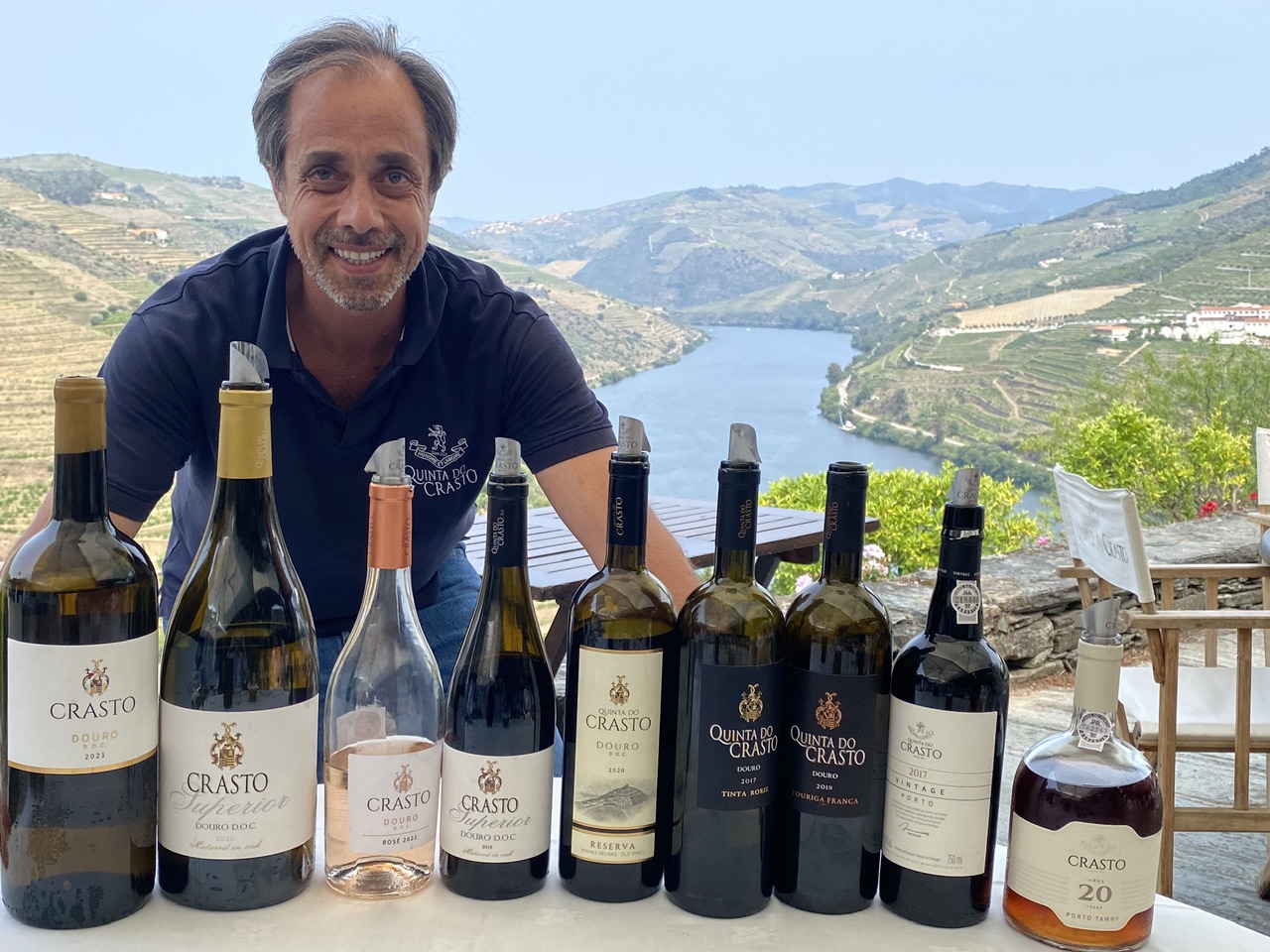
We start with two whites. The 2021 Douro is an entry level wine. It comes from grapes grown at 600m altitude on granite soils, and it sees no oak. The wine is fresh, with good line, citrus and melon flavours, refreshing acidity, good energy, and a saline and mineral finish. This is an entry level wine? (91 points).  The 2020 Superior White comes from a similar vineyard, but in contrast, has been matured for 8 months in barrique, 50% new of light toast. The other feature is the batonage, in a racking system of barrels, which allows each barrel to turn individually. It also avoids any oxygen contact. This wine is also fresh, and impresses with its fine texture (93 points).

Now to the reds, which is the winery's main focus. The 2019 Superior, from a good year, comes from the Upper Douro, not far from the Spanish border. The main varieties in this blend are Touriga Nacional, Touriga Franca, Tinta Roriz, and Souzao. The wine is matured in oak for 12 months, 35% new. Red plum is the main flavour. The wine has firm tannins and will require a bit more time to fully settle (90 points). The 2020 Reserva has an incredibly black colour. It comes from old 50-100 year old vineyards, 42 blocks in total. Each individual block is a field blend - amazing. The wine is matured in 60% new oak, but the oak is not obvious. The wine is concentrated and powerful, but elegant as well, with a long lasting mouthfeel (95 points).

The final two reds in this tasting are single variety wines, which is not often found in the Douro. The 2018 Touriga Franca comes from 40 year old vines, and is matured in 85% new oak. Despite this, it is a lighter wine, but with some bite. It is fresh, red fruited, and with some spice (93 points). The 2017 Tinta Roriz (Tempranillo in Spain) is also matured for 18 months in 85% new oak. It has a darker colour and is a bigger wine. The palate is quite complex with red and black fruits, dark mocca, and olive flavours (95 points). 

Overall, this tasting has been impressive. Manuel Lobo has been the winemaker for 18 years now. He has assembled an incredible portfolio of vineyard sources. The oak treatment is smart, and all the wines are of a high standard.

Friday, June 30, 2023

Niepoort

 Niepoort, a family business in its 6th generation, is an important winery in Portugal. When I visited here 6-7 years ago, I was impressed with the white wines. In a country which started from Port, then moved to serious red table wines, this was different. Dirk Niepoort, the 5th generation winemaker, has influenced many younger winemakers in Portugal. It all stemmed from his broad-based experience in wine. I am showing here one of his three wine cellars.


Since my first visit the range has expanded enormously, and I was looking forward to tasting some exciting wines from the six regions Niepoort operates in. The main winery is based in Douro, but the philosophy is almost an antithesis of typical Douro wines: Niepoort wines are fresh and low alcohol. What was unfortunate was that I got caught up in the increasing wine tourism trend: I was offered more entry level wines.


The Agua Viva Champagne, made in the traditional method, was quite agreeable. Quite fresh, but some toast on the back palate, and plenty of mousse. 

The 2021 Dialogois a field blend from a number of Douro vineyards, is fermented in stainless steel. This is a very light wine, with citrus and green apple flavours, and vivid acidity at 11% alcohol - an easy drinking, quite simple, but well made wine (86 points). The 2021 Redoma is sourced similarly, but from 60 year old vines. The wine is matured in French barriques for six months, 10% new. This has added some toastiness and complexity to the more intense fruit. Alcohol is 11% again (91 points).

The first red is the 2020 Lagar de Baixo. It comes from the Bairrada region, near the ocean, and is made from the Bara grape. This variety is lighter in character than the typical Douro grapes. The wine has been aged in Foudre for 18 months. The wine is quite transparent, the fruit not intense - an open, easy drinking and approachable style (88 points). The 2020 Batuta was the best wine in the line-up. It comes from two vineyards in the Douro, one high up, one near the river, to blend intensity and freshness. The wine is a blend of eight or nine varieties (who knows?). It is fermented in steel, and after a staggering 80 days of maceration moved to oak barrels for 22 months. Despite this, the wine is fresh and elegant, and the blue fruit flavours attractive (93 points).

I would have liked to taste more of the Niepoort range. Alas, it was not to be.


Wednesday, June 28, 2023

Wine & Soul

 My final stop in Europe is the Douro Valley. I have very fond memories of this region from a visit 6-7 years ago. This time, I will only visit the four wineries which impressed me most at the time. Today, the first stop is at Wine & Soul. This was a very small, high quality operation at the time. It is still a family business, but it has gone from strength to strength and produces 120,000 bottles per annum now.


The passion of the winemaking couple is old vines. The original vineyard, owned for a bit over 20 years now, is called Pintas, and their field blend from 95 year old wines made the business famous. Then it had the chance to acquire an even older vineyard, with vines 135 years old, some eight years ago, I think.

The first wines of the tasting were from much younger fruit, of course. The 2022 Manoella White is a blend of three varieties, with Rabigato being the major one. This is a crisp wine, a little fruity, with citrus and stone fruit flavours. There is some complexity in this summer wine, but the finish is a little short (90 points). The Manoella Rosé is based on the national grape, Touriga Nacional. The colour is very pale, it is fashioned along Provencal Rosé. I found the wine quite tight, and lacking in flavour (87 points).

Then came two mid level wines. The 2021 Manoella Red is based on four varieties, with Touriga Nacional and Touriga Franca being the major components. The vines for this wine are young, and it shows. The wine is quite fruity and a bit blocky (88 points). The 2021 Pintas Character Red is a big step up. This is a field blend from the famous vineyard, I suppose declassified from the flagship. The wine is matured in old barrels for 18 months. The wine is blue and black fruited, with more depth and more elegance. The wine has good length, but is a bit rough and angular on the finish (92 points).

The 2020 Manoella VV (vielle vignes) is a terrific wine. Only 3000 bottles are made from the oldest vines of this vineyard, including over 30 varieties. The soil of this vineyard, mainly clay based, is quite fertile, and this is reflected in the glass. This wine, red fruited, is super elegant and feminine, with silky tannins, and a fine grained, long finish (96 points).

The 2020 Pintas from a vineyard only a few hundred meters away, is quite a contrast. The soil of this vineyard is quite poor and rocky. The vines struggle more. Again, this is a field blend from over 30 varieties, from vines 95 years old. The wine has been matured in barrique for 18 months, 15% new. This is a firmer, more masculine wine, red and black fruited. The tannins are strong, and the finish is long. This wine will need more time to completely integrate, but the structure of this wine promises a long life (95 points). 

Sunday, February 26, 2023

Portuguese White Wine

 Portuguese white wine is not something you come across every day. Recently I had the opportunity to taste five high quality Portuguese white wines. They showed interesting personalities, quite different from anything you would taste from France, Italy, Germany, the US, or Australia. All these wines are blends of a number of indigenous varieties. The winemakers claim this is not important. It is about the site.


The first wine was a 2019 Antonio Madeira A Liberdade from Dão. This is a blend of 23 varieties, wines come from two vineyards 25 and 80 years old. This wine has a darker, almost golden colour. In the mouth, the wine is quite thick with yellow peach on the front palate, but merging into lemon curd and a saline finish. The structure is more rounded than linear and the acidity not high (92 points).

The second wine was the 2019 Luis Seabra Xista Ilimitado from Douro. Louis Seabra studied under Dirk Niepoort, the most influential white wine maker in Portugal. This wine had a lighter colour, probably reflecting higher altitude vineyards. and more of a citrus flavour, and also stone fruit. There is Asian Five Spice and good energy in this wine (92 points).


The third wine was different again. The 2018 Vinho Imperfeitos D&V Code from Dão and Vinho Verde is made at tiny volumes and is a bit of a cult wine. The wine has good drive on the back of citrus flavours. This is quite a gentle wine. There are almond flavours on the palate. The acidity is medium. This wine is perhaps the most sophisticated of the line-up, but the price is hard to justify (93 points).

My favorite was the 2019 Antonio Madeira Branco. This wine has incredible personality. The wine is very peppery. The wine has more of a herbal character, with celery, fennel, and ginger prominent. This is quite a unique wine, very spicy. It would work well with Asian food (93 points). 

The final wine was the 2020 Luis Seabra Xisto Cru Branco. It is a field blend, as the others, with Rabigato the main variety. The vines are at least 70 years old, grown on schisty soil. The dominant flavour in this wine is pineapple. The wine has spent time on lees. It has some lactic or creamy feel, probably from malolactic fermentation. There is some minerality on the palate. The wine is well balanced with a bit more acidity than in the other wines (92 points).

If you like a more full-bodied white wine, you go for #1. If you like a citrus wine more closer to what you know, wine #2 is for you. Wine #3 is only for people where money is no object. Wine #4 is the most unusual, very spicy. And wine #5 is the most worked and complex wine. 


Friday, December 31, 2021

Quinta Do Crasto Vinha Da Ponte - A Unique Wine

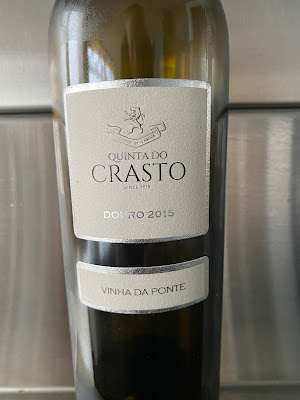
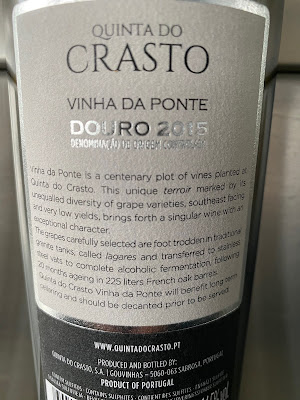
 Quinta do Crasto is among the best, if not the best Portuguese winery. The Vinha da Ponte wine will be legendary over time and is unique for a couple of reasons. The first is the vineyard. It is situated on the steep slopes of the Douro Valley in schisty soil. There are probably over 30 varieties in this very low yielding, terraced vineyard of more than 100 year old vines. The best known are Touriga Nacional, Tinta Barroca, Tempranillo, Touriga Francesa, Tinta Dao. There are some white varieties here as well. All is put together in a true field blend.


The second is the winemaking. As I understand it, the grapes are picked at the same time. Some may have an alcohol level of 16%, some of 11%. Obviously, most will be around the 14% mark. The grapes are then foot trodden in traditional lagares. After fermentation, the wine is matured for 20 months in new French oak barrels. This wine is only made in exceptional years, seven times this century so far.


I am drinking the 2015 Quinta do Crasto Vinha da Ponte. I managed to get two bottles to Australia, with great difficulty. The bouquet has lifted aromatics. I smell red and blue forest berries on the nose.

The flavours of this full-bodied wine are unusual. It is very blue fruited. There are red berries as well and some spice. I decanted the wine, as suggested on the back label, but the wine still felt very young with a lot of energy. It was a warm vintage, but the acidity in this wine is high - maybe because some varieties are harvested early for them. Tannins have medium intensity. The oak is smartly integrated and hides behind the strong fruit, which carries through to the long finish.

This is quite a unique wine with a lot of personality. I also have two bottles of the sister wine, the Maria Teresa, but based on this experience, I will leave them in the cellar a little longer.

Score: 96/+++  


Tuesday, November 6, 2018

Crasto Tinto Superior

Quinta do Crasto is Portugal's best winery of table wines. The focus on quality, as exemplified by the management of the sorting table, for example, is second to none. It's best wines are field blends of old single vineyards, containing an astonishing 50+ varieties. The wine reviewed here is different.

The 2015 Crasto Tinto Superior comes from a newly planted vineyard (14 years old) in the Douro Superior subregion. This is the warmest of the three subregions, close to the Spanish border and furthest from the ocean. The plantings are Touriga Nacional, Touriga Franca and Tinto Roriz (Tempranillo) as recommended to focus on by the Government, as well as Souzao, a variety with high acidity. This is sensible to include in a warm region such as Douro Superior.

The first impression on the palate is the round mouthfeel and slightly velvety character. Black fruit delivers intensity, and blue fruit elegance. The flavours are not too complex, but the different varieties add interest. The tannins of this wine are firm, showing the Touriga Nacional influence, and a little coarse. Together with the concentrated fruit, the tannins deliver a long finish.

I imagine this can be a fantastic wine with increased vine age.

Score: 93/+++ 

Monday, April 2, 2018

Quinta Nova Mirabilis Grande Reserva


I thought I might drink the only bottle of Portuguese red wine I have in my cellar, to celebrate the publication of my detailed article on the Douro Valley, published in this month's Gourmet Traveller Wine. This is the 2013 Quinta Nova Mirabilis Grande Reserva Tinto. It comes in an unusual bottle shape, similar to wine bottles from the 18th century - or maybe it is hard to get away from Port. Serious red table wine production in the Douro Valley is just over 20 years old. However, the grapes going into this wine can be up to 100 years old. They come from many indigenous varieties. Interestingly, this wine does not include any Touriga Nacional, which is Portugal's most famous grape variety. You can learn more about the different grape varieties from my article.

This wine is full-bodied and quite ripe, but manages to be quite elegant all the same. The flavours are black cherry and dark chocolate, but the wine surprisingly is not very expressive. There is enough acidity to keep the wine alive for a number of years. The finish falls a little flat.

Score: 90/0 

Monday, June 26, 2017

Quinta Do Vesuvio

Some facts are hard to comprehend. The Symington family owns 27 wineries in the Douro Valley. The focus is Port, of course, with its famous Graham's and Dow's brands. But there is also a serious table wine effort under way. The leading winery for it is Quinta do Vesuvio, and the leading red carries the same name.

The 2015 Quinta do Vesuvio, from a great vintage, is a multi variety wine, with Touriga Nacional and Touriga Franca being the main contributors. The colour of the wine is deep purple. Blackberry aroma jumps from the glass.

Concentrated blackberry and bramble flavours hit the palate. This is a pretty full-on, full-bodied wine, yet the wine is quite elegant: a modern version of the Douro red. Acidity gives the wine freshness, despite the fruit weight. The wine is balanced, with firm tannins, and needs time to mellow.  For me, it is a bit too much of everything. I suggest drinking from 2020.

Score: 93/+

Monday, June 19, 2017

Conceito Bastardo Red

I am pursuing more intriguing wines and varieties from Portugal. The Bastardo (not a great name?) grape variety is known in the Jura of France as Trousseau. Apparently there is some in the Barossa Valley, named Cabernet Gros (another bad name), but I have never come across it.

The 2014 Conceito Bastardo has a pale pink colour. It comes from a high altitude vineyard in the Douro Superior and therefore a slightly cooler plot in this hot area. The grapes are picked early. The flavour profile is a bit like Pinot Noir, with red berry fruit, but more towards raspberry than strawberry or cherry. There is also some spice, and a lot of acidity. The alcohol level is 13%. This wine did not see any oak. I find this a fresh and attractive, though slightly unbalanced wine for the hot Portuguese inland summer climate.

Score: 91/+

Sunday, June 18, 2017

Passagem Reserva

The 2013 Passagem Reserva from the Douro Valley  superior region in Portugal has a dark purple, inky colour. It is a blend of Touriga Nacional, Touriga Franca and Tinto Cao. It is a full-bodied wine. Blackberry and cassis are joined by mocca flavours on the mid-palate. The wine is not overripe, but quite dense, and the tannins are a little coarse.

Score: 89/-