Showing posts with label Bordeaux. Show all posts

Saturday, February 15, 2025

Château Margaux

 In a recent tasting of high quality French and Australian wines from 2010, one wine shone above the rest; the 2010 Château Margaux.


The wine first impressed with its aromatic and perfumed aromas, so typical of the Margaux subregion. In this case, they were caressing the nose with seamless fragrances.

The main impression is that this is such a complete wine. Nothing sticks out; no acidity, no particular flavour. The mouthfeel is one of intensity and opulence. The wine is elegant and in perfect harmony. It almost detracts to discuss fruit flavours, but if you must, blackcurrant and blueberry would be dominant in this 90% Cabernet Sauvignon. The wine is very youthful and will go on for decades. The finish is incredibly long and silky. I tasted this wine some years ago, and even as a young wine, it was very harmonious and drinkable. Doing this early in life, and carrying it through for maybe 20-40 years is remarkable.

Score: 100/+++ 

I am acutely aware that a famous label can influence wine notes significantly. I believe I would have given this review to a no label wine.  


Saturday, November 30, 2024

Château Pontet-Canet

 In the last post, I talked about a surprising Barolo. Today, it is about a surprising Bordeaux wine. I experienced the 2004 Château Pontet-Canet.


So the wine is 20 years old, comes from a cooler vintage and is from Pauillac, where the soil is stony and the tannins strong. This should translate into a somewhat austere wine with piercing tannins.

Instead, I experience quite a rounded wine, dark fruited, with a very pleasant and complex mouthfeel. The tannins do not overwhelm, but are getting more prominent and dry with more tasting. Overall, this wine is a pleasant surprise.

Score: 95/+++

The conclusion is that overall descriptors of vintage or soil deliver little accurate prediction of a particular wine. Despite the popular notion 'we let nature do their thing', winemakers have a significant influence on the end product. Why otherwise would some be so revered?   


Thursday, October 24, 2024

Is Bordeaux The First Major Wine Region In Modern Times To Collapse?

 The en primeur worked great for leading Bordeaux wineries. These wines need time to come into their own, yet en primeur sales generate cash-flow straight away. In addition, these sales take place without a proper assessment of quality.

Over the last years, a number of developments happened and have started to form a perfect storm. First, early this century, Chinese buyers got into the market irrespective of price. The major US customers increasingly turned away. As the Chinese economy started to stall, and directions were given to stop drinking imported wine, this market fell away. In addition, younger consumers in the Western world increasingly turned off serious and intense red wine.

Yet, not withstanding these trends, many wineries kept increasing en primeur prices year on year. As quality could not keep pace, prices in the secondary market could not match en primeur prices. The incentives to buy en primeur, securing supply and better prices, are no longer there.

And now we have the 2024 vintage. It is a disaster. Flowering was poor, ripening is uneven, leading to longer hang time and exposure to mildew.The industry is putting its usual spin on the vintage, but volumes will be down, quality down as well. Prices must fall. It will be interesting to see how the wineries will cope.

Thursday, July 13, 2023

Bordeaux 2022 Vintage

 Every new vintage is hyped up as one of the greatest or at least something special. Experienced wine consumers let this go by. However, it is hard to ignore the avalanche of high ratings for even mid-priced Bordeaux wines from the 2022 vintage (these are based on barrel samples). 

I normally do not mention any commercial operators in the industry, but today I will make an exception, as Langton's has managed to bring a tasting of over 30 en primeur wines from this vintage to Sydney. It is very rare to be able to taste en primeur outside of Bordeaux. Yours truly attended the tasting last night. So what is the verdict?

On tasting were wines in the low and mid price range from both left and right bank. The lower priced wines ($50-100) were relatively simple, and I would recommend a Cabernet from one of good makers in Australia over them any day.

However, in the mid range ($100-500), there were some amazing wines. So what is the characteristic of the vintage? Elegance, elegance, elegance combined with depth of fruit and silky, sometimes firm tannins. There was also a significant difference between the wines, where it comes down to preferences. Château Trotanoy and La Fleur-Pétrus were super elegant, and the tannins so fine grained, they were hardly there. Château Hosanna seemed to be without tannins. These wines, all from Pomerol, were good, but not for me.

My favorites were Château Haut Bailly from Pressac-Léognan, Château Beychevelle from St-Julien and Clos Saint Martin from St-Emilion. Not far behind were Certan de May and Seraphine from Pomerol. These wines were elegant, with great depth of fruit, already very balanced and fine tannins. The Clos Saint Martin probably had the biggest punch of these. This selection also suggests that great wines were made across the region.

In the morning, and after writing this, I had a look at some of the wine critics’ ratings of these wines. They went from 95 to 99 points. The Haut Bailly was especially praised, likely one of the wines of this vintage.

There were a couple of wines from Margaux of all regions, which were denser and bolder, but I liked the wines with a happy medium weight.  

Tuesday, July 4, 2023

Château d’Yquem - A Paradox Wine


What can you write about a legendary wine? I will focus on what I experience as the striking feature. This brings me to paradox wines. I am not sure that I invented the term, but I have used it from time to time. A paradox wine is a wine which combines features which are normally opposite to each other, for example powerful and elegant. Powerful implies intensity, even brutality. Elegance implies lightness, detail. Yet some wines manage to combine both.


What do I see in the 2014 Château d’Yquem? There is pure honey, some toffee, candied fruits and hazelnut on the palate. The wine is smooth and long, but most strikingly, this is a paradox wine. It is very intense, yet lifted on the finish. The intensity makes it very serious, but it is also very pleasurable: a paradox wine.


Score: 97/+++


Friday, June 2, 2023

Two Iconic French Reds

 In the tasting of iconic wines, two French reds impressed: from Côte-Rôtie, the 2016 François Villard Le Gallet Blanc, and from Bordeaux the 2002 Lafite-Rothschild.


One Shiraz, one Cabernet blend, but two complete wines, and with increasing age moving towards each other.

The name Gallet Blanc has nothing to do with white wine, but is named after the two original vineyard suppliers, Gallet and Blanc. The grapes come from the Côte-Brune, which normally produces quite masculine wines, but in 2016, a cooler year, everything is very balanced on a fruit profile of raspberry and red cherry. Graphite adds to complexity of this supple, very elegant wine with a long finish (96 points).

The 2002 Lafite is also a very balanced wine, at peace with itself. Red- and blackcurrant flavours are still intense, and the wine still has great drive. Black olive and graphite flavours are here as well. The mouthfeel is elegant and silky, and the flavours go on and on; still a lot of life in this wine (96 points).    


Wednesday, May 31, 2023

Le Petit Cheval Blanc

 Perhaps the most underrated top level wine in the world is White Bordeaux. Maybe this is because it is mostly a Sauvignon Blanc dominant wine, which many wine enthusiasts scoff at. However, some of these wines are exquisite, such as the 2016 Le Petit Cheval Blanc. Normally, this wine is a Sauvignon Blanc/Semillon blend, but in 2016 it is 100% Sauvignon Blanc.


The wine is fermented on its lees. Lavender and other floral notes hit the nose. Grapefruit and asparagus flavours dominate the palate, there is pineapple and lime, too. The wine is not grassy. The impression is more of rich bees wax. This is quite a ripe wine, but fresh at the same time. There is a lot going on here. The acidity blends well into the fruit flavours and leads to a long and fine finish.

I cannot say I have tasted a wine like this before. It was well worth it.

Score: 95/+++ 


Wednesday, January 25, 2023

Château Clos de Boüard Bordeaux

 With ever increasing prices of wines from the best European regions, one is tempted to try new producers who still need to establish their brand. Obviously one needs to be selective. When I came across a new wine from a co-owner of Château Angélus, Coralie de Boüard, I thought this is worth trying, given she knows how top class wine is produced. This is my experience with the 2016 Château Clos de Boüard Bordeaux from the mountain area of Saint-Emilion.


So this is a wine at 15% alcohol. It had to happen in Bordeaux. This has not been a pretty experience. You smell the alcohol already on the nose. The wine is dark fruited with earthy notes. However, the alcohol kills the fruit quality. The wine is dense and ripe with firm tannins, but the alcohol kills these, too.

This was really unpleasant. Only the second time in my life did I add water to  wine to achieve some dilution. Not surprisingly, this did not help the taste.

Score: 76/---

PS: I woke up with a headache.


Thursday, August 4, 2022

The Penfolds 2022 Collection

 I remarked in my last Penfolds post about the subtle changes in the wines, which boils down to increased accessibility at young age. The other major shift is the positioning as a global luxury brand: one day its handbags, but today it's the launch of the Penfolds 2022 Collection. 


This is done as an event, not a serious wine tasting.


Having said this, the comparison from entry level wines from three different continents was interesting and quite instructive. The 2019 FWT 585 from Bordeaux is a blend of Cabernet (53%), Merlot (34%), and Petit Verdot (13%). FWT stands for French winemaking trial, of course. 585 is more interesting. It is the amount of dollars claimed by Max Schubert on return from his trip to Bordeaux - sounds little, but it was the early 50s. The wine has been matured in French and American oak. How did they smuggle American oak to Bordeaux? Anyway, the wine is medium bodied and impresses with its structure. Thyme and lavender on the nose, redcurrant and cranberry on the palate. It is early days and will be interesting to drink in a few years (94 points).

This was teamed up with the 2020 Bin 28 Shiraz, Penfold's workhorse. This wine is dark and warm: think blackberry, chocolate, mud cake, plum pudding - dependable, but a bit tough from the 2020 drought year (92 points).

The entry level California wine, the 2018 Bin 600 Cabernet/Shiraz includes fruit from Napa Valley, Sonoma and Paso Robles. The blackcurrant fruit flavours are ripe, and the boysenberry points to Napa Cabernet. There is also considerable vanilla from the 40% new oak. A concern is the lack of acidity in this wine (90 points).

The exciting aspect of this tasting was the fact that the wines truly spoke of their country of origin.

One more comment on ratings. Critics rated these wines and others from the collection much higher. It needs to be understood that there is a close relationship between the 'famous' critics and Penfolds. Here you get a truly independent view. I hope to be able to assess the premium wines in a little while. 


Tuesday, May 31, 2022

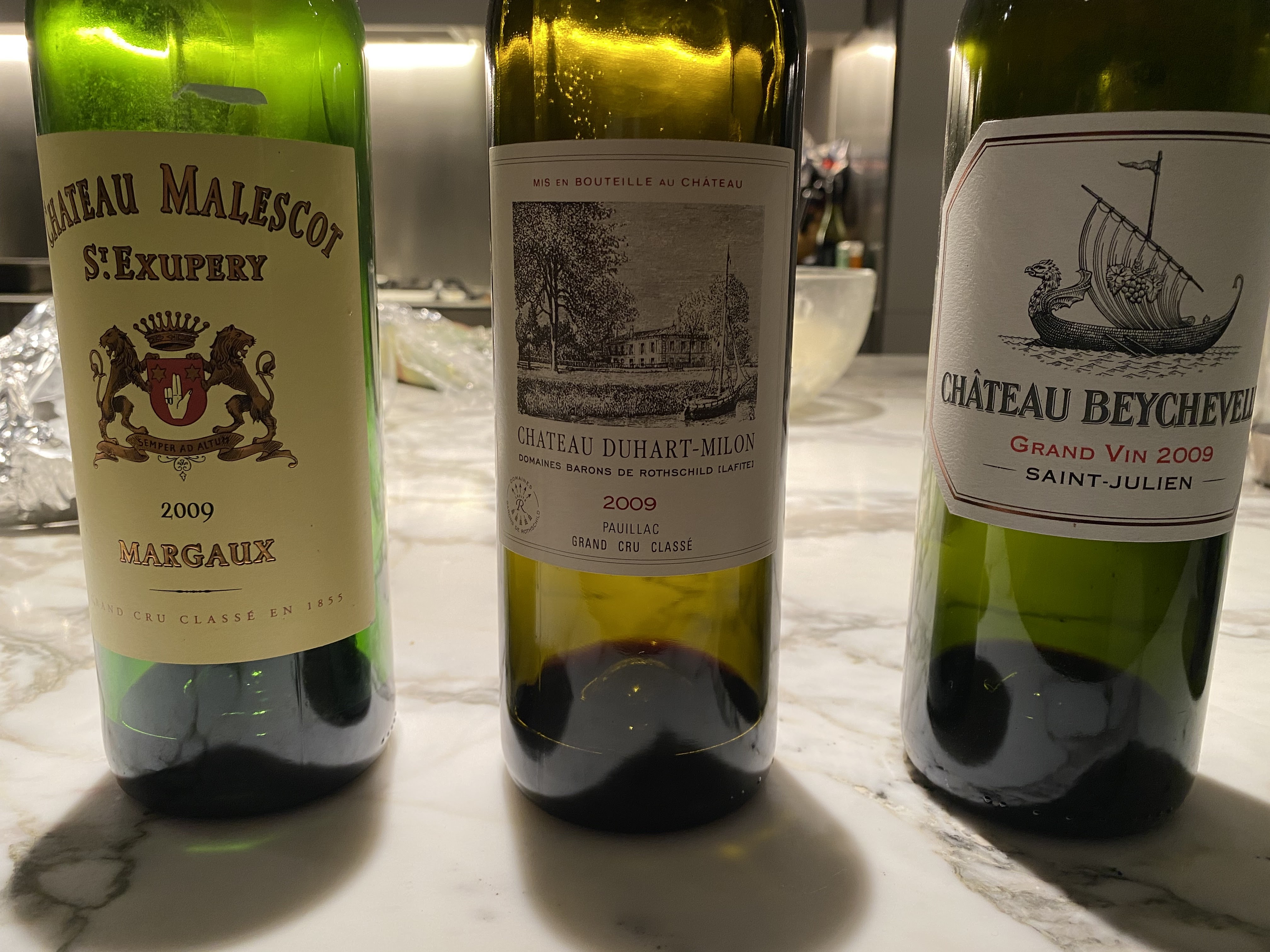
Three Wines From Bordeaux 2009

 Having had the pleasure of the mature Lynch-Bages, I wanted to explore how the 2009 vintage stacks up by tasting three wines from different left bank subregions.


The results were surprising to me. The favorite from these three wines was the 2009 Chateau Beychevelle from St. Julien. This is quite a dark fruited wine with cassis and plum flavours on the palate. Tobacco augments the long finish. This is a well balanced wine with lively acidity promising a long future. The highlight for me was the equal power and elegance of this wine (97 points). 

The 2009 Chateau Malescot St Exupery is a wine I have reviewed before. In this tasting, I found it quite muscular, somewhat surprising for the Margaux subregion. The blackcurrant, redcurrant and espresso flavours are quite concentrated. Still, this is an elegant wine with a satisfying mouthfeel and a long finish (95 points).

The 2009 Chateau Duhart-Milon Rothschild from Pauillac does not have the same intensity, but the blackberry and blueberry flavours deliver a silky texture. This is quite a smooth wine as you would expect from the Lafite stable (95 points).

Sub-regionality did not show up in expected ways. The Margaux was concentrated rather than perfumed, the Pauillac smooth rather than tannic. In Bordeaux, the winemaker wins over terroir, at least this time.

Overall, the 2009 vintage certainly delivered at this price point. The fruit flavours are intense, and the wines balanced. I reviewed more value based wines from this vintage before. There, the results were much more mixed.  


Monday, May 30, 2022

Chateau Lynch-Bages Vertical Tasting

This Is A Vertical, But The Years Are On The Back

Verticals of more than 15 year old Bordeaux wines are not easy to come by. This was a special occasion. The four wines were from 2001-2004 Lynch-Bages.

Let me start with two main conclusions. One really needs to be patient with good quality Bordeaux and wait 10-15 years before opening the wines. This is to experience the wine in perfect harmony. I have mentioned this many times on this blog. The second conclusion is that a great producer can make excellent wine in difficult vintages. Wine Spectator rated three of these vintages between 86 and 90 points, only 2003 at 95 points (more on this later).

The best wine was the 2004 Lynch-Bages. It was in perfect balance. The redcurrant fruit still very present. The mouthfeel was surprisingly big. Cedar and tobacco flavours rounded out the palate, while the firm tannins held up the structure (96 points). The 2001 was also very enjoyable. Here I noticed more smoky and earthy flavours. This is a more developed wine with good length and still lively acidity (95 points). The 2002, from a really lean vintage, was holding up, too. It is a leaner wine, with red capsicum prominent - still a fresh and balanced wine (92 points).

The one wine that started to struggle, was the 2003 Lynch-Bages. This was a very hot vintage, in particular pre harvest. The wines were supposed to be powerful, but they were also ripe. And this showed in this wine. Redcurrant fruit was still there, but was overtaken by tertiary flavours, leather in particular. The tannins did not stand up any longer - a (probably) once attractive wine in decline (88 points).

Overall, this was a fascinating tasting. There was a special Lynch-Bages character, certainly in the first three wines mentioned: redcurrant fruit, liveliness, balance, backed by a firm tannin structure.

One more thing: Over 30,000 cases are made each year. Achieving outstanding quality for this volume is different from the minuscule quantities most Burgundy producers dare to handle. 


Friday, February 18, 2022

Chateau Léoville-Barton

 There was a concern that the warm 2003 vintage in Bordeaux would deliver overripe wines with limited ageing potential. A few posts ago I reviewed the gorgeous Lafite-Rothschild from that year, and now it is the turn of the 2003 Chateau-Léoville Barton. This is another enticing wine.


This wine is super aromatic and perfumed on the nose.

There is a huge depth of flavour on the palate; blackberry and dark cherry in particular, some tobacco as well. This is a very intense wine, but also elegant. The firm tannins deliver a nice counterpoint. There is an x factor all the way, including a long finish. I loved this wine.

Score: 97/+++

Friday, January 28, 2022

Chateau Lafite Rothschild

 Great producers do well in difficult vintages. An example is the 2003 Chateau Lafite Rothschild. It was a hot year,  and the risk was to make overripe wine. Enter this excellent drop.


This wine is velvety on the nose, very inviting. On the palate feminine flavours of loganberry and mulberry engulf the mouth. This wine is super smooth. It is delicate and fragrant. There is a significant vanilla/oak influence, but it does not detract from the fruit where black currants rule on the back palate. The finish is very long and balanced. This is a complete wine.

Score: 98/+++


Tuesday, January 25, 2022

Can Sauvignon Blanc Age?

 A few days ago, I had an opportunity to taste a couple of older Sauvignon Blancs. They were not pure, but the 2010 Mount Mary Triolet included at least 75% Sauvignon Blanc, barrel-fermented, and the 2016 Blanc de Lynch-Bages had 52% Sauvignon Blanc. The other varieties in both cases are Semillon, and Muscadelle.


In terms of the question asked in the headline, the Lynch-Bages has the advantage. The Semillon component is larger, and the wine less old. And it showed.

The Lynch-Bages had good energy. There was a tropical expression on the palate, with pineapple and guava flavours. I tasted cinnamon spice as well. The wine delivered an attractive velvety mouthfeel. It was still fresh (92 points).

The Triolet had an attractive entry on the palate. The flavours were more in the citrus spectrum, but I detected a bit of guava as well. However, it fell off on the back palate and the wine finished quite flat. The second taste was a bit more satisfying (89 points).

Has the question been answered? Not really. The Triolet made you question the ageing potential, and the Lynch-Bages had too much Semillon in the wine to answer in the positive.


Tuesday, December 7, 2021

Chateau Rauzan-Ségla

 The high quality Chateau Rauzan-Ségla from the Margaux subregion swims somewhat under the radar in Australia. The 2005 Chateau Rauzan-Ségla is testament to the winery's quality. 


2005 was a warm vintage, and after opening the wine, it is already clear this is a big wine. The nose is highly aromatic, with blackcurrant and earthy notes emerging from the glass.

On the palate, a complex flavour, a blend of blackcurrant, charcoal meat, cigarbox, and smoky and slightly saline elements emerges. The oak is noticeable, but well integrated by now. This is a dense and powerful wine at 'only' 13.5% alcohol. The Merlot component delivers on the mid-palate, no problem. Firm and dry tannins lead to a full-flavoured finish. This wine demands beef. 

This Margaux will live much longer, as secondary notes will completely take over in time. Decanting is highly recommended.

Score: 95/++    


Monday, November 15, 2021

Chateau Malescot St. Exupery

 The most aromatic wines in Bordeaux come from the subregion of Margaux. The 2009 Chateau Malescot St. Exupery is a very good example. It is a blend of 51% Cabernet Sauvignon, 35% Merlot, 8% Cabernet Franc and 4% Petit Verdot (rounding).


The nose is intense and perfumed, with forest berry notes. On the palate, blackcurrant, black cherry, graphite and cedar flavours deliver a typical Cabernet Sauvignon sensation. The mouthfeel is elegant with gentle spice.The wine delivers quite a regal experience. There is a bit of a hole on the mid palate, but it is minor, before the wine finishes very smooth. It lingers on the palate with well integrated tannins.

This is a classy wine which deserves more recognition. It drinks well now, and will stay at this level for another 5-10 years for sure.

Score: 94/++ 


Tuesday, October 19, 2021

Classification Turmoil At St.-Emilion

 The classification of St.-Emilion needs to be renewed every 10 years. Wineries need to submit an application and supply their credentials. Cheval-Blanc and Chateau Ausone, who are in the highest classification, have decided not to make a submission for the 2022 renewal. Their reasoning? There is now some emphasis placed on the treatment of visitors and social media activities. They believe it should remain based on terroir, wine, and history alone. It is therefore likely they will drop out of the classification, and they do not mind.

Is this another stepping stone towards making these classifications irrelevant? The other being that some lower rated wineries on the left bank outperform higher rated wineries on a consistent basis.

PS: I visited Chateau Ausone some years ago, and was treated very well. 

A Premium Merlot Tasting

 Merlot is a fickle grape. If the wine is not from Pomerol or St. Emilion, it is a disappointment, most of the time. Merlot is a good blender with Cabernet, fleshing out the mid-palate, but on its own, it often lacks structure. A group of us got together to find out if there are excellent Merlot examples outside the famous Right Bank areas. And indeed, we found an outstanding wine, and several good examples.


The outstanding wine was the 2016 Henri Milan 'Le Jardin'. This wine comes from Provence, and the winemaker has the understated goal of achieving Petrus quality on this special plot of blue clay. The winery is biodynamic. Therefore, the beautiful perfume on the nose is perhaps no surprise. This is a complex wine with blackcurrant, truffle, dark chocolate and horse saddle flavours. The wine is quite tannic and has a huge amount of energy. Sadly, production is minuscule (96 points). He is on his way, I think.

The second wine was the 2010 Villa Maria Gimblett Gravels Merlot/Cabernet Sauvignon Library Release. This is perhaps not an entirely fair inclusion, as this wine is only 67% Merlot, but still, Merlot dominates. Villa Maria produces wines of varying quality, this wine impressed.


This is a complex wine. Floral notes rise invitingly from the glass. The palate is very elegant and focussed. Herbal flavours reminded me of Italian origin. The wine is not underripe, in fact the core is sweet, and the tannins are silky (94 points).

The third wine is another small production wine. It is the 2015 Chateau Picoron. It comes from a right bank vineyard, if you will, which is situated 10-15km south-east of Saint-Emilion.


From a warm vintage, this is a powerhouse. It is a bit in your face and aggressive. Black and red cherry fruit dominates, and there are savoury notes as well. The tannins are high, as is the alcohol (15.2%). The structure is sound, and the finish long (91 points). I preferred the 2016, which was also tasted. It was similar in style, but gentler (92 points).

The last wine I would like to report on is the 2018 Hickinbotham The Revivalist Merlot. It comes from the cool northern part of McLaren Vale. In fact the Merlot is grown from the highest altitude plots of this outstanding vineyard. 


The wine was not rated as highly as the last two, probably because of its strong fruit component on the palate. This wine makes a big statement. It is lush, but not just fruity. Mushroom flavours add to the very balanced mouthfeel (94 points). I liked it a lot, and a very experienced taster thought it was from Pomerol.

The Merlot grape is a very 'open' grape, which means it is influenced a lot by terroir. The 'Le Jardin' is grown on blue clay, and the Hickinbotham is also grown on very old silty loam and brown clay. I came to the conclusion that soil is a key factor for this variety, more so than for any other major grape variety. 

A number of older Merlots (more than 10 years) were also presented at the tasting. They had lost their fruit and were over the hill. Another lesson: do not age Merlot for too long.


Sunday, June 13, 2021

Château Prieuré-Lichine

 Margaux is the largest subregion of the left bank of Bordeaux wines. It is quite diverse with many different soil profiles. The wines, still dominated by Cabernet Sauvignon, have a higher percentage of Merlot in them than the other left bank wines. Margaux is known for more aromatic wines than any other wines from Bordeaux. This puts them in good stead as the climate warms.

This is a review of the 2010 Château Prieuré-Lichine. I once had a memorable lunch at this property and have enjoyed their wines.


Normally, there is a risk of drinking red wine too warm, but in this case, I opened it when it was too cold. It had not opened up too well. This review is of the wine on day two, when the temperature was much better.

The expected feminine aromas were on display from this wine of deep purple to black colour. This is a full-bodied wine delivering a complex palate of blackberry, black olive, mocca, and earthy notes. The wine has good balance. The elegant mouthfeel gets overtaken by firm, slightly coarse tannins, but then, the finish is long and almost lifted.

While not perfect, I enjoyed this wine. It delivered satisfying flavours and good length.

Score: 93/+++ 


Wednesday, May 26, 2021

Lafite-Rothschild

This 2004 Lafite-Rothschild was a most unusual bottle. Please look at the label. The left part is clearly missing. The owner checked with the Château, and they confirmed they used a faulty label run. Tasting the wine, it was immediately clear this is not a fake bottle. How bizarre! Would this fault increase the bottle value, similar to some faulty stamps, or reduce it?


2004 is perhaps not a stellar Bordeaux vintage, but this wine showed extremely well. The nose was super aromatic and complex. On the palate, pure black and blue fruits, as well as black olive, lead to a harmonious mouthfeel. This is a soft, elegant, and velvety wine, in typical Lafiiite style. Earthy notes add interest. Most of all, this is a wine totally at peace with itself. Superb!  

Score: 97/+++