Wednesday, July 26, 2023
Hickinbotham Trueman Cabernet Sauvignon
Monday, July 24, 2023
Cirillo 1850 Ancestor Grenache
There are two stylistic expressions of Grenache. There is the lighter coloured, lithe, ethereal type. Yangarra Ovitelli would be an example. And then we have the full-bodied, dark, ripe Grenache. Cirillo's old vine Grenache is certainly of the second type. The 2016 Cirillo 1850 Ancestor Grenache comes from the arguably oldest Grenache vineyard in the world, grown on the sandy soils of Vine Vale.
Saturday, July 22, 2023
Massolino Vigna Rionda
A little while ago, I asked a highly regarded Australian winemaker, if he had only one last wine to drink before his death, what would it be? I expected him to either pick one of his Shiraz or Grenache. Instead, he said; the 2001 Massolino Vigna Rionda. The Vignarionda vineyard is the legendary south and west facing vineyard in Serralunga, Piedmont. I tasted wine from this vineyard for the first time at my recent Piedmont visit. I have only one bottle of this in my cellar, the 2004 Massolino Vigna Rionda Reserva. I thought the evening of the opening match of the Matildas at the world cup soccer would be a good time to open it.
Monday, July 17, 2023
The Standish Wine Company - A Vintage Comparison
People who follow my blog know that I am quite fond of the Standish wines. They push fruit weight and ripeness to the boundary, but in doing so manage to match power with elegance. I like these wines in particular, as in this way they deliver a uniqueness of what Barossa Shiraz can be in the world of wine.
Today, I will report on a comparison between two wines of 2021, the current release, and the same wines from 2018. Before I go into details, a few words on alcohol levels.
Three of the 2021 releases have a noted alcohol content of 14.9%. Apart from the fact that this is high, it is most likely to be higher in reality. As in Australia the actual level can be 1.5%ige points different from the label, it seems Dan Standish wanted to avoid a 15% plus labelling. Do these wines really all have the same alcohol level? I find it difficult to talk to Dan Standish about this. It is legal, but seems deceiving to me.
Why is the alcohol so high in a drought braking, milder vintage? Standish likes to use whole-bunch in his wines. The 2021 Lamella uses 100% whole-bunch , there is 70% in the Schubert Theorem. People use different arguments about the benefit of whole-bunch. To me it adds texture, tannin structure and complexity, but the stems have to be ripe. So in a mild vintage like 2021, harvesting has to be late to achieve stem ripeness. This drives the sugar content, and ultimately alcohol up.
Now let us have a look at the wines.
The labels are not very interesting. I am showing the back label for the 2021s.So I am comparing here the 2021 Lamella with the 2018, and the same years for the Schubert Theorem. In theory, the Lamella would be the freshest of the Standish line-up, and the Schubert Theorem the biggest wine. As these are big wines, I have tasted them over three days, from an open bottle.
The Lamella comes from the Hutton Vale vineyard in the northern part of Eden Valley. The cuttings come from the Mt. Edelstone vineyard. The red-brown earth is similar to much of the Barossa Valley, but the vineyard is at higher altitude. The fruit is the latest picked of the Standish vineyards.
The 2021 Lamella is quite ripe; it is black fruited as opposed to the more typical blue fruit from Eden Valley. The oak is noticeable, but the fruit can take it. There are Early Grey, black olive, and licorice flavours. On day one, the wine needs time to open up in the glass. Then it becomes quite elegant and delivers a long, harmonious line. On day two, the fruit is more aromatic, but the alcohol is also starting to come through. On day three, the wine loses some freshness and energy.
Score: 96/+++
The 2018 Lamella shows more violets and is more fragrant. Yes, there is fruit weight, but the wine is more transparent and layered. Raspberry, and blue fruits dominate the slightly peppered palate. This is very elegant. The wine has good energy. It is still very young. I love the silky finish. On day two, the wine has opened up more, and on day three it remains superbly elegant.
Score: 98/+++
The Schubert Theorem comes from a vineyard on Roennfelt Road in Marananga. The vineyards have quite a bit of quartz here, which tends to make the wines big and ripe, as the quartz reflects the heat at night, and the ripening continues. Whole-bunch is 70%.
The 2021 Schubert Theorem is the big surprise for me in this line-up. The wine is black, deep, and powerful, as expected, but it is also quite elegant and lush with silky tannins. In addition to the black and blue fruits, black olive and pencil shave add to this balanced and majestic wine. It has a very long finish. Clearly, the milder conditions were beneficial to the Schubert Theorem in this year. In many ways, the wine is similar to the 2018 Lamella, but with a firmer finish and more fruit weight. The wine remained silky and smooth on day two and three.
Score: 98/+++
The 2018 Schubert Theorem has a similar flavour profile: blackberry, ripe plum, black olive. The wine feels more blocky in the mouth, and is starting to taste a little tough and ripe. On day two, it is less blocky, but starts to show a slightly hot finish, and is not as rounded as on the first day. The very dry tannins lead to a long finish. As the wine mellows, the alcohol becomes noticeable.
Score: 95/++
Overall, this tasting presents a complex picture. Here are some of my insights:
1) The 2018s are still young. In fact, in a blind tasting, one may not be able to distinguish 21 from 18. This points to a very long life for these wines.
2) The wines must definitely breathe. Day two was the tasting peak. At least a few hours decanting is highly recommended.
3) It is hard to predict which of these extraordinary wines performs best. In this tasting it was the 2018 from Eden Valley (the warmer year in the cooler region), and the 2021 Schubert Theorem (the warm region from a cooler year).
4) The concern: initially, the fruit power dominates the alcohol. But as the wines mellow, alcohol may raise its ugly head.
Confused? Comments welcome.
Thursday, July 13, 2023
Bordeaux 2022 Vintage
Every new vintage is hyped up as one of the greatest or at least something special. Experienced wine consumers let this go by. However, it is hard to ignore the avalanche of high ratings for even mid-priced Bordeaux wines from the 2022 vintage (these are based on barrel samples).
I normally do not mention any commercial operators in the industry, but today I will make an exception, as Langton's has managed to bring a tasting of over 30 en primeur wines from this vintage to Sydney. It is very rare to be able to taste en primeur outside of Bordeaux. Yours truly attended the tasting last night. So what is the verdict?
On tasting were wines in the low and mid price range from both left and right bank. The lower priced wines ($50-100) were relatively simple, and I would recommend a Cabernet from one of good makers in Australia over them any day.
However, in the mid range ($100-500), there were some amazing wines. So what is the characteristic of the vintage? Elegance, elegance, elegance combined with depth of fruit and silky, sometimes firm tannins. There was also a significant difference between the wines, where it comes down to preferences. Château Trotanoy and La Fleur-Pétrus were super elegant, and the tannins so fine grained, they were hardly there. Château Hosanna seemed to be without tannins. These wines, all from Pomerol, were good, but not for me.
My favorites were Château Haut Bailly from Pressac-Léognan, Château Beychevelle from St-Julien and Clos Saint Martin from St-Emilion. Not far behind were Certan de May and Seraphine from Pomerol. These wines were elegant, with great depth of fruit, already very balanced and fine tannins. The Clos Saint Martin probably had the biggest punch of these. This selection also suggests that great wines were made across the region.
In the morning, and after writing this, I had a look at some of the wine critics’ ratings of these wines. They went from 95 to 99 points. The Haut Bailly was especially praised, likely one of the wines of this vintage.
There were a couple of wines from Margaux of all regions, which were denser and bolder, but I liked the wines with a happy medium weight.
Saturday, July 8, 2023
Dominio de Atauta Valdegatiles
Tuesday, July 4, 2023
Château d’Yquem - A Paradox Wine
What can you write about a legendary wine? I will focus on what I experience as the striking feature. This brings me to paradox wines. I am not sure that I invented the term, but I have used it from time to time. A paradox wine is a wine which combines features which are normally opposite to each other, for example powerful and elegant. Powerful implies intensity, even brutality. Elegance implies lightness, detail. Yet some wines manage to combine both.
What do I see in the 2014 Château d’Yquem? There is pure honey, some toffee, candied fruits and hazelnut on the palate. The wine is smooth and long, but most strikingly, this is a paradox wine. It is very intense, yet lifted on the finish. The intensity makes it very serious, but it is also very pleasurable: a paradox wine.
Score: 97/+++
Sunday, July 2, 2023
Quinta Do Crasto
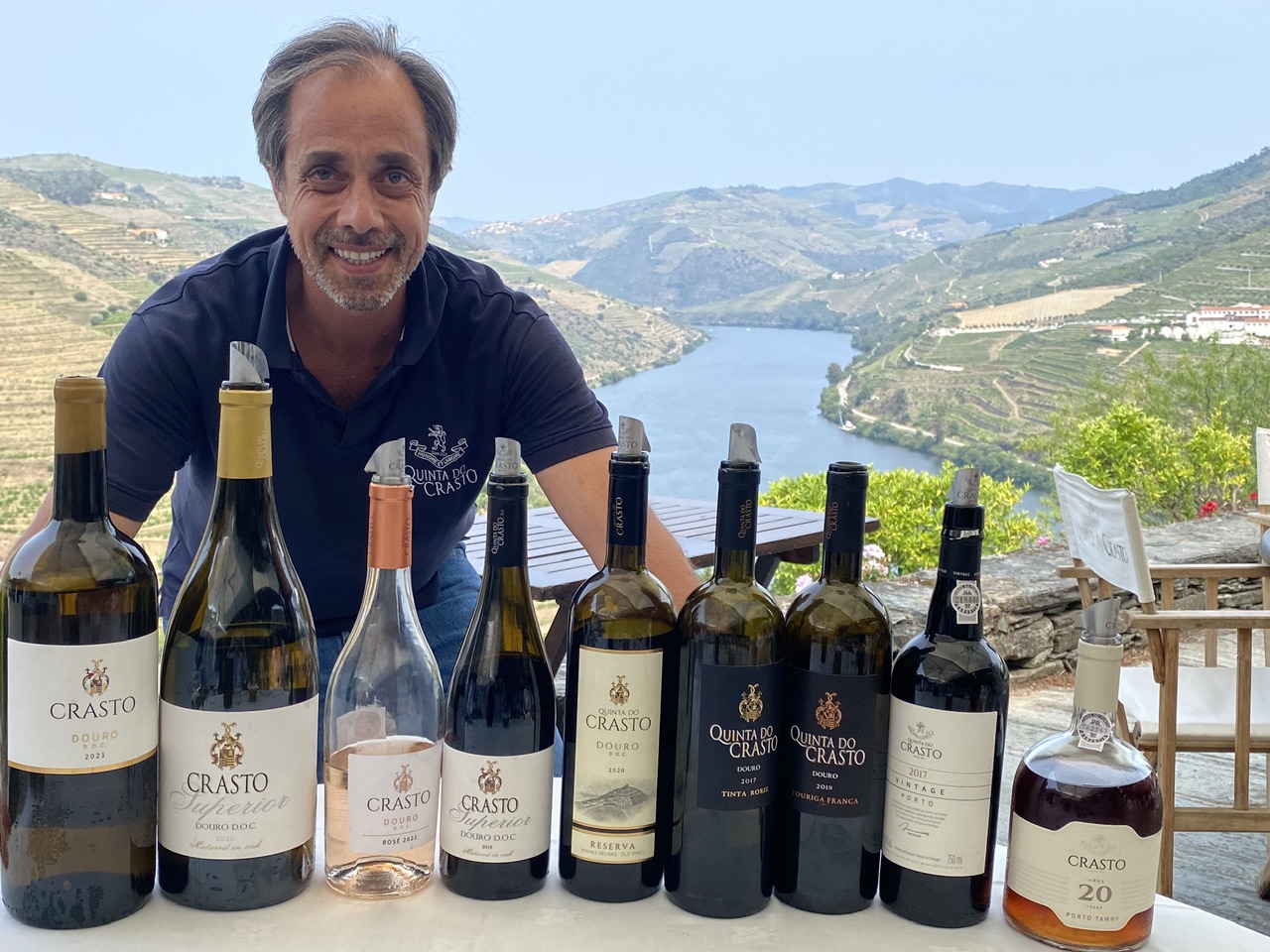
Visiting Quinta do Crasto, Portugal’s leading table wine producer IMHO, first requires a hair raising drive up the Douro mountains. But you are rewarded not only with amazing views, a look at its world famous Maria Teresa vineyard (above), but also a memorable tasting. The Maria Teresa vineyard, over 100 years old, is always voted as one of the world’s top 10 vineyards and the single vineyard wine certainly made the reputation of Crasto. When I visited 6-7 years ago, Manuel Lobo, the winemaker, described a project to identify the different grape varieties of this field blend. He estimated about 35. When I met him now, he mentioned they are up to 54 varieties - astonishing and pretty unique. The care for this vineyard is such that if vines die, and the variety is not known, they replant with the major varieties mix, in order to maintain the profile of this vineyard. It is an amazing story, but not the only one. Total production of table wines has grown dramatically to 1.8 million bottles. Let us taste some.
We start with two whites. The 2021 Douro is an entry level wine. It comes from grapes grown at 600m altitude on granite soils, and it sees no oak. The wine is fresh, with good line, citrus and melon flavours, refreshing acidity, good energy, and a saline and mineral finish. This is an entry level wine? (91 points). The 2020 Superior White comes from a similar vineyard, but in contrast, has been matured for 8 months in barrique, 50% new of light toast. The other feature is the batonage, in a racking system of barrels, which allows each barrel to turn individually. It also avoids any oxygen contact. This wine is also fresh, and impresses with its fine texture (93 points).
Now to the reds, which is the winery's main focus. The 2019 Superior, from a good year, comes from the Upper Douro, not far from the Spanish border. The main varieties in this blend are Touriga Nacional, Touriga Franca, Tinta Roriz, and Souzao. The wine is matured in oak for 12 months, 35% new. Red plum is the main flavour. The wine has firm tannins and will require a bit more time to fully settle (90 points). The 2020 Reserva has an incredibly black colour. It comes from old 50-100 year old vineyards, 42 blocks in total. Each individual block is a field blend - amazing. The wine is matured in 60% new oak, but the oak is not obvious. The wine is concentrated and powerful, but elegant as well, with a long lasting mouthfeel (95 points).
The final two reds in this tasting are single variety wines, which is not often found in the Douro. The 2018 Touriga Franca comes from 40 year old vines, and is matured in 85% new oak. Despite this, it is a lighter wine, but with some bite. It is fresh, red fruited, and with some spice (93 points). The 2017 Tinta Roriz (Tempranillo in Spain) is also matured for 18 months in 85% new oak. It has a darker colour and is a bigger wine. The palate is quite complex with red and black fruits, dark mocca, and olive flavours (95 points).
Overall, this tasting has been impressive. Manuel Lobo has been the winemaker for 18 years now. He has assembled an incredible portfolio of vineyard sources. The oak treatment is smart, and all the wines are of a high standard.
Friday, June 30, 2023
Niepoort
Niepoort, a family business in its 6th generation, is an important winery in Portugal. When I visited here 6-7 years ago, I was impressed with the white wines. In a country which started from Port, then moved to serious red table wines, this was different. Dirk Niepoort, the 5th generation winemaker, has influenced many younger winemakers in Portugal. It all stemmed from his broad-based experience in wine. I am showing here one of his three wine cellars.
Wednesday, June 28, 2023
Vintage Conditions And Alcohol
Conventional wisdom has it that hot vintages lead to wines with high alcohol, and cool vintages deliver more moderate alcohol. A couple of recent experiences suggest it is more complicated, or even the opposite might be true.
The 2022 vintage in the Douro Valley was very hot as harvest time was approaching, with temperatures up to 45 degrees. At Wine & Soul, the old vines closed down to protect themselves and stopped producing sugar. The resulting wines will have an alcohol level of 13 to 13.5%, whereas 14.5% is the norm.
Conversely, at the Standish Wine Company, the 2021 wines have a high alcohol content of around 15% from a mild vintage without heat spikes. What happened here? Simply, Dan Standish picked very late to get full ripeness, including tannin ripeness from the stems.
By the way, I will review some of the 2021 Standish wines soon, and make some comparison to an older vintage.
Wine & Soul
My final stop in Europe is the Douro Valley. I have very fond memories of this region from a visit 6-7 years ago. This time, I will only visit the four wineries which impressed me most at the time. Today, the first stop is at Wine & Soul. This was a very small, high quality operation at the time. It is still a family business, but it has gone from strength to strength and produces 120,000 bottles per annum now.
Friday, June 23, 2023
Albino Rocca
Back in Barbaresco, my final Piedmont post will cover the tasting at Albino Rocca.
Albino Rocca produces about 100,000 bottles in total per year. Vinification takes place in large Slavonian barrels. The maceration period is long, 30-60 days, to gain colour and tannin structure.The 2020 Cottà from older vines is probably better known, and the red clay soils deliver a bigger, fruitier wine, a bit like the 2020s from Cascina delle Rose. Still the wine is elegant. Production is low of these two Barbarescos: 2000-2500 bottles (91 points).
The main Barbaresco, with a volume of 8000-9000 bottles, is Ronchi. The 2020 is more powerful than Cottà, but it remains a soft wine, with a firm acidic backbone (92 points). We compared this with the 2019, which was better balanced, again, firm acidity, but a much longer finish (94 points).
The winemaking of Albino Rocca is impressive, with elegance of the wines being the common denominator.