Tuesday, September 29, 2020

Dr. Edge Oregon Pinot Noir


Dr. Edge made his name in Tasmania, but he is now also making wine in Oregon's Willamette Valley. The 2018 Dr. Edge Willamette Valley Pinot Noir is a blend of several vineyards. Kirsch is a prominent flavour in this savoury wine. There is fennel, herbs and minerality in this delicately woven wine. The body is fairly light. The medium+ acidity makes this a fresh wine with dry tannins on the finish (93 points).

The 2018 Dr. Edge Eola-Amity Hills Pinot Noir comes from one of the key subregions in the Willamette Valley. This is a single vineyard wine with a similar profile as the blended wine. Spice is more prominent. It is a step up in elegance, and the tannins are smooth. The finish is long and precise. Overall, there is a bit more bite in this wine (94 points). 

The 2018 Dr. Edge Chehalem Mountains Pinot Noir from the north of Willamette has a beautiful texture. The fruit here is more strawberry-like. Minerality and smokiness speak of the volcanic place. This is the most elegant of the three. On the flip side, the mouthfeel is quite light. For this reason, my pick is the Eola-Amity (93 points). 


Saturday, September 26, 2020

The Last Bottle Of The First Wine

 Tertini is a winery which should be on your radar. Its home is the Southern Highlands. I reviewed some of its wines a little while ago. It is nice when there is a story associated with the wine you are drinking. Often it would involve you in relation to the wine. This one is different. This story writes itself.

I am drinking the last bottle of the first wine of Tertini, a 2005 Tertini Riesling. It was generously given to me by the winery. Amazingly, the colour of this high altitude wine is still green/golden after 15 years.


This is a remarkable wine. Citrus is prominent on the palate. The wine is still fresh, with lime peel and honeycomb flavours. Acidity keeps the wine lively, and on the back palate, lanolin or petrol flavours emerge. The mouthfeel is very satisfying, with this complexity. Love this wine.

Score: 95/+++


Thursday, September 24, 2020

Roberto Voerzio Barbera

 Roberto Voerzio is said to be the most meticulous winemaker in Piedmont with very detailed vineyard work and a rigorous grape selection process. He was the leader of the 'modernists' in the 1990s, moving to short maceration periods and French barriques. His Barolos are among Piedmont's best. But today, I am reviewing the 2015 Roberto Voerzio Barbera d'Alba 'Il Ceretto'.  


This wine opens with a rich aroma of black cherries and forest notes. This Barbera, from a warm vintage, is already quite developed on the palate - a rich and ripe wine with concentrated fruit, mocca and some oak flavours. The wine delivers a big mouthfeel, elegant in a way, but ripeness takes over.  There is medium acidity in this wine, and soft tannins. The finish is smooth. 

This wine will appeal to those who like big South Australian reds. As an aside, I tasted this wine a little too warm. It should be served at Tasmanian, not Queensland room temperature.

Score: 90/0


Tuesday, September 22, 2020

Chardonnay Shoot-Out

 Three great Chardonnays were pitted against each other, a Giaconda, a Leeuwin Estate, and a Meursault.  


Giaconda was perhaps the first Australian winery which modeled its Chardonnay on Burgundy principles. This 2010 Giaconda Chardonnay, looking back from today's perspective, looks old-fashioned, though. The structure is fine, but the wine feels heavily worked in terms of malolactic fermentation and oak treatment. This wine is quite broad. Previous fruit flavours have given way to honeycomb, almond and marzipan notes. The mouthfeel is good and the finish satisfying.

Score: 94/+

The Burgundy representative is a 2014 Remoissenet Père et Fils Meursault 1er Cru 'Perrières'. This wine is more refreshing than some Meursault with fine citrus and pineapple fruit. It feels a little aged already, but has good drive and persistence in the mouth. The finish is long.

Score: 95/++

The 2010 Leeuwin Art Series Chardonnay is unmistakably Margaret River: white flower and warmer climate fruit flavours: ripe lemon, pineapple, passionfruit. However, the colour is still light, and the wine tastes fresh and young. This is a beautiful wine, full flavoured, yet dancing on the tongue: power and grace.

Score: 96/+++ 

And the winner is Leeuwin Chardonnay.


Saturday, September 19, 2020

Grenache

 Grenache is experiencing a renaissance, not just because it was International Grenache Day yesterday. The flavour profile appeals, and the wines are not as heavy and serious as, say, Cabernet Sauvignon or Shiraz. Here are some Grenache and Grenache infused wines I tasted a couple of days ago.

Having said this, the 2010 Chateau de Beaucastel is quite a massive Chateauneuf-du-Pape. This wine is still bright. The raspberry and cranberry flavours shine through. There is licorice as well. The tannins are soft. However, the wine is a little hot on the finish (93 points).


The 2010 Alegre Valgañón Garnacha from Rioja demonstrates some of the challenges with Grenache. This wine has some herbal and eucalypt characteristics, which comes when the wine is picked a bit early out of fear it might get too alcoholic otherwise. The signature raspberry fruit is there, but also some black fruited notes and leather. This is quite a complex wine, mature, and no doubt based on very old vines (94 points). 

Marco Cirillo is my favorite Grenache producer in Australia (there are a couple of serious challengers emerging). He has been focused on this variety from the beginning tending to his fabulous sandy soils vineyard in Vine Vale. The 2012 Cirillo 1850 Grenache is based on perhaps the oldest Grenache vines in the world. This wine is hugely perfumed. The raspberry flavours are very clean and pure supported by savoury characteristics. This is a luscious wine with a long finish (96 points).

The 2009 Château de Fonsalette Réservé Côtes du Rhône is the most expensive wine in this line-up. I found it a bit disappointing. While it had a sweet fruit core, the overwhelming impression evolved from vegetable and herbal notes with tomato and anise flavours quite prominant (90 points).


A positive surprise was the 2012 Domaine Léon Barral Faugères 'Jadis'. Faugères is a subregion in the Languedoc with special red sand and limestone soils. The vineyard is biodynamically managed. This wine is a blend of 50% Carignan, 30% Shiraz, 20% Grenache. This wine is very bright and fresh,  with ripe raspberry and dark fruit,  and a big mouthfeel. This is quite a funky wine, bold and dense. There is a higher acidity in this wine than in many Grenaches and the tannins are dry. Well managed Carignan appears to be the major contributor to this profile (94 points). 

Wednesday, September 16, 2020

The Standish Wine Company The Schubert Theorem

 I have reported on this wine before, its strange label, and the logic of the Schubert Theorem. A little while ago, I wrote a comprehensive review of the stunning 2018 wines by The Standish Wine Company. So this review of the 2010 The Schubert Theorem is to partly predict how the 2018 wines may look in 10 years time.

The colour of this wine is close to black, very inky. There is no sign of ageing in the colour (the wine is bottled under cork with a wax seal). It is full-bodied, with  big fruit weight, and filling the mouth easily in all directions. In other words, the structure is massive. Ripe plum, but also some blue fruit notes and redcurrant and raspberry flavours deliver a complex fruit taste. Marmalade hints at some secondary flavours, but fruit still very much dominates. Oak is in the background.

This is a powerful and ripe wine, but still energetic with enough acidity to drive the wine forward down the palate. The finish is long. This wine will live well easily for another 10 years, maybe peaking in five.

My sense is that the 2018s are perhaps a bit more nuanced and energetic, but this 2010 is a shining example of a big Barossa wine with good drinkability.   

Score: 96/+++ 

Monday, September 7, 2020

Dom Perignon

 When a friend of mine presented a bottle of 1990 Dom Perignon with the words 'I don't think this has always been stored properly', we were both more than sceptical.


The cork came out well and looked good. This Champagne was amber in colour, and some small bubbles rose to the surface. So far so good.

And the taste was excellent. Apple crumble and toasty flavours delivered a complex experience for this still very alive Champagne.

It is astonishing how this bottle delivered so well. There is a debate if ageing of Champagne is a good idea, but the flavours experienced here could never be replicated by a young Champagne. 

Score: 95/+++


Tuesday, September 1, 2020

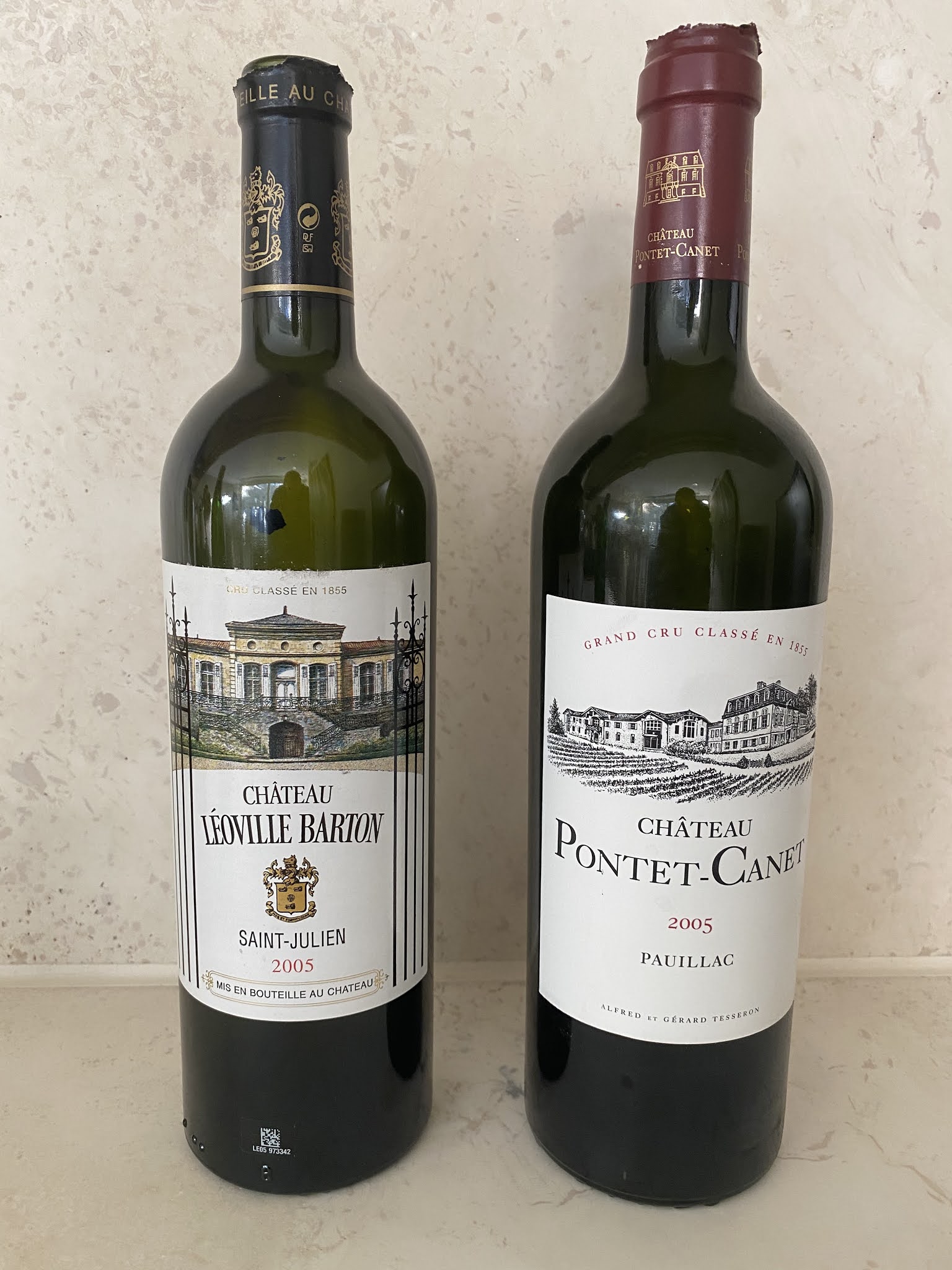
Bordeaux 2005

 I recently tasted three Bordeaux wines from the highly regarded 2005 vintage.


The 2005 Leoville-Barton from Saint-Julien shows a bit of development in its colour. Attractive blackberry and forest aromas on the nose. Blackcurrant flavours still dominate, but the wine has lost some fruit intensity. The oak is well integrated, but quite noticeable. This is a smooth wine, with sweetness from the vanilla flavours. Fine grained tannins lead to a medium plus finish. 

Score: 94/++

I could not believe what I tasted, when I tried the 2005 Pontet-Canet next. It tasted like a carbon copy of the Leoville-Barton despite being from a different subregion. The colour was a bit less developed, and the wine a little fresher, but otherwise an identical flavour and structure profile. 

Score: 95/++


The 2005 Rauzan-Ségla presented as a much more sophisticated wine. Blackcurrants are intense, but there is cedar, licorice, some new oak, and earthy flavours as well. This is a masculine wine, perhaps unexpected from Margeaux. It is quite focused, with good drive, and with a silky texture. The tannins are firm, but finely grained. The finish is very long.

Score: 97/+++

After 15 years, these wines have developed complexity, good balance and elegance. They should not have been drunk much earlier, but certainly the last two will still be great in 5 to 10 years.


Monday, August 31, 2020

Felton Road Chardonnay

 Some of the leading wineries in Australia and New Zealand do not seem to care much about the appeal of their label; think Penfolds or Felton Road. I guess they do not have to. Today, I will review the 2018 Felton Road Block 2 Chardonnay. Here is a bottle shot. It may be the last Felton Road one.


Felton Road is mainly known for its Pinot Noir, but it produces fine Chardonnay as well. This wine is still very tightly wound. It is precise. There are many modern aspects to this wine: Biodynamic viticulture, whole-bunch pressed, indigenous yeast, no fining, no filtration, used oak only.

Citrus and grapefruit flavours are balanced by creamy notes from the malolactic fermentation. The wine is energetic, with mineral notes towards the finish. Schisty soils define Block 2. Everything is right here, just missing the x factor at this stage for an exceptional score.

Score: 94/+++


Sunday, August 30, 2020

Keller von der Fels Riesling

 The internationally best known German Riesling estates are from the Mosel; think Dr. Loosen, J.J. Pruem etc. This is partly due to their marketing skill, partly the American sweet tooth and their interest in Auslese and Spaetlese wines. In Germany, wines from the Rheingau and Rheinhessen are held in the highest esteem. The Keller wines sit right at the top.

A little while ago, I reviewed an astonishing Riesling from Keller. Today we step down from those lofty heights, and I will review a still very good Kabinett Riesling from Rheinhessen.


The 2015 Keller 'von der Fels' Riesling shows a brilliant green-golden colour. This wine from a warm vintage fills the mouth with grapefruit, stone fruit and some tropical flavours, yet has enough energy and acidity to drive down the palate to a dry finish. This is an elegant wine, a little forward perhaps, but the focus and fine finish are rewarding.

Score: 90/++ 


Friday, August 21, 2020

Identifying Cabernet Sauvignon Across The World

 In a recent tasting, a group of us compared premium Cabernet Sauvignon across France, Italy, Australia and the US. A common view is that old world and new world Cabernet is becoming more difficult to distinguish as warmer climate in Europe makes these wines more 'new world', while efforts to reduce ripeness in Australia and the US makes these wines more 'old world'. As we found out, the Cabernet world is more complicated than this and distinctions remain.


Starting with premium French Cabernet (Bordeaux), the most important issue is that one should not open a bottle less than 10 years old. This is the minimum time for its complexity to unfold and the new oak to integrate. So what is typical? Well, in comparison with the Italian Cabernets (we tasted four very good ones), it is the 'completeness' of the wine. Little expense is spared in the winemaking process. The tannin and oak management are excellent, and all this leads often to a house style. If you have been lucky enough to drink a number of vintages of Mouton and Lafite, you would never mix them up in a blind tasting although they are neighbours. 

In comparison with the 'new world', the main difference is the shape of the wine in the mouth and acidity. Acidity is higher in the French wines, and the wines tend to be more linear. The fruit weight has increased with warmer vintages, but the shape of the wine is still 'old world'.

I do not have great experience with Italian Cabernet, and the tasted wines (San Leonardo, Grattamacco, Ornellaia, Guado Al Tasso)  were quite different from each other. Yet they shared characteristics, too. Overall, they were less polished than the French wines, not always balanced, some showing green character and the famous hole on the mid-palate. They had character. As one participant mentioned: "The Italian wines show the vineyard, the French wines the winery." The Ornellaia is perhaps an outlier, being very elegant, and also very sweet, playing to the American palate. Similar to the French wines, acidity in Italian Cabernet tends to be pronounced and the wines long and linear rather than broad.

We tasted only one Napa Cabernet, but it showed the expected profile. These wines are sweet, ripe, and broad in the mouth, even for 'middle of the road' wines as this one was. The blockbuster wines show extremes on these characteristics plus high alcohol.

How does Australia fit in? The key give away is the subdued acidity in most Cabernet, leading to plush wines. They are not on steroids as Napa, but they tend to be more 'sun-kissed' than the European versions and riper.
 

Thursday, August 20, 2020

Penfolds Bin 389 Cabernet/Shiraz

 The Penfolds Bin 389 is often called 'Baby Grange', because it is matured in oak previously used by Grange. And it has in common the finalization of fermentation in barrel. However, the fact that it is a Cabernet dominant blend makes it quite different. I will now call it 'Old Faithful'. It has been around for almost 70 years, and you know what you are getting.

The 2010 Penfolds Bin 389 Cabernet/Shiraz has an almost black colour, very inky. There is blackberry on the nose, and the eucalypt gives the Coonawarra Cabernet Sauvignon away. I never thought I would use the term 'fresh' in describing a Penfolds wine, but this wine is still vibrant at 10 years. The wine is elegant yet very full-bodied. The energy in the wine makes it long rather than round. The wine is not heavy, despite the 14.5% alcohol. The tannins are fine grained, and there is a long finish of black fruit.

On day two, strong espresso notes became prominent, and the fruit was a bit dry. Therefore only

Score: 95/++